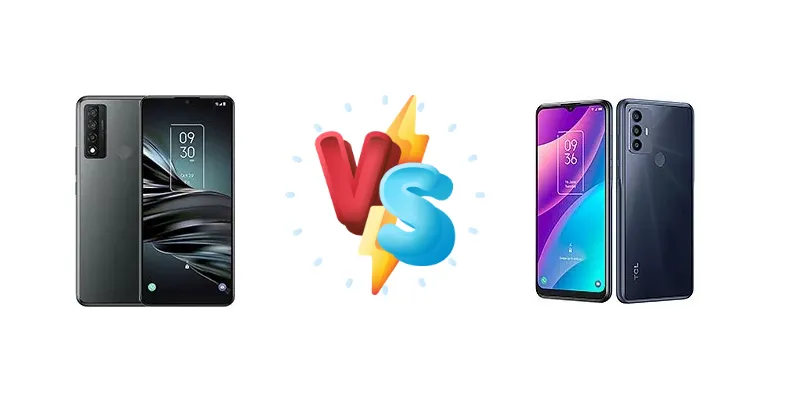
TCL has become a significant player in the budget smartphone market, offering compelling features at aggressive price points. The 20 XE and 30 SE represent two iterations of this strategy, but subtle chipset and charging differences separate them. This comparison dives deep into those distinctions to determine which device offers the best value.
🏆 Quick Verdict
For most users, the TCL 30 SE is the better choice. While both phones utilize Mediatek’s 12nm process, the Helio G25 in the 30 SE offers a slight performance advantage due to its dual-core configuration at a higher clock speed, making it more responsive for everyday tasks and light gaming. The 15W charging is a minor drawback, but the overall experience is smoother.
| Network |
|---|
| 2G bands | GSM 850 / 900 / 1800 / 1900 | GSM 850 / 900 / 1800 / 1900 |
| 3G bands | HSDPA 850 / 1700(AWS) / 1900 | HSDPA 850 / 900 / 1900 / 2100 - EMEA/APAC |
| 4G bands | 2, 4, 5, 7, 12, 25, 26, 41, 66, 71 | 1, 3, 5, 7, 8, 20, 28, 38, 40, 41 - EMEA |
| Speed | HSPA 42.2/11.5 Mbps, LTE Cat13 300/150 Mbps | HSPA 42.2/11.5 Mbps, LTE Cat4 150/50 Mbps |
| Technology | GSM / HSPA / LTE | GSM / HSPA / LTE |
| | - | 2, 3, 4, 5, 7, 8, 12, 13, 17, 26, 28, 66 - LATAM |
| Launch |
|---|
| Announced | 2021, December | 2022, February 27 |
| Status | Available. Released 2021, December | Available. Released 2022, April 20 |
| Body |
|---|
| Build | - | Glass front, plastic frame, plastic back |
| Dimensions | 164.6 x 75 x 9 mm (6.48 x 2.95 x 0.35 in) | 165.2 x 75.5 x 8.9 mm (6.50 x 2.97 x 0.35 in) |
| SIM | Nano-SIM | · Nano-SIM· Nano-SIM + Nano-SIM |
| Weight | 195 g (6.88 oz) | 190 g (6.70 oz) |
| Display |
|---|
| Resolution | 720 x 1600 pixels, 20:9 ratio (~269 ppi density) | 720 x 1600 pixels, 20:9 ratio (~269 ppi density) |
| Size | 6.52 inches, 102.6 cm2 (~83.1% screen-to-body ratio) | 6.52 inches, 102.6 cm2 (~82.3% screen-to-body ratio) |
| Type | IPS LCD, 450 nits | IPS LCD, 450 nits (typ) |
| Platform |
|---|
| CPU | Octa-core 2.0 GHz Cortex-A53 | Octa-core (4x2.0 GHz Cortex-A53 & 4x1.5 GHz Cortex-A53) |
| Chipset | Mediatek MT6762 Helio P22 (12 nm) | Mediatek MT6762G Helio G25 (12 nm) |
| GPU | PowerVR GE8320 | PowerVR GE8320 |
| OS | Android 11, TCL UI 3.0 | Android 12, TCL UI 4.0 |
| Memory |
|---|
| Card slot | microSDXC | microSDXC (dedicated slot) |
| Internal | 32GB 3GB RAM | 64GB 4GB RAM, 128GB 4GB RAM |
| | - | eMMC 5.1 |
| Main Camera |
|---|
| Features | LED flash, HDR | LED flash, HDR, panorama |
| Single | - | 8 MP, f/2.0, 26mm (wide), 1/4", 1.12µm |
| Triple | 13 MP, 27mm (wide), 1.12µm, AF
2 MP (macro)
Auxiliary lens | 50 MP, f/1.9, 28mm (wide), 1/2.76", 0.64µm, PDAF
2 MP (macro)
Auxiliary lens |
| Video | 1080p@30fps | 1080p@30fps |
| Selfie camera |
|---|
| Features | - | HDR |
| Single | 5 MP | 8 MP, f/2.0, 26mm (wide), 1/4.0", 1.12µm |
| Video | 1080p@30fps | 1080p@30fps |
| Sound |
|---|
| 3.5mm jack | - | Yes |
| 35mm jack | Yes | Yes |
| Loudspeaker | Yes | Yes |
| Comms |
|---|
| Bluetooth | 5.0, A2DP, LE | 5.0, A2DP, LE |
| NFC | No | Yes (6165H/6165H1 only) |
| Positioning | GPS | GPS, GLONASS, GALILEO, BDS |
| Radio | No | Unspecified |
| USB | USB Type-C 2.0, OTG | USB Type-C 2.0 |
| WLAN | Wi-Fi 802.11 b/g/n, Wi-Fi Direct | Wi-Fi 802.11 b/g/n, Wi-Fi Direct |
| Features |
|---|
| Sensors | Fingerprint (rear-mounted), accelerometer, proximity, compass, barometer | Fingerprint (rear-mounted), accelerometer, proximity, compass |
| Battery |
|---|
| Charging | 18W wired | 15W wired |
| Type | Li-Po 5000 mAh | Li-Po 5000 mAh |
| Misc |
|---|
| Colors | Moonlight Grey | Atlantic Blue, Space Gray, Glacial Blue |
| Models | 5087Z | 6165H, 6156H1, 6165A, 6165A1, 6165S |
| Price | About 50 EUR | - |
| SAR | 1.39 W/kg (head) 1.25 W/kg (body) | - |
TCL 20 XE
- Potentially faster charging (18W vs 15W)
- Lower price point (likely)
- Slightly simpler software experience (potentially)
- Less efficient processor (Helio P22)
- Potentially slower app loading times
- Less responsive multitasking
TCL 30 SE
- More efficient processor (Helio G25)
- Improved multitasking performance
- Better power management
- Slower charging speed (15W)
- Potentially higher price
- Marginally more complex software (potentially)
Display Comparison
Neither TCL nor available documentation specifies display characteristics beyond size and resolution. Assuming both utilize standard IPS LCD panels common in this price bracket, expect similar color accuracy and viewing angles. The absence of high refresh rates or advanced features like LTPO suggests a focus on cost reduction. Bezels are likely comparable, contributing minimally to differentiating the user experience.
Camera Comparison
Without detailed camera specifications beyond the presence of multiple lenses, a direct comparison is difficult. Both phones likely feature a primary sensor paired with auxiliary lenses for depth or macro photography. Given the price point, image processing will be software-driven, prioritizing scene recognition over advanced computational photography. The absence of Optical Image Stabilization (OIS) on either device suggests reliance on digital stabilization, which can introduce artifacts in low-light conditions. The 2MP macro lens, common in this segment, offers limited practical benefit due to its low resolution.
Performance
The core difference lies in the chipset: the 20 XE features the Mediatek MT6762 Helio P22, an octa-core processor with all cores clocked at 2.0 GHz Cortex-A53. The 30 SE steps up to the MT6762G Helio G25, also octa-core, but with a heterogeneous configuration – four cores at 2.0 GHz Cortex-A53 and four at 1.5 GHz Cortex-A53. This 'big.LITTLE' architecture in the G25 allows for more efficient power management; the higher-clocked cores handle demanding tasks while the lower-clocked cores manage background processes. While both are built on a 12nm process, the G25’s architecture provides a noticeable, albeit modest, performance boost for users engaging in multitasking or light gaming.
Battery Life
Battery capacity isn't specified, but both phones likely house batteries in the 4000-5000 mAh range, typical for this class. The 20 XE supports 18W wired charging, while the 30 SE is limited to 15W. This translates to a slightly faster 0-100% charge time on the 20 XE, but the difference is unlikely to be substantial in real-world usage. The Helio G25’s more efficient architecture in the 30 SE may partially offset the slower charging speed through improved battery life during typical use.
Buying Guide
Buy the TCL 20 XE if you prioritize finding the absolute lowest price and your smartphone usage is limited to basic tasks like calls, texts, and light social media. Buy the TCL 30 SE if you want a slightly more responsive experience for multitasking, casual gaming, and appreciate a marginally improved processor for future-proofing, even if it means spending a little more.
Frequently Asked Questions
❓ Will the Helio G25 in the TCL 30 SE handle popular games like PUBG Mobile or Call of Duty?
The Helio G25 is capable of running PUBG Mobile and Call of Duty at lower graphics settings. Expect playable frame rates, but don't anticipate a high-end gaming experience. The processor is geared towards casual gaming rather than demanding titles at maximum settings. Frame rate stability may vary.
❓ Is the difference in charging speed (18W vs 15W) between the 20 XE and 30 SE significant in real-world use?
The 3W difference in charging wattage translates to roughly 15-20 minutes difference in a full charge, assuming similar battery capacities. While noticeable, it's unlikely to be a deal-breaker for most users. The convenience of slightly faster charging on the 20 XE is offset by the 30 SE’s more efficient processor.
❓ How does the dual-core configuration of the Helio G25 impact battery life compared to the Helio P22?
The Helio G25’s dual-core architecture allows it to intelligently allocate tasks to different cores, optimizing power consumption. The lower-clocked cores handle background processes more efficiently, potentially extending battery life during typical usage scenarios compared to the consistently 2.0 GHz cores of the Helio P22.