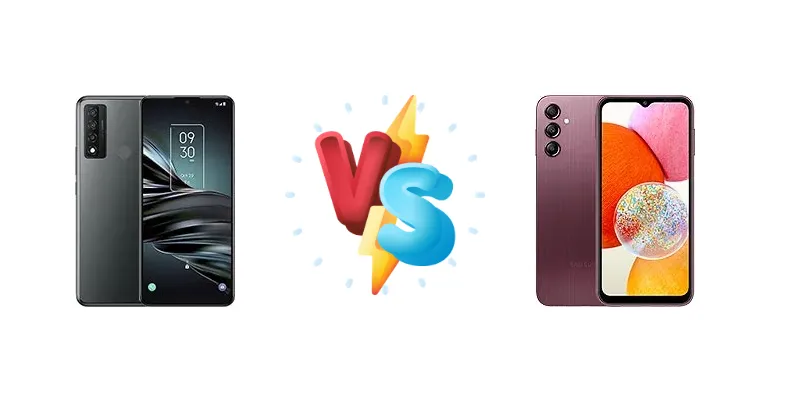
The TCL 20 XE and Samsung Galaxy A14 represent compelling options in the ultra-budget smartphone space. While both aim to deliver essential smartphone functionality at an accessible price, they diverge significantly in their internal hardware, particularly in chipset choice. This comparison dissects these differences to determine which device offers the best value for your money.
🏆 Quick Verdict
For most users, the Samsung Galaxy A14 emerges as the superior choice. Its Mediatek Helio G80 (or Exynos 850 variant) provides a noticeable performance uplift over the TCL 20 XE’s Helio P22, translating to smoother multitasking and a more responsive user experience. While the A14 charges slightly slower, the performance gains justify the trade-off.
| Network |
|---|
| 2G bands | GSM 850 / 900 / 1800 / 1900 | GSM 850 / 900 / 1800 / 1900 |
| 3G bands | HSDPA 850 / 1700(AWS) / 1900 | HSDPA 850 / 900 / 2100 |
| 4G bands | 2, 4, 5, 7, 12, 25, 26, 41, 66, 71 | 1, 3, 5, 7, 8, 20, 28, 38, 40, 41 |
| Speed | HSPA 42.2/11.5 Mbps, LTE Cat13 300/150 Mbps | HSPA, LTE |
| Technology | GSM / HSPA / LTE | GSM / HSPA / LTE |
| Launch |
|---|
| Announced | 2021, December | 2023, February 28 |
| Status | Available. Released 2021, December | Available. Released 2023, March 27 |
| Body |
|---|
| Build | - | Glass front, plastic back, plastic frame |
| Dimensions | 164.6 x 75 x 9 mm (6.48 x 2.95 x 0.35 in) | 167.7 x 78 x 9.1 mm (6.60 x 3.07 x 0.36 in) |
| SIM | Nano-SIM | · Nano-SIM· Nano-SIM + Nano-SIM |
| Weight | 195 g (6.88 oz) | 201 g (7.09 oz) |
| Display |
|---|
| Resolution | 720 x 1600 pixels, 20:9 ratio (~269 ppi density) | 1080 x 2408 pixels, 20:9 ratio (~400 ppi density) |
| Size | 6.52 inches, 102.6 cm2 (~83.1% screen-to-body ratio) | 6.6 inches, 104.9 cm2 (~80.2% screen-to-body ratio) |
| Type | IPS LCD, 450 nits | PLS LCD |
| Platform |
|---|
| CPU | Octa-core 2.0 GHz Cortex-A53 | Octa-core (2x2.0 GHz Cortex-A75 & 6x1.8 GHz Cortex-A55) - Version AOcta-core (4x2.0 GHz Cortex-A55 & 4x2.0 GHz Cortex-A55) - Version B |
| Chipset | Mediatek MT6762 Helio P22 (12 nm) | Mediatek MT6769 Helio G80 (12 nm) - Version AExynos 850 (8 nm) - Version B |
| GPU | PowerVR GE8320 | Mali-G52 MC2 |
| OS | Android 11, TCL UI 3.0 | Android 13, upgradable to Android 15, One UI 7 |
| Memory |
|---|
| Card slot | microSDXC | microSDXC (dedicated slot) |
| Internal | 32GB 3GB RAM | 64GB 4GB RAM, 128GB 4GB RAM, 128GB 6GB RAM |
| Main Camera |
|---|
| Features | LED flash, HDR | LED flash, panorama, HDR |
| Single | - | 13 MP, f/2.0, (wide) |
| Triple | 13 MP, 27mm (wide), 1.12µm, AF
2 MP (macro)
Auxiliary lens | 50 MP, f/1.8, 26mm (wide), 1/2.75", 0.64µm, PDAF
5 MP, f/2.2, 17mm (ultrawide), 1/5.0", 1.12µm
2 MP (macro) |
| Video | 1080p@30fps | 1080p@30fps |
| Selfie camera |
|---|
| Single | 5 MP | 13 MP, f/2.0, 26mm (wide), 1/3.1", 1.12µm |
| Video | 1080p@30fps | 1080p@30fps |
| Sound |
|---|
| 3.5mm jack | - | Yes |
| 35mm jack | Yes | Yes |
| Loudspeaker | Yes | Yes |
| Comms |
|---|
| Bluetooth | 5.0, A2DP, LE | 5.1 or 5.3, A2DP, LE |
| NFC | No | Yes (market/region dependent) |
| Positioning | GPS | GPS, GALILEO, GLONASS, BDS, QZSS |
| Radio | No | Unspecified |
| USB | USB Type-C 2.0, OTG | USB Type-C 2.0 |
| WLAN | Wi-Fi 802.11 b/g/n, Wi-Fi Direct | Wi-Fi 802.11 a/b/g/n/ac, dual-band, Wi-Fi Direct |
| Features |
|---|
| Sensors | Fingerprint (rear-mounted), accelerometer, proximity, compass, barometer | Fingerprint (side-mounted), accelerometer, proximity, compass |
| Battery |
|---|
| Charging | 18W wired | 15W wired |
| Type | Li-Po 5000 mAh | Li-Po 5000 mAh |
| Misc |
|---|
| Colors | Moonlight Grey | Black, Dark Red, Silver, Green |
| Models | 5087Z | SM-A145F, SM-A145F/DSN, SM-A145M, SM-A145M/DS, SM-A145P, SM-A145R |
| Price | About 50 EUR | € 85.76 / $ 147.60 / £ 79.95 |
| SAR | 1.39 W/kg (head) 1.25 W/kg (body) | - |
| SAR EU | - | 0.46 W/kg (head) 1.37 W/kg (body) |
TCL 20 XE
- Potentially faster charging (18W)
- Lower price point (likely)
- Compact form factor (potentially)
- Significantly weaker processor
- Less responsive user experience
- Limited multitasking capabilities
Samsung Galaxy A14
- More powerful processor (Helio G80 or Exynos 850)
- Smoother multitasking and app performance
- Potentially longer software support
- Slower charging (15W)
- Higher price point
- Larger size may not suit all users
Display Comparison
Neither TCL nor Samsung provide detailed display specifications beyond basic resolution. However, the A14’s larger screen size is a clear advantage for media consumption. Both utilize LCD panels, and given the price point, expect standard color accuracy and brightness levels. The TCL 20 XE likely has narrower bezels, but the A14’s larger display area is more impactful. PWM dimming rates are unknown for both, making it difficult to assess flicker-related eye strain.
Camera Comparison
Camera performance is likely similar in real-world scenarios, given both phones target the budget segment. Both will feature a primary camera and multiple auxiliary lenses of limited utility. The TCL 20 XE’s camera specs are not readily available, but the A14’s main sensor is likely larger, offering better low-light performance. The A14’s image processing, while not flagship-level, will likely be more refined than the TCL 20 XE’s. Avoid relying on the 2MP macro lenses on either device; their image quality will be subpar.
Performance
The performance gap is the most significant differentiator. The Samsung Galaxy A14, depending on the region, features either the Mediatek Helio G80 or the Exynos 850. The Helio G80, built on a 12nm process, boasts a more modern CPU architecture with its Cortex-A75 performance cores (2x2.0 GHz) alongside six Cortex-A55 cores (1.8 GHz), compared to the TCL 20 XE’s all-Cortex-A53 setup running at 2.0 GHz. The Exynos 850, fabricated on an 8nm node, offers even greater efficiency and potentially sustained performance. This translates to faster app loading times, smoother scrolling, and a more capable gaming experience on the A14. The Helio P22 in the TCL 20 XE will struggle with demanding tasks and multitasking.
Battery Life
The TCL 20 XE supports 18W wired charging, while the Samsung Galaxy A14 is limited to 15W. However, the A14’s more efficient chipset (especially the Exynos 850 variant) will likely offset the slower charging speed, resulting in comparable real-world battery life. Both phones will comfortably last a full day with moderate usage, but the A14’s efficiency provides a buffer for heavier workloads. Actual 0-100% charge times will depend on the charger used, but the TCL 20 XE should theoretically charge slightly faster.
Buying Guide
Buy the TCL 20 XE if your primary needs are basic communication – calls, texts, and light social media – and you prioritize a minimal financial investment. It’s a functional device for those on a very tight budget. Buy the Samsung Galaxy A14 if you value a more fluid user experience, occasional gaming, and a potentially longer software support lifecycle. The A14 offers a better balance of features and performance for everyday use.
Frequently Asked Questions
❓ Does the Exynos 850 chip in some Galaxy A14 models overheat during prolonged gaming sessions?
The Exynos 850, built on an 8nm process, is generally efficient and well-managed. While it may get warm during extended gaming, it's unlikely to experience significant thermal throttling like the Helio P22 in the TCL 20 XE. The A14’s larger chassis also aids in heat dissipation.
❓ Is the 2MP macro camera on either phone worth using for detailed close-up shots?
No. 2MP macro cameras on budget phones typically produce low-resolution, soft images with limited detail. They are largely a marketing feature and offer minimal practical benefit. Stick to the main camera for better results.
❓ Can the Samsung Galaxy A14 handle popular games like PUBG Mobile at acceptable frame rates?
The Galaxy A14, particularly the Helio G80 variant, can run PUBG Mobile at medium settings with reasonably stable frame rates. Expect some occasional dips during intense action. The TCL 20 XE will struggle to maintain playable frame rates even at the lowest settings.
❓ How long will software updates be supported on the TCL 20 XE compared to the Samsung Galaxy A14?
Samsung generally provides longer software support for its devices than TCL. The Galaxy A14 is likely to receive at least two major Android updates and several years of security patches, while the TCL 20 XE’s support lifecycle will likely be shorter.