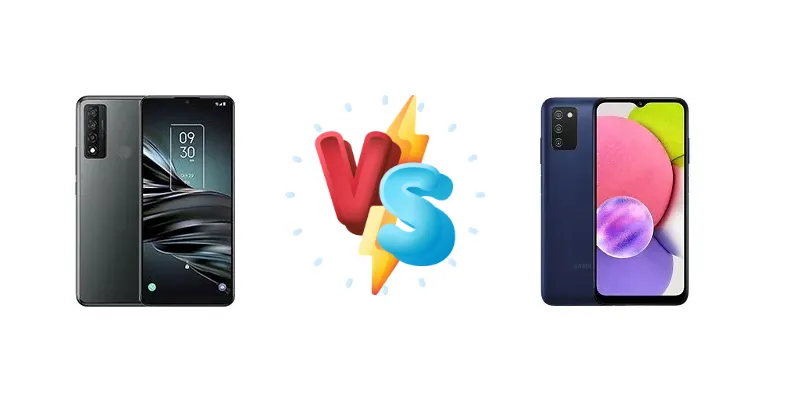
The TCL 20 XE and Samsung Galaxy A03s represent the extreme end of the smartphone price spectrum, targeting users who prioritize affordability above all else. Both devices rely on Mediatek chipsets, but subtle differences in processing power, display characteristics, and charging speeds create distinct user experiences. This comparison dissects these nuances to determine which phone delivers the most value.
🏆 Quick Verdict
For the average user prioritizing basic functionality and a slightly brighter display, the Samsung Galaxy A03s emerges as the better choice. Its Helio P35 chipset offers a modest performance edge, and the measured 488 nits brightness provides a more usable outdoor experience, despite both phones sharing a similar contrast ratio.
| Network |
|---|
| 2G bands | GSM 850 / 900 / 1800 / 1900 | GSM 850 / 900 / 1800 / 1900 |
| 3G bands | HSDPA 850 / 1700(AWS) / 1900 | HSDPA 850 / 900 / 2100 |
| 4G bands | 2, 4, 5, 7, 12, 25, 26, 41, 66, 71 | 1, 3, 5, 7, 8, 20, 28, 38, 40, 41 |
| Speed | HSPA 42.2/11.5 Mbps, LTE Cat13 300/150 Mbps | HSPA 42.2/5.76 Mbps, LTE Cat4 150/50 Mbps |
| Technology | GSM / HSPA / LTE | GSM / HSPA / LTE |
| | - | 2, 4, 5, 7, 12, 13, 14, 25, 26, 41, 66, 71 - SM-A037U |
| Launch |
|---|
| Announced | 2021, December | 2021, August 18 |
| Status | Available. Released 2021, December | Available. Released 2021, August 18 |
| Body |
|---|
| Build | - | Glass front, plastic frame, plastic back |
| Dimensions | 164.6 x 75 x 9 mm (6.48 x 2.95 x 0.35 in) | 164.2 x 75.9 x 9.1 mm (6.46 x 2.99 x 0.36 in) |
| SIM | Nano-SIM | Nano-SIM + Nano-SIM |
| Weight | 195 g (6.88 oz) | 196 g (6.91 oz) |
| Display |
|---|
| Resolution | 720 x 1600 pixels, 20:9 ratio (~269 ppi density) | 720 x 1600 pixels, 20:9 ratio (~270 ppi density) |
| Size | 6.52 inches, 102.6 cm2 (~83.1% screen-to-body ratio) | 6.5 inches, 102.0 cm2 (~81.8% screen-to-body ratio) |
| Type | IPS LCD, 450 nits | PLS LCD |
| Platform |
|---|
| CPU | Octa-core 2.0 GHz Cortex-A53 | Octa-core (4x2.35 GHz Cortex-A53 & 4x1.8 GHz Cortex-A53) |
| Chipset | Mediatek MT6762 Helio P22 (12 nm) | Mediatek MT6765 Helio P35 (12 nm) |
| GPU | PowerVR GE8320 | PowerVR GE8320 |
| OS | Android 11, TCL UI 3.0 | Android 11, upgradable to Android 13, One UI 5.1 Core |
| Memory |
|---|
| Card slot | microSDXC | microSDXC (dedicated slot) |
| Internal | 32GB 3GB RAM | 32GB 2GB RAM, 32GB 3GB RAM, 32GB 4GB RAM, 64GB 3GB RAM, 64GB 4GB RAM |
| | - | eMMC 5.1 |
| Main Camera |
|---|
| Features | LED flash, HDR | LED flash |
| Single | - | 5 MP, f/2.2 |
| Triple | 13 MP, 27mm (wide), 1.12µm, AF
2 MP (macro)
Auxiliary lens | 13 MP, f/2.2, (wide), AF
2 MP (macro)
Auxiliary lens |
| Video | 1080p@30fps | 1080p@30fps |
| Selfie camera |
|---|
| Single | 5 MP | 5 MP, f/2.2 |
| Video | 1080p@30fps | 1080p@30fps |
| Sound |
|---|
| 3.5mm jack | - | Yes |
| 35mm jack | Yes | Yes |
| Loudspeaker | Yes | Yes |
| Comms |
|---|
| Bluetooth | 5.0, A2DP, LE | 5.0, A2DP |
| NFC | No | Yes (market/region dependent) |
| Positioning | GPS | GPS, GLONASS, GALILEO, BDS |
| Radio | No | No |
| USB | USB Type-C 2.0, OTG | USB Type-C 2.0 |
| WLAN | Wi-Fi 802.11 b/g/n, Wi-Fi Direct | Wi-Fi 802.11 b/g/n, Wi-Fi Direct |
| Features |
|---|
| Sensors | Fingerprint (rear-mounted), accelerometer, proximity, compass, barometer | Fingerprint (side-mounted), accelerometer, proximity |
| Battery |
|---|
| Charging | 18W wired | 15W wired |
| Type | Li-Po 5000 mAh | Li-Po 5000 mAh |
| Misc |
|---|
| Colors | Moonlight Grey | Black, Blue, White |
| Models | 5087Z | SM-A037F, SM-A037F/DS, SM-A037M, SM-A037G, SM-A037U, SM-S134DL, SM-A037W, SM-A037U1, SM-S135DL |
| Price | About 50 EUR | $ 65.65 / £ 82.99 / ₹ 10,800 |
| SAR | 1.39 W/kg (head) 1.25 W/kg (body) | - |
| SAR EU | - | 0.36 W/kg (head) 1.09 W/kg (body) |
| Tests |
|---|
| Battery life | - |
Endurance rating 122h
|
| Camera | - |
Photo / Video |
| Display | - |
Contrast ratio: 1718:1 (nominal) |
| Loudspeaker | - |
-27.4 LUFS (Good)
|
| Performance | - |
AnTuTu: 103465 (v8), 101299 (v9)
GeekBench: 889 (v5.1)
GFXBench: 5.5fps (ES 3.1 onscreen) |
TCL 20 XE
- Faster 18W charging
- Potentially lower price point
- Reliable brand reputation
- Less powerful Helio P22 chipset
- Likely lower display brightness
- Limited RAM impacting multitasking
Samsung Galaxy A03s
- More powerful Helio P35 chipset
- Brighter 488 nit display
- Slightly smoother user experience
- Slower 15W charging
- Samsung’s software can be bloated
- Potentially higher price
Display Comparison
Both the TCL 20 XE and Samsung Galaxy A03s feature displays with a 1718:1 contrast ratio, suggesting similar image quality in terms of black levels and color pop. However, the Samsung Galaxy A03s boasts a measured peak brightness of 488 nits, significantly improving visibility in direct sunlight compared to the TCL 20 XE, which lacks published brightness data. While both likely utilize LCD panels, the A03s’ higher brightness is a tangible advantage for outdoor use. Bezels are expected to be substantial on both devices, consistent with their price point.
Camera Comparison
Both devices are equipped with 'Photo / Video' capabilities, but detailed camera specifications are lacking. Given the price bracket, image quality will likely be heavily reliant on software processing. The absence of information regarding sensor size and aperture makes a direct comparison difficult. It’s safe to assume both phones will struggle in low-light conditions, and the inclusion of a 2MP macro camera on either device is largely a marketing gimmick, offering minimal practical benefit. Expect acceptable results in well-lit environments.
Performance
The Samsung Galaxy A03s’ Mediatek Helio P35 chipset represents a step up from the TCL 20 XE’s Helio P22. The P35 utilizes a big.LITTLE architecture with four Cortex-A53 cores clocked at 2.35 GHz and four at 1.8 GHz, compared to the P22’s uniform octa-core 2.0 GHz Cortex-A53 configuration. This means the A03s can handle more demanding tasks with greater efficiency, offering a smoother experience during app switching and light gaming. While neither chipset is a powerhouse, the P35’s architecture provides a noticeable advantage in responsiveness. Both phones likely feature limited RAM, impacting multitasking capabilities.
Battery Life
Both the TCL 20 XE and Samsung Galaxy A03s achieve an endurance rating of 122 hours, indicating similar battery life under typical usage. However, the TCL 20 XE supports 18W wired charging, while the A03s is limited to 15W. This means the TCL 20 XE will theoretically charge faster, potentially offsetting the slightly lower battery capacity (if any exists). In practice, the difference in charging speed may not be substantial, but it’s a point in favor of the TCL device.
Buying Guide
Buy the TCL 20 XE if you need a phone primarily for essential tasks like calls, texts, and light social media, and are comfortable with potentially slower app loading times. Buy the Samsung Galaxy A03s if you prefer a slightly more responsive experience, particularly when multitasking or running slightly more demanding apps, and value a brighter screen for outdoor visibility. Both are suitable for first-time smartphone users or as reliable backup devices.
Frequently Asked Questions
❓ Will the Samsung Galaxy A03s struggle with popular apps like TikTok or Instagram?
While the Helio P35 can handle these apps, expect some occasional lag or slowdowns, especially when multitasking. The A03s is best suited for moderate use of social media, rather than extended, intensive sessions. Closing unused apps will help maintain performance.
❓ Is the 18W charging on the TCL 20 XE a significant advantage in real-world use?
The 3W difference in charging speed isn't massive, but it will shave off some time during a full charge. Expect roughly a 30-60 minute difference between a full 0-100% charge, depending on usage during charging. It's a modest benefit, but a benefit nonetheless.
❓ Can either of these phones handle basic mobile gaming?
Both phones can handle less demanding 2D games and older 3D titles. However, don't expect a smooth experience with graphically intensive games like PUBG or Call of Duty. Frame rates will likely be low, and you may encounter stuttering or lag.
❓ How much storage do these phones typically come with, and is it expandable?
Both phones typically ship with 32GB of internal storage, which is quite limited. Fortunately, both support microSD card expansion, allowing you to add up to 512GB or 1TB of additional storage, depending on the model.