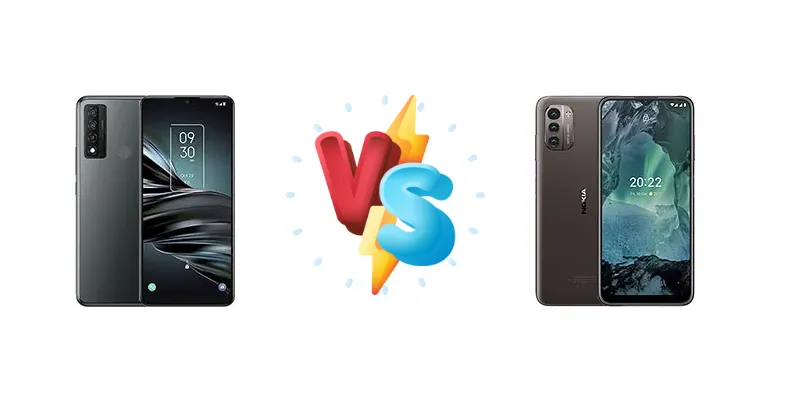
The TCL 20 XE and Nokia G21 represent compelling options in the ultra-budget smartphone space. Both aim to deliver essential smartphone functionality without breaking the bank, but they take different approaches to achieving this. The TCL prioritizes a familiar Mediatek chipset, while the Nokia opts for a Unisoc solution and emphasizes battery endurance. This comparison will dissect their key differences to help you choose the right device.
🏆 Quick Verdict
For most users, the Nokia G21 emerges as the better choice. While both phones share 18W charging, the Nokia’s Unisoc T606 chipset offers a more modern CPU architecture, and its measured 500 nits brightness provides a more usable outdoor experience. The identical battery endurance ratings further solidify the Nokia’s advantage.
| Network |
|---|
| 2G bands | GSM 850 / 900 / 1800 / 1900 | GSM 850 / 900 / 1800 / 1900 |
| 3G bands | HSDPA 850 / 1700(AWS) / 1900 | HSDPA 850 / 900 / 2100 - International |
| 4G bands | 2, 4, 5, 7, 12, 25, 26, 41, 66, 71 | 1, 3, 5, 7, 8, 20, 28, 38, 40, 41 - International |
| Speed | HSPA 42.2/11.5 Mbps, LTE Cat13 300/150 Mbps | HSPA 42.2/5.76 Mbps, LTE Cat4 150/50 Mbps |
| Technology | GSM / HSPA / LTE | GSM / HSPA / LTE |
| | - | 1, 2, 3, 4, 5, 7, 8, 12, 17, 28, 40, 66 - LATAM |
| Launch |
|---|
| Announced | 2021, December | 2022, February 14 |
| Status | Available. Released 2021, December | Available. Released 2022, February 15 |
| Body |
|---|
| Build | - | Glass front, plastic frame, plastic back |
| Dimensions | 164.6 x 75 x 9 mm (6.48 x 2.95 x 0.35 in) | 164.6 x 75.9 x 8.5 mm (6.48 x 2.99 x 0.33 in) |
| SIM | Nano-SIM | · Nano-SIM· Nano-SIM + Nano-SIM |
| Weight | 195 g (6.88 oz) | 190 g (6.70 oz) |
| Display |
|---|
| Resolution | 720 x 1600 pixels, 20:9 ratio (~269 ppi density) | 720 x 1600 pixels, 20:9 ratio (~270 ppi density) |
| Size | 6.52 inches, 102.6 cm2 (~83.1% screen-to-body ratio) | 6.5 inches, 102.0 cm2 (~81.6% screen-to-body ratio) |
| Type | IPS LCD, 450 nits | IPS LCD, 90Hz, 400 nits (typ) |
| Platform |
|---|
| CPU | Octa-core 2.0 GHz Cortex-A53 | Octa-core (2x1.6 GHz Cortex-A75 & 6x1.6 GHz Cortex-A55) |
| Chipset | Mediatek MT6762 Helio P22 (12 nm) | Unisoc T606 (12 nm) |
| GPU | PowerVR GE8320 | Mali-G57 MP1 |
| OS | Android 11, TCL UI 3.0 | Android 11, upgradable to Android 13 |
| Memory |
|---|
| Card slot | microSDXC | microSDXC (dedicated slot) |
| Internal | 32GB 3GB RAM | 64GB 3GB RAM, 64GB 4GB RAM, 128GB 4GB RAM, 128GB 6GB RAM |
| | - | eMMC 5.1 |
| Main Camera |
|---|
| Features | LED flash, HDR | LED flash, HDR, panorama |
| Single | - | 8 MP, f/2.0, (wide) |
| Triple | 13 MP, 27mm (wide), 1.12µm, AF
2 MP (macro)
Auxiliary lens | 50 MP, f/1.8, 28mm (wide), 1/2.76", 0.64µm, PDAF
2 MP (macro)
Auxiliary lens |
| Video | 1080p@30fps | 1080p@30fps |
| Selfie camera |
|---|
| Single | 5 MP | 8 MP, f/2.0, (wide) |
| Video | 1080p@30fps | 1080p@30fps |
| Sound |
|---|
| 3.5mm jack | - | Yes |
| 35mm jack | Yes | Yes |
| Loudspeaker | Yes | Yes |
| Comms |
|---|
| Bluetooth | 5.0, A2DP, LE | 5.0, A2DP, LE |
| NFC | No | Yes (market/region dependent) |
| Positioning | GPS | GPS, GLONASS, GALILEO |
| Radio | No | FM radio, RDS |
| USB | USB Type-C 2.0, OTG | USB Type-C 2.0, OTG |
| WLAN | Wi-Fi 802.11 b/g/n, Wi-Fi Direct | Wi-Fi 802.11 a/b/g/n/ac, dual-band, Wi-Fi Direct |
| Features |
|---|
| Sensors | Fingerprint (rear-mounted), accelerometer, proximity, compass, barometer | Fingerprint (side-mounted), accelerometer, proximity |
| Battery |
|---|
| Charging | 18W wired | 18W wired, PD3.0 |
| Type | Li-Po 5000 mAh | Li-Po 5050 mAh |
| Misc |
|---|
| Colors | Moonlight Grey | Nordic Blue, Dusk |
| Models | 5087Z | TA-1418, TA-1477, TA-1415, TA-1405, TA-1404, TA-1412 |
| Price | About 50 EUR | About 90 EUR |
| SAR | 1.39 W/kg (head) 1.25 W/kg (body) | 1.00 W/kg (head) 1.10 W/kg (body) |
| SAR EU | - | 0.34 W/kg (head) 1.05 W/kg (body) |
| Tests |
|---|
| Battery life | - |
Endurance rating 126h
|
| Camera | - |
Photo / Video |
| Display | - |
Contrast ratio: 1631:1 (nominal) |
| Loudspeaker | - |
-30.7 LUFS (Below average)
|
| Performance | - |
AnTuTu: 171299 (v9)
GeekBench: 1193 (v5.1)
GFXBench: 8.9fps (ES 3.1 onscreen) |
TCL 20 XE
- Familiar Mediatek chipset ecosystem
- Potentially lower cost (depending on retailer)
- Simple and straightforward Android experience
- Older CPU architecture (all Cortex-A53)
- Likely lower peak brightness
- No PD3.0 charging support
Nokia G21
- More modern CPU architecture (Cortex-A75)
- Brighter display (500 nits measured)
- PD3.0 charging compatibility
- Unisoc chipset may have limited software support
- Potentially slightly higher price
- Camera details are sparse
Display Comparison
The Nokia G21 boasts a measured peak brightness of 500 nits, a significant advantage over the TCL 20 XE, which lacks published brightness data. Both displays share a 1631:1 contrast ratio, suggesting similar color reproduction capabilities. However, the higher brightness of the Nokia G21 translates to better visibility in direct sunlight, a crucial factor for outdoor use. The lack of information regarding panel technology (IPS vs. VA) for the TCL 20 XE makes a detailed comparison of viewing angles and color accuracy difficult, but the Nokia’s brightness advantage is clear.
Camera Comparison
Both devices list 'Photo / Video' capabilities, but lack specific details regarding sensor size, aperture, or image processing algorithms. This suggests both phones employ entry-level camera systems focused on basic photography. Without further information, it’s difficult to assess the image quality differences. The absence of details regarding Optical Image Stabilization (OIS) on either device indicates that low-light performance will likely be limited. The focus should be on the primary sensor, as the inclusion of a 2MP macro camera on either phone offers minimal practical benefit.
Performance
The Nokia G21’s Unisoc T606 chipset features a hybrid CPU configuration with 2x Cortex-A75 cores and 6x Cortex-A55 cores, offering a performance edge over the TCL 20 XE’s all-Cortex-A53 based Mediatek Helio P22. The A75 cores provide a noticeable boost in single-core performance, improving responsiveness in everyday tasks. While both chipsets are fabricated on a 12nm process, the architectural improvements in the Unisoc T606 translate to a more fluid user experience, particularly when multitasking. The TCL 20 XE’s Helio P22, while adequate for basic use, will likely struggle with more demanding applications.
Battery Life
Both the TCL 20 XE and Nokia G21 share an endurance rating of 126 hours, indicating comparable battery life under similar usage conditions. However, the Nokia G21 supports Power Delivery 3.0 (PD3.0) charging, offering wider compatibility with modern chargers and potentially faster charging speeds with compatible adapters, despite both being rated for 18W wired charging. The TCL 20 XE lacks PD3.0 support, limiting its charging flexibility. While the mAh capacity isn't specified for either device, the endurance rating suggests efficient power management.
Buying Guide
Buy the TCL 20 XE if you prioritize a proven, if older, chipset ecosystem and are comfortable with potentially lower peak performance in demanding tasks. Buy the Nokia G21 if you value a more modern CPU architecture for smoother multitasking, a brighter display for outdoor visibility, and the convenience of PD3.0 charging compatibility, even if the overall performance difference isn't massive.
Frequently Asked Questions
❓ Does the Unisoc T606 in the Nokia G21 suffer from significant thermal throttling during prolonged gaming sessions?
While the Unisoc T606 isn't a high-end gaming chip, its thermal performance is generally adequate for casual gaming. Given the phone's plastic construction and passive cooling, some throttling is expected during extended, demanding gameplay. However, the more efficient CPU architecture compared to the Helio P22 should result in more sustained performance before throttling becomes noticeable.
❓ Is the 18W charging on the Nokia G21 significantly faster in real-world use due to PD3.0 support?
The inclusion of PD3.0 on the Nokia G21 allows it to negotiate higher voltages and currents with compatible chargers, potentially reducing charging times. However, the actual speed difference will depend on the charger used. With a standard 18W PD charger, you may see a modest improvement in charging speed compared to the TCL 20 XE, which lacks PD3.0 support.
❓ How does the software experience differ between the TCL 20 XE and Nokia G21?
The Nokia G21 is part of the Android One program, promising a cleaner, near-stock Android experience with guaranteed software updates for a specified period. The TCL 20 XE typically features a customized TCL UI, which may include pre-installed apps and a different visual style. Users who prefer a minimalist software experience will likely favor the Nokia G21.