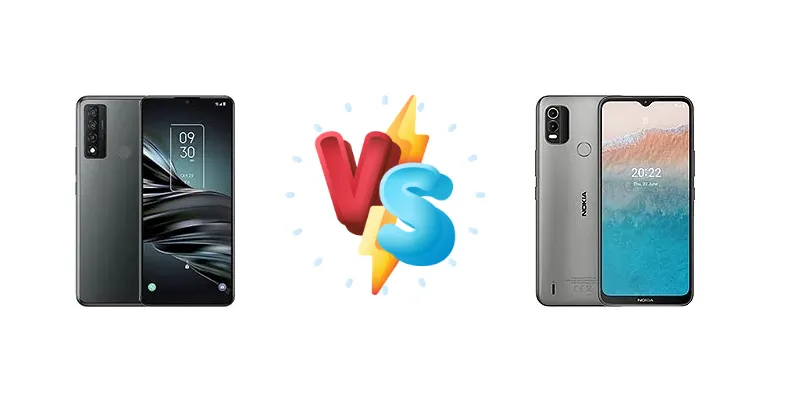
The TCL 20 XE and Nokia C21 Plus represent the extreme end of the smartphone price spectrum. Both aim to deliver essential smartphone functionality at a minimal cost, but they take different approaches to achieving this. The TCL prioritizes a more powerful, albeit older, chipset, while the Nokia opts for a newer, but less performant, processor. This comparison will dissect these choices and determine which device offers the best value.
🏆 Quick Verdict
For the average user prioritizing responsiveness and occasional multitasking, the TCL 20 XE emerges as the better choice. Its Mediatek Helio P22 chipset, despite being based on a 12nm process, offers a noticeable performance advantage over the Nokia C21 Plus’s Unisoc SC9863A, making everyday tasks smoother. However, the Nokia C21 Plus may appeal to those seeking maximum battery life and a slightly newer platform.
| Network |
|---|
| 2G bands | GSM 850 / 900 / 1800 / 1900 | GSM 850 / 900 / 1800 / 1900 |
| 3G bands | HSDPA 850 / 1700(AWS) / 1900 | HSDPA 850 / 900 / 2100 |
| 4G bands | 2, 4, 5, 7, 12, 25, 26, 41, 66, 71 | LTE |
| Speed | HSPA 42.2/11.5 Mbps, LTE Cat13 300/150 Mbps | HSPA 42.2/5.76 Mbps, LTE Cat4 150/50 Mbps |
| Technology | GSM / HSPA / LTE | GSM / HSPA / LTE |
| | - | HSDPA 850 / 900 / 1700(AWS) / 1900 / 2100 |
| Launch |
|---|
| Announced | 2021, December | 2022, February 28 |
| Status | Available. Released 2021, December | Available. Released 2022, April 29 |
| Body |
|---|
| Build | - | Glass front, aluminum frame, plastic back |
| Dimensions | 164.6 x 75 x 9 mm (6.48 x 2.95 x 0.35 in) | 164.8 x 75.9 x 8.6 mm (6.49 x 2.99 x 0.34 in) |
| SIM | Nano-SIM | · Nano-SIM· Nano-SIM + Nano-SIM |
| Weight | 195 g (6.88 oz) | 178 g or 191 g (6.28 oz) |
| | - | Splash protection |
| Display |
|---|
| Protection | - | Scratch-resistant glass |
| Resolution | 720 x 1600 pixels, 20:9 ratio (~269 ppi density) | 720 x 1600 pixels, 20:9 ratio (~269 ppi density) |
| Size | 6.52 inches, 102.6 cm2 (~83.1% screen-to-body ratio) | 6.52 inches, 102.6 cm2 (~82.1% screen-to-body ratio) |
| Type | IPS LCD, 450 nits | IPS LCD |
| Platform |
|---|
| CPU | Octa-core 2.0 GHz Cortex-A53 | Octa-core (4x1.6 GHz Cortex-A55 & 4x1.2 GHz Cortex-A55) |
| Chipset | Mediatek MT6762 Helio P22 (12 nm) | Unisoc SC9863A (28 nm) |
| GPU | PowerVR GE8320 | IMG8322 |
| OS | Android 11, TCL UI 3.0 | Android 11 (Go edition) |
| Memory |
|---|
| Card slot | microSDXC | microSDXC (dedicated slot) |
| Internal | 32GB 3GB RAM | 32GB 2GB RAM, 32GB 3GB RAM, 64GB 2GB RAM, 64GB 3GB RAM, 64GB 4GB RAM |
| | - | eMMC 5.1 |
| Main Camera |
|---|
| Dual | - | 13 MP, (wide), AF
Auxiliary lens |
| Features | LED flash, HDR | LED flash, HDR, panorama |
| Single | - | 5 MP |
| Triple | 13 MP, 27mm (wide), 1.12µm, AF
2 MP (macro)
Auxiliary lens | - |
| Video | 1080p@30fps | 1080p@30fps |
| Selfie camera |
|---|
| Features | - | LED flash |
| Single | 5 MP | 5 MP |
| Video | 1080p@30fps | 720p |
| Sound |
|---|
| 3.5mm jack | - | Yes |
| 35mm jack | Yes | Yes |
| Loudspeaker | Yes | Yes |
| Comms |
|---|
| Bluetooth | 5.0, A2DP, LE | 4.2, A2DP |
| NFC | No | No |
| Positioning | GPS | GPS |
| Radio | No | FM radio |
| USB | USB Type-C 2.0, OTG | microUSB 2.0 |
| WLAN | Wi-Fi 802.11 b/g/n, Wi-Fi Direct | Wi-Fi 802.11 b/g/n |
| Features |
|---|
| Sensors | Fingerprint (rear-mounted), accelerometer, proximity, compass, barometer | Fingerprint (rear-mounted), accelerometer, proximity |
| Battery |
|---|
| Charging | 18W wired | 10W wired |
| Type | Li-Po 5000 mAh | Li-Ion 4000/5050 mAh |
| Misc |
|---|
| Colors | Moonlight Grey | Dark Cyan, Warm Gray |
| Models | 5087Z | TA-1433, TA-1431, TA-1426, TA-1424 |
| Price | About 50 EUR | About 120 EUR |
| SAR | 1.39 W/kg (head) 1.25 W/kg (body) | 0.57 W/kg (head) 0.65 W/kg (body) |
| SAR EU | - | 0.40 W/kg (head) 0.99 W/kg (body) |
TCL 20 XE
- Faster processor for smoother performance
- Faster 18W charging
- Potentially better image processing
- Older chipset architecture
- Likely less optimized software
Nokia C21 Plus
- Potentially longer battery life due to efficient cores
- Lower price point (likely)
- Newer Unisoc chipset
- Significantly slower processor
- Slower 10W charging
- Less efficient manufacturing process (28nm)
Display Comparison
Neither TCL nor Nokia provide display specifications beyond resolution. However, given the price point, both likely utilize IPS LCD panels. The key difference lies under the hood. The TCL 20 XE’s chipset has a more capable GPU, potentially allowing for smoother scrolling and transitions. The Nokia C21 Plus, with its less powerful processor, may exhibit more noticeable lag in display-intensive tasks. Bezels are expected to be substantial on both devices, reflecting their budget nature.
Camera Comparison
Detailed camera specifications are unavailable for either device. However, given their market segment, image quality is unlikely to be a primary strength. Both will likely feature a primary camera and potentially a depth sensor. The TCL 20 XE’s more powerful ISP (Image Signal Processor) within the Helio P22 chipset *could* translate to slightly better image processing, particularly in low-light conditions, but expectations should remain modest. Focusing on the chipset difference, the TCL has a processing advantage that could improve image quality.
Performance
The TCL 20 XE’s Mediatek Helio P22, built on a 12nm process, features an octa-core CPU clocked at 2.0 GHz using Cortex-A53 cores. This contrasts sharply with the Nokia C21 Plus’s Unisoc SC9863A, fabricated on a larger 28nm node. The Unisoc utilizes a heterogeneous core configuration with 4x1.6 GHz Cortex-A55 cores and 4x1.2 GHz Cortex-A55 cores. While the A55 cores are more efficient, the lower clock speeds and the less efficient manufacturing process of the Unisoc chip result in overall lower performance. The TCL will handle multitasking and app loading times more effectively, while the Nokia may struggle with demanding applications.
Battery Life
The Nokia C21 Plus’s 10W charging is significantly slower than the TCL 20 XE’s 18W charging. While neither phone boasts a large battery capacity (specifics are unavailable), the TCL’s faster charging will reduce downtime. The Unisoc SC9863A’s 28nm process is less efficient than the Helio P22’s 12nm process, meaning the Nokia may need to charge more frequently despite potentially having similar battery capacity. The TCL offers a more convenient charging experience.
Buying Guide
Buy the TCL 20 XE if you need a phone capable of handling more than just basic tasks, such as light social media browsing and occasional gaming. Its faster processor will provide a more fluid user experience. Buy the Nokia C21 Plus if you prioritize absolute affordability and extended battery life, and your usage is limited to calls, texts, and very light app usage. The Nokia is a good option for first-time smartphone users or as a reliable backup device.
Frequently Asked Questions
❓ Will the Unisoc SC9863A in the Nokia C21 Plus struggle with popular apps like Facebook or WhatsApp?
While the Nokia C21 Plus can run these apps, the Unisoc SC9863A’s limited processing power may result in noticeable lag when scrolling through feeds or loading images. The TCL 20 XE, with its Helio P22, will provide a smoother experience with these commonly used applications.
❓ How long will it take to fully charge each phone from 0%?
With 18W charging, the TCL 20 XE should reach 100% in approximately 2-3 hours, depending on battery capacity. The Nokia C21 Plus, with its 10W charging, will likely take 4-5 hours or longer to fully charge, making it less convenient for users who need a quick top-up.
❓ Is the TCL 20 XE a good option for playing mobile games?
The TCL 20 XE is capable of running some less demanding mobile games, but don't expect a high-performance gaming experience. The Helio P22 is an entry-level chipset and will struggle with graphically intensive titles. The Nokia C21 Plus is even less suited for gaming due to its weaker processor.