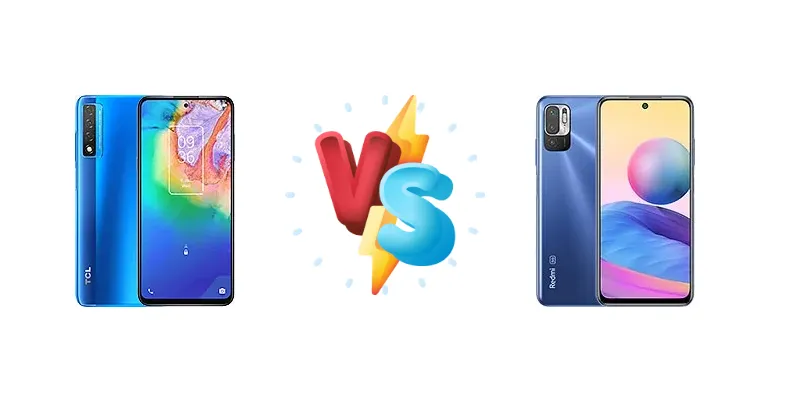
The TCL 20 5G and Xiaomi Redmi Note 10 5G represent compelling options in the increasingly crowded budget 5G smartphone market. Both aim to deliver next-generation connectivity without breaking the bank, but they achieve this through different approaches to chipset selection and feature prioritization. This comparison dissects their key specifications to determine which device offers the best value.
🏆 Quick Verdict
For the average user prioritizing a slightly brighter display and potentially wider carrier compatibility, the Xiaomi Redmi Note 10 5G edges out the TCL 20 5G. However, the TCL 20 5G’s Snapdragon 690 offers a refined experience and Qualcomm’s Quick Charge support, making it a strong contender for those within the Qualcomm ecosystem.
| Network |
|---|
| 2G bands | GSM 850 / 900 / 1800 / 1900 | GSM 850 / 900 / 1800 / 1900 |
| 3G bands | HSDPA 850 / 900 / 1900 / 2100 | HSDPA 850 / 900 / 1700(AWS) / 1900 / 2100 |
| 4G bands | 1, 3, 5, 7, 8, 20, 26, 28, 32, 38, 40, 41 | 1, 2, 3, 4, 5, 7, 8, 12, 17, 20, 28, 32, 38, 40, 41, 66 |
| 5G bands | 1, 3, 5, 28, 41, 78 SA/NSA | 1, 3, 7, 8, 20, 28, 38, 40, 41, 66, 77, 78 SA/NSA |
| Speed | HSPA, LTE, 5G | HSPA, LTE, 5G |
| Technology | GSM / HSPA / LTE / 5G | GSM / HSPA / LTE / 5G |
| | HSDPA 850 / 900 / 1700(AWS) / 1900 / 2100 | - |
| Launch |
|---|
| Announced | 2020, November 30. Released 2020, December 07 | 2021, March 04 |
| Status | Discontinued | Available. Released 2021, April 28 |
| Body |
|---|
| Build | - | Glass front (Gorilla Glass 3), plastic back, plastic frame |
| Dimensions | 166.2 x 76.8 x 9.1 mm (6.54 x 3.02 x 0.36 in) | 161.8 x 75.3 x 8.9 mm (6.37 x 2.96 x 0.35 in) |
| SIM | · Nano-SIM· Nano-SIM + Nano-SIM | Nano-SIM + Nano-SIM |
| Weight | 206 g (7.27 oz) | 190 g (6.70 oz) |
| Display |
|---|
| Protection | - | Corning Gorilla Glass 3 |
| Resolution | 1080 x 2400 pixels, 20:9 ratio (~395 ppi density) | 1080 x 2400 pixels, 20:9 ratio (~405 ppi density) |
| Size | 6.67 inches, 107.4 cm2 (~84.2% screen-to-body ratio) | 6.5 inches, 102.0 cm2 (~83.7% screen-to-body ratio) |
| Type | IPS LCD, HDR10, 450 nits (typ) | IPS LCD, 90Hz, 400 nits (typ), 500 nits (HBM) |
| Platform |
|---|
| CPU | Octa-core (2x2.0 GHz Kryo 560 Gold & 6x1.7 GHz Kryo 560 Silver) | Octa-core (2x2.2 GHz Cortex-A76 & 6x2.0 GHz Cortex-A55) |
| Chipset | Qualcomm SM6350 Snapdragon 690 5G (8 nm) | Mediatek Dimensity 700 (7 nm) |
| GPU | Adreno 619L | Mali-G57 MC2 |
| OS | Android 10, TCL UI | Android 11, MIUI 12 |
| Memory |
|---|
| Card slot | microSDXC (uses shared SIM slot) | microSDXC (uses shared SIM slot) |
| Internal | 128GB 6GB RAM, 256GB 6GB RAM | 64GB 4GB RAM, 128GB 4GB RAM, 128GB 6GB RAM, 128GB 8GB RAM, 256GB 4GB RAM, 256GB 8GB RAM |
| | UFS 2.1 | UFS 2.2 |
| Main Camera |
|---|
| Features | LED flash, HDR, panorama | Dual-LED dual-tone flash, HDR, panorama |
| Single | - | 8 MP, f/2.0, (wide) |
| Triple | 48 MP, f/1.8, 26mm (wide), 1/2.0", 0.8µm, PDAF
8 MP, f/2.2, 16mm, 118˚ (ultrawide), 1/4.0", 1.12µm
2 MP (macro) | 48 MP, f/1.8, 26mm (wide), 1/2.0", 0.8µm, PDAF
2 MP (macro)
Auxiliary lens |
| Video | 4K@30fps, 1080p@30/60fps, gyro-EIS | 1080p@30fps |
| Selfie camera |
|---|
| Features | HDR | - |
| Single | 8 MP, f/2.0, 27mm, (wide), 1/4.0", 1.12µm | 8 MP, f/2.0, (wide) |
| Video | 1080p@30fps | 1080p@30fps |
| Sound |
|---|
| 3.5mm jack | Yes | Yes |
| 35mm jack | Yes | Yes |
| Loudspeaker | Yes | Yes |
| | 24-bit/192kHz audio | 24-bit/192kHz audio |
| Comms |
|---|
| Bluetooth | 5.1, A2DP, LE, aptX HD | 5.1, A2DP, LE |
| Infrared port | - | Yes |
| NFC | Yes | Yes (market/region dependent) |
| Positioning | GPS (L1+L5), GLONASS, BDS, GALILEO | GPS, GLONASS, GALILEO, BDS |
| Radio | FM radio | FM radio |
| USB | USB Type-C 2.0, OTG | USB Type-C 2.0 |
| WLAN | Wi-Fi 802.11 a/b/g/n/ac, dual-band, Wi-Fi Direct | Wi-Fi 802.11 a/b/g/n/ac, dual-band, Wi-Fi Direct |
| Features |
|---|
| Sensors | Fingerprint (side-mounted), accelerometer, gyro, proximity, compass | Fingerprint (side-mounted), accelerometer, gyro, proximity, compass |
| Battery |
|---|
| Charging | 18W wired, QC4 | 18W wired |
| Type | Li-Po 4500 mAh | Li-Po 5000 mAh |
| Misc |
|---|
| Colors | Mist Gray, Placid Blue | Chrome Silver, Graphite Gray, Nighttime Blue, Aurora Green |
| Models | T781, T781K, T781H | M2103K19G, M2103K19C |
| Price | About 300 EUR | € 96.62 / £ 107.59 |
| SAR | - | 0.94 W/kg (head) 1.06 W/kg (body) |
| SAR EU | - | 0.54 W/kg (head) 0.90 W/kg (body) |
| Tests |
|---|
| Battery life | - |
Endurance rating 121h
|
| Camera | - |
Photo / Video |
| Display | - |
Contrast ratio: 1795:1 (nominal) |
| Loudspeaker | - |
-27.0 LUFS (Good)
|
TCL 20 5G
- Qualcomm Snapdragon 690 offers a refined experience.
- QC4 fast charging support for potentially faster charging.
- 8nm process may lead to better thermal management.
- Display brightness is likely lower than the Redmi Note 10 5G.
- Limited details on camera sensor specifications.
Xiaomi Redmi Note 10 5G
- Brighter display (492 nits) for better outdoor visibility.
- Dimensity 700 may offer wider 5G band support.
- Comparable battery life to the TCL 20 5G.
- MediaTek chipset may not be as thermally efficient.
- Lacks Qualcomm Quick Charge support.
Display Comparison
Both devices feature a contrast ratio of 1795:1, suggesting similar panel characteristics in terms of black levels. However, the Xiaomi Redmi Note 10 5G boasts a measured peak brightness of 492 nits, exceeding the TCL 20 5G’s unspecified brightness. This difference translates to better outdoor visibility for the Redmi Note 10 5G. While both likely utilize LCD panels given the price point, the Redmi Note 10 5G’s higher brightness provides a more comfortable viewing experience in bright ambient light.
Camera Comparison
Both phones offer photo and video capabilities, but detailed sensor information is lacking. Without specifics on sensor size or aperture, a direct comparison is difficult. The absence of details suggests neither phone prioritizes exceptional camera performance. Users should expect adequate results in good lighting conditions, but low-light performance is likely to be limited. The inclusion of a 2MP macro camera on both devices is largely a marketing tactic, offering minimal practical benefit due to the low resolution and lack of optical image stabilization (OIS).
Performance
The core difference lies in the chipsets: the TCL 20 5G utilizes the Qualcomm Snapdragon 690 5G (8nm) with its Kryo 560 cores, while the Redmi Note 10 5G employs the MediaTek Dimensity 700 (7nm). The Dimensity 700’s Cortex-A76 cores, clocked at 2.2 GHz, offer a slight clock speed advantage over the Snapdragon 690’s 2.0 GHz Kryo 560 Gold cores. However, the 8nm process of the Snapdragon 690 may offer better thermal efficiency. Both chipsets are capable of handling everyday tasks and moderate gaming, but the Dimensity 700’s integrated 5G modem may provide broader network compatibility depending on regional 5G deployments.
Battery Life
Both the TCL 20 5G and Xiaomi Redmi Note 10 5G share an endurance rating of 121 hours, indicating comparable battery life under similar usage scenarios. Both support 18W wired charging, but the TCL 20 5G benefits from Qualcomm Quick Charge 4 (QC4) compatibility, potentially enabling faster charging speeds with a compatible charger. While the battery capacity isn’t specified, the similar endurance ratings suggest comparable battery sizes and power efficiency.
Buying Guide
Buy the TCL 20 5G if you prioritize a proven chipset architecture from Qualcomm and benefit from QC4 fast charging. This is ideal for users already invested in the Qualcomm ecosystem or those who frequently use Quick Charge accessories. Buy the Xiaomi Redmi Note 10 5G if you value a slightly brighter display, measured at 492 nits, and potentially broader 5G band support depending on your region, making it a better choice for travelers or those with specific carrier needs.
Frequently Asked Questions
❓ Does the MediaTek Dimensity 700 in the Redmi Note 10 5G suffer from significant thermal throttling during extended gaming sessions?
While the Dimensity 700 is a capable chipset, it's known to generate more heat than the Snapdragon 690 under sustained load. Expect some performance throttling during prolonged gaming, but it shouldn't be severe enough to render games unplayable. The TCL 20 5G’s 8nm process may offer slightly better thermal headroom.
❓ Is the 18W charging on either phone truly 'fast charging', and how long does it take to fully charge the battery?
18W charging is considered moderate fast charging. While not the fastest available, it's adequate for these price points. Expect a full charge to take approximately 2-3 hours. The TCL 20 5G’s QC4 compatibility *could* reduce this time with a compatible charger, but the Redmi Note 10 5G lacks this support.
❓ Which phone is more likely to receive software updates and security patches?
Xiaomi generally has a more aggressive software update schedule than TCL. While neither brand is known for exceptional long-term support, Redmi Note 10 5G users are likely to receive updates more frequently, though the longevity of support remains uncertain for both devices.