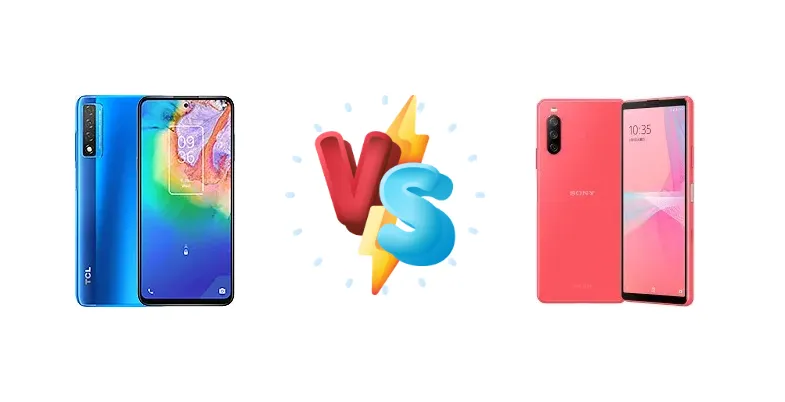
The TCL 20 5G and Sony Xperia 10 III Lite represent a fascinating intersection in the mid-range 5G smartphone market. Both devices leverage the Qualcomm Snapdragon 690 5G chipset, promising similar performance. However, Sony positions the 10 III Lite as a more refined experience, and key differences in charging technology and potentially software optimization warrant a detailed comparison for prospective buyers.
🏆 Quick Verdict
For the average user prioritizing convenience, the Sony Xperia 10 III Lite is the better choice. While both phones share the same Snapdragon 690 chipset, the 30W charging with Power Delivery and Quick Charge support significantly reduces downtime compared to the TCL 20 5G’s 18W QC4 charging.
| Network |
|---|
| 2G bands | GSM 850 / 900 / 1800 / 1900 | GSM 850 / 900 / 1800 / 1900 |
| 3G bands | HSDPA 850 / 900 / 1900 / 2100 | HSDPA 850 / 1900 |
| 4G bands | 1, 3, 5, 7, 8, 20, 26, 28, 32, 38, 40, 41 | 1, 3, 4, 12, 18, 19, 38, 41 |
| 5G bands | 1, 3, 5, 28, 41, 78 SA/NSA | 77, 78 SA/NSA |
| Speed | HSPA, LTE, 5G | HSPA, LTE, 5G |
| Technology | GSM / HSPA / LTE / 5G | GSM / HSPA / LTE / 5G |
| | HSDPA 850 / 900 / 1700(AWS) / 1900 / 2100 | - |
| Launch |
|---|
| Announced | 2020, November 30. Released 2020, December 07 | 2021, August 20 |
| Status | Discontinued | Available. Released 2021, August 27 |
| Body |
|---|
| Build | - | Glass front (Gorilla Glass 6), glass back (Gorilla Glass 6), plastic frame |
| Dimensions | 166.2 x 76.8 x 9.1 mm (6.54 x 3.02 x 0.36 in) | 154 x 68 x 8.3 mm (6.06 x 2.68 x 0.33 in) |
| SIM | · Nano-SIM· Nano-SIM + Nano-SIM | Nano-SIM + eSIM |
| Weight | 206 g (7.27 oz) | 169 g (5.96 oz) |
| Display |
|---|
| Protection | - | Corning Gorilla Glass 6 |
| Resolution | 1080 x 2400 pixels, 20:9 ratio (~395 ppi density) | 1080 x 2520 pixels, 21:9 ratio (~457 ppi density) |
| Size | 6.67 inches, 107.4 cm2 (~84.2% screen-to-body ratio) | 6.0 inches, 84.1 cm2 (~80.3% screen-to-body ratio) |
| Type | IPS LCD, HDR10, 450 nits (typ) | OLED, 1B colors, HDR |
| Platform |
|---|
| CPU | Octa-core (2x2.0 GHz Kryo 560 Gold & 6x1.7 GHz Kryo 560 Silver) | Octa-core (2x2.0 GHz Kryo 560 Gold & 6x1.7 GHz Kryo 560 Silver) |
| Chipset | Qualcomm SM6350 Snapdragon 690 5G (8 nm) | Qualcomm SM6350 Snapdragon 690 5G (8 nm) |
| GPU | Adreno 619L | Adreno 619 |
| OS | Android 10, TCL UI | Android 11 |
| Memory |
|---|
| Card slot | microSDXC (uses shared SIM slot) | microSDXC (uses shared SIM slot) |
| Internal | 128GB 6GB RAM, 256GB 6GB RAM | 64GB 6GB RAM |
| | UFS 2.1 | - |
| Main Camera |
|---|
| Features | LED flash, HDR, panorama | LED flash, HDR, panorama |
| Triple | 48 MP, f/1.8, 26mm (wide), 1/2.0", 0.8µm, PDAF
8 MP, f/2.2, 16mm, 118˚ (ultrawide), 1/4.0", 1.12µm
2 MP (macro) | 12 MP, f/1.8, 27mm (wide), 1/2.8", PDAF
8 MP, f/2.4, 54mm (telephoto), 1/4.0", PDAF, 2x optical zoom
8 MP, f/2.2, 16mm, 120˚ (ultrawide), 1/4.0" |
| Video | 4K@30fps, 1080p@30/60fps, gyro-EIS | 4K@30fps, 1080p@30fps |
| Selfie camera |
|---|
| Features | HDR | HDR |
| Single | 8 MP, f/2.0, 27mm, (wide), 1/4.0", 1.12µm | 8 MP, f/2.0, 24mm (wide), 1/4.0" |
| Video | 1080p@30fps | 1080p@30fps |
| Sound |
|---|
| 3.5mm jack | Yes | Yes |
| 35mm jack | Yes | Yes |
| Loudspeaker | Yes | Yes |
| | 24-bit/192kHz audio | - |
| Comms |
|---|
| Bluetooth | 5.1, A2DP, LE, aptX HD | 5.1, A2DP, LE, aptX HD |
| NFC | Yes | Yes |
| Positioning | GPS (L1+L5), GLONASS, BDS, GALILEO | GPS, GLONASS, GALILEO, BDS, QZSS |
| Radio | FM radio | No |
| USB | USB Type-C 2.0, OTG | USB Type-C 3.1, OTG, video output |
| WLAN | Wi-Fi 802.11 a/b/g/n/ac, dual-band, Wi-Fi Direct | Wi-Fi 802.11 a/b/g/n/ac, dual-band, Wi-Fi Direct |
| Features |
|---|
| Sensors | Fingerprint (side-mounted), accelerometer, gyro, proximity, compass | Fingerprint (side-mounted), accelerometer, proximity, compass |
| Battery |
|---|
| Charging | 18W wired, QC4 | 30W wired, PD, QC |
| Type | Li-Po 4500 mAh | Li-Po 4500 mAh |
| Misc |
|---|
| Colors | Mist Gray, Placid Blue | Black, White, Blue, Pink |
| Models | T781, T781K, T781H | XQ-BT44 |
| Price | About 300 EUR | About 370 EUR |
TCL 20 5G
- Potentially lower price point
- 5G connectivity
- Snapdragon 690 chipset
- Slower 18W charging
- Potentially less refined software
- Unknown display quality
Sony Xperia 10 III Lite
- Faster 30W charging with PD/QC
- Sony’s image processing expertise
- Potentially smoother software experience
- Likely higher price
- 5G connectivity (same as TCL)
- Unknown display quality
Display Comparison
Both devices lack detailed display specifications in the provided data. However, given their market positioning, it's reasonable to assume both utilize LCD panels. The absence of high refresh rate support is likely. The key differentiator, if any, will be color accuracy and peak brightness, which are unknown. Sony typically calibrates its displays for more accurate color reproduction, potentially giving it an edge for content consumption, but this is speculative without further data.
Camera Comparison
Without detailed camera sensor information, a direct comparison is limited. Both phones likely feature a multi-camera setup, but the quality of the image processing will be crucial. Sony’s Xperia line is known for its image processing algorithms, often prioritizing natural colors and detail. TCL’s image processing tends to be more saturated. The absence of information regarding OIS (Optical Image Stabilization) is notable; its presence on one device but not the other would be a significant advantage for low-light photography. We can assume both will have a standard wide, ultrawide, and potentially a depth sensor, but sensor size and aperture are unknown.
Performance
Both the TCL 20 5G and Sony Xperia 10 III Lite are powered by the Qualcomm SM6350 Snapdragon 690 5G (8 nm) chipset, featuring an octa-core CPU configuration with 2x2.0 GHz Kryo 560 Gold and 6x1.7 GHz Kryo 560 Silver cores. This means CPU performance will be virtually identical. The real-world performance difference will likely stem from RAM management and software optimization. Sony’s software is generally more refined, potentially leading to smoother multitasking. Thermal throttling, while unlikely to be severe with this chipset, could be slightly better managed by Sony due to their experience with thermal design.
Battery Life
The battery capacity is not specified for either device. However, the charging capabilities are a clear differentiator. The Sony Xperia 10 III Lite supports 30W wired charging with both Power Delivery (PD) and Quick Charge (QC) protocols, enabling significantly faster charging times. The TCL 20 5G is limited to 18W charging with QC4. This means the Sony can likely achieve a 0-100% charge in under 75 minutes, while the TCL will likely take over 90 minutes, even with similar battery capacities. This difference in charging speed directly impacts usability and convenience.
Buying Guide
Buy the TCL 20 5G if you need a functional 5G phone at the absolute lowest possible price point and are willing to compromise on charging speed and potentially software updates. Buy the Sony Xperia 10 III Lite if you prefer a faster-charging device with Sony’s established camera processing and a more polished software experience, even if it comes at a slightly higher cost.
Frequently Asked Questions
❓ Does the Snapdragon 690 in either phone struggle with demanding games like PUBG or Call of Duty?
The Snapdragon 690 is a capable mid-range chipset, but it's not designed for ultra-high settings in demanding games. Both phones will likely be able to run PUBG and Call of Duty at medium settings with acceptable frame rates. Expect some frame drops during intense action. Neither phone has dedicated gaming features like vapor chambers or trigger buttons.
❓ Is the lack of detailed display specs a major concern? Should I expect a good viewing experience?
The absence of display specifications is a drawback. Both phones likely use LCD panels, which are generally less vibrant than OLED displays. Without knowing the peak brightness or color accuracy, it's difficult to assess the viewing experience. However, for everyday use like browsing and social media, the displays should be adequate.
❓ How much does software support differ between TCL and Sony for these models?
Sony typically provides longer software support (both Android version updates and security patches) than TCL. TCL’s software update track record is less consistent. If long-term software support is a priority, the Sony Xperia 10 III Lite is the better choice.