
TCL 20 5G vs Google Pixel 4a 5G: Which 5G Phone Delivers the Best Value?
| Phones Images | |||||
|---|---|---|---|---|---|
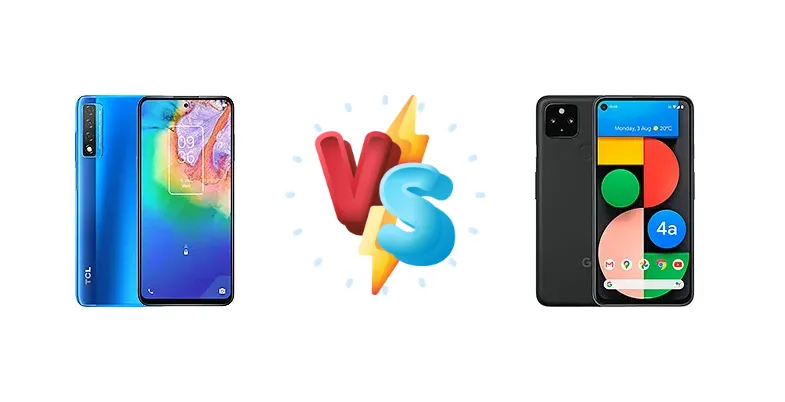
|
🏆 Quick Verdict
For the average user prioritizing camera quality and software experience, the Google Pixel 4a 5G emerges as the superior choice. Its Snapdragon 765G provides a noticeable performance edge, and Google’s computational photography consistently delivers excellent results. However, the TCL 20 5G offers a competitive package for those on a tighter budget.
| PHONES | ||
|---|---|---|
| Phone Names | TCL 20 5G | Google Pixel 4a 5G |
| Network | ||
|---|---|---|
| 2G bands | GSM 850 / 900 / 1800 / 1900 | GSM 850 / 900 / 1800 / 1900 |
| 3G bands | HSDPA 850 / 900 / 1900 / 2100 | HSDPA 850 / 900 / 1700(AWS) / 1900 / 2100 |
| 4G bands | 1, 3, 5, 7, 8, 20, 26, 28, 32, 38, 40, 41 | 1, 2, 3, 4, 5, 7, 8, 12, 13, 14, 17, 18, 19, 20, 25, 26, 28, 29, 30, 32, 38, 39, 40, 41, 42, 46, 48, 66, 71 |
| 5G bands | 1, 3, 5, 28, 41, 78 SA/NSA | 1, 2, 3, 5, 7, 8, 12, 28, 41, 66, 71, 77, 78 Sub6, mmWave (market dependant) |
| Speed | HSPA, LTE, 5G | HSPA, LTE, 5G |
| Technology | GSM / HSPA / LTE / 5G | GSM / HSPA / LTE / 5G |
| HSDPA 850 / 900 / 1700(AWS) / 1900 / 2100 | - | |
| Launch | ||
|---|---|---|
| Announced | 2020, November 30. Released 2020, December 07 | 2020, September 30 |
| Status | Discontinued | Available. Released 2020, November 05 |
| Body | ||
|---|---|---|
| Build | - | Glass front (Gorilla Glass 3), plastic back, plastic frame |
| Dimensions | 166.2 x 76.8 x 9.1 mm (6.54 x 3.02 x 0.36 in) | 153.9 x 74 x 8.2 mm (Sub-6) or 8.5 mm (Sub-6 and mmWave) |
| SIM | · Nano-SIM· Nano-SIM + Nano-SIM | Nano-SIM + eSIM |
| Weight | 206 g (7.27 oz) | 168 g (5G Sub-6); 171 g ( 5G Sub-6 and mmWave) (5.93 oz) |
| Display | ||
|---|---|---|
| Protection | - | Corning Gorilla Glass 3 |
| Resolution | 1080 x 2400 pixels, 20:9 ratio (~395 ppi density) | 1080 x 2340 pixels, 19.5:9 ratio (~413 ppi density) |
| Size | 6.67 inches, 107.4 cm2 (~84.2% screen-to-body ratio) | 6.2 inches, 95.7 cm2 (~84.1% screen-to-body ratio) |
| Type | IPS LCD, HDR10, 450 nits (typ) | OLED, HDR |
| - | Always-on display | |
| Platform | ||
|---|---|---|
| CPU | Octa-core (2x2.0 GHz Kryo 560 Gold & 6x1.7 GHz Kryo 560 Silver) | Octa-core (1x2.4 GHz Kryo 475 Prime & 1x2.2 GHz Kryo 475 Gold & 6x1.8 GHz Kryo 475 Silver) |
| Chipset | Qualcomm SM6350 Snapdragon 690 5G (8 nm) | Qualcomm SM7250 Snapdragon 765G 5G (7 nm) |
| GPU | Adreno 619L | Adreno 620 |
| OS | Android 10, TCL UI | Android 11, upgradable to Android 14 |
| Memory | ||
|---|---|---|
| Card slot | microSDXC (uses shared SIM slot) | No |
| Internal | 128GB 6GB RAM, 256GB 6GB RAM | 128GB 6GB RAM |
| UFS 2.1 | UFS 2.1 | |
| Main Camera | ||
|---|---|---|
| Dual | - | 12.2 MP, f/1.7, 27mm (wide), 1/2.55", 1.4µm, dual pixel PDAF, OIS 16 MP, f/2.2, 107˚ (ultrawide), 1.0µm |
| Features | LED flash, HDR, panorama | LED flash, Pixel Shift, Auto-HDR, panorama |
| Triple | 48 MP, f/1.8, 26mm (wide), 1/2.0", 0.8µm, PDAF 8 MP, f/2.2, 16mm, 118˚ (ultrawide), 1/4.0", 1.12µm 2 MP (macro) | - |
| Video | 4K@30fps, 1080p@30/60fps, gyro-EIS | 4K@30/60fps, 1080p@30/60/120/240fps; gyro-EIS |
| Selfie camera | ||
|---|---|---|
| Features | HDR | HDR |
| Single | 8 MP, f/2.0, 27mm, (wide), 1/4.0", 1.12µm | 8 MP, f/2.0, 24mm (wide), 1/4.0", 1.12µm |
| Video | 1080p@30fps | 1080p@30fps |
| Sound | ||
|---|---|---|
| 3.5mm jack | Yes | Yes |
| 35mm jack | Yes | Yes |
| Loudspeaker | Yes | Yes, with stereo speakers |
| 24-bit/192kHz audio | - | |
| Comms | ||
|---|---|---|
| Bluetooth | 5.1, A2DP, LE, aptX HD | 5.0, A2DP, LE, aptX HD |
| NFC | Yes | Yes |
| Positioning | GPS (L1+L5), GLONASS, BDS, GALILEO | GPS, GLONASS, GALILEO, QZSS, BDS |
| Radio | FM radio | No |
| USB | USB Type-C 2.0, OTG | USB Type-C 3.1 |
| WLAN | Wi-Fi 802.11 a/b/g/n/ac, dual-band, Wi-Fi Direct | Wi-Fi 802.11 a/b/g/n/ac, dual-band, Wi-Fi Direct |
| Features | ||
|---|---|---|
| Sensors | Fingerprint (side-mounted), accelerometer, gyro, proximity, compass | Fingerprint (rear-mounted), accelerometer, gyro, proximity, compass, barometer |
| Battery | ||
|---|---|---|
| Charging | 18W wired, QC4 | 18W wired, PD2.0 |
| Type | Li-Po 4500 mAh | Li-Po 3885 mAh |
| Misc | ||
|---|---|---|
| Colors | Mist Gray, Placid Blue | Just Black, Clearly White |
| Models | T781, T781K, T781H | GD1YQ, G025I, G025E, G025H, G6QU3 |
| Price | About 300 EUR | About 140 EUR |
TCL 20 5G
- More affordable price point
- Supports Quick Charge 4.0 for potentially faster charging with compatible adapters
- Decent 5G connectivity for the price
- Less powerful Snapdragon 690 chipset
- Likely inferior camera performance compared to the Pixel
- Potentially less frequent software updates
Google Pixel 4a 5G
- More powerful Snapdragon 765G chipset for smoother performance
- Superior camera quality thanks to Google’s computational photography
- Guaranteed software updates and a cleaner Android experience
- Higher price tag
- Uses Power Delivery 2.0, requiring a compatible charger for optimal speed
- May not offer expandable storage
Display Comparison
Neither TCL nor Google provided detailed display specs in the context data. However, given the market positioning, both likely utilize LCD panels. The key difference lies in processing power available to drive the display; the Pixel 4a 5G’s more powerful Snapdragon 765G could potentially handle more complex display algorithms for improved color accuracy and dynamic range. Bezels are likely comparable, typical of this price bracket. Without specific data, it's difficult to definitively declare a winner.
Camera Comparison
While both phones likely feature multi-camera systems, the Pixel 4a 5G benefits significantly from Google’s renowned computational photography. The Snapdragon 765G’s image signal processor (ISP) is more advanced than the 690’s, enabling superior noise reduction, dynamic range, and detail preservation. Without specific sensor details, we can assume the Pixel 4a 5G likely employs a larger main sensor, contributing to better low-light performance. The TCL 20 5G will likely offer acceptable image quality, but will struggle to match the Pixel’s consistency and overall quality. The absence of details on OIS makes it difficult to assess stabilization performance.
Performance
The core of the difference between these phones is the chipset. The Google Pixel 4a 5G’s Snapdragon 765G, fabricated on a 7nm process, boasts a more powerful CPU configuration – a 2.4 GHz Kryo 475 Prime core alongside a 2.2 GHz Kryo 475 Gold core and six 1.8 GHz Kryo 475 Silver cores – compared to the TCL 20 5G’s Snapdragon 690 (8nm) with its 2.0 GHz Kryo 560 Gold and 1.7 GHz Kryo 560 Silver cores. The 7nm process node of the 765G is more efficient, translating to better sustained performance and potentially lower thermal throttling during demanding tasks. This means the Pixel 4a 5G will handle multitasking, gaming, and resource-intensive applications more smoothly. The 765G also has a more capable Adreno GPU.
Battery Life
Both devices feature 18W wired charging, but utilize different charging standards – QC4 for TCL and PD2.0 for Google. While wattage is the same, the efficiency of the charging circuitry and the phone’s power management algorithms can impact actual charging times. The Snapdragon 765G’s improved power efficiency could offset a potentially smaller battery capacity in the Pixel 4a 5G, resulting in comparable real-world battery life. Without battery capacity data, it’s difficult to definitively state which phone offers superior endurance.
Buying Guide
Buy the TCL 20 5G if you need a functional 5G phone with decent performance for everyday tasks and prioritize affordability above all else. Buy the Google Pixel 4a 5G if you prefer a smoother user experience, a significantly better camera system, and guaranteed software updates, even if it means spending a bit more.