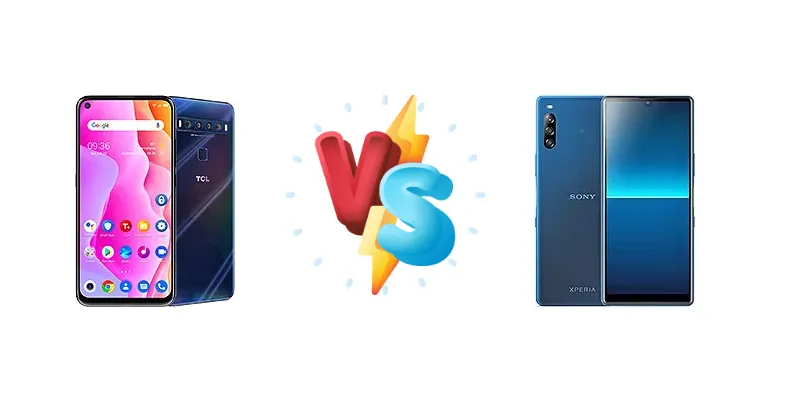
The TCL 10L and Sony Xperia L4 represent distinct approaches to the budget smartphone market. The TCL 10L leverages Qualcomm's Snapdragon 665, aiming for a balance of performance and efficiency, while the Sony Xperia L4 opts for MediaTek's Helio P22, incorporating USB Power Delivery for potentially faster charging. This comparison dives deep into the specifications to determine which device offers the most compelling user experience.
🏆 Quick Verdict
For the average user prioritizing overall performance and a more modern chipset architecture, the TCL 10L emerges as the better choice. Its Snapdragon 665 offers a noticeable advantage in processing power and graphics capabilities compared to the Xperia L4’s Helio P22, making it more suitable for multitasking and light gaming.
| Network |
|---|
| 2G bands | GSM 850 / 900 / 1800 / 1900 | GSM 850 / 900 / 1800 / 1900 |
| 3G bands | HSDPA 850 / 900 / 1700(AWS) / 1900 / 2100 | HSDPA 850 / 900 / 1900 / 2100 |
| 4G bands | 1, 2, 3, 4, 5, 7, 8, 12, 13, 17, 25, 26, 28, 38, 40, 41, 66 | 1, 2, 3, 5, 7, 8, 20, 40 |
| Speed | HSPA 42.2/5.76 Mbps, LTE (2CA) Cat13 400/75 Mbps | HSPA 42.2/5.76 Mbps, LTE (2CA) Cat6 300/50 Mbps |
| Technology | GSM / HSPA / LTE | GSM / HSPA / LTE |
| | 1, 3, 5, 7, 8, 20, 28, 38, 40, 41 | - |
| Launch |
|---|
| Announced | 2020, April 06. Released 2020, May 19 | 2020, February 20. Released 2020, April 28 |
| Status | Discontinued | Discontinued |
| Body |
|---|
| Build | - | Glass front, plastic back, plastic frame |
| Dimensions | 162.2 x 75.6 x 8.4 mm (6.39 x 2.98 x 0.33 in) | 159 x 71 x 8.7 mm (6.26 x 2.80 x 0.34 in) |
| SIM | · Nano-SIM· Nano-SIM + Nano-SIM | · Nano-SIM· Nano-SIM + Nano-SIM |
| Weight | 180 g (6.35 oz) | 178 g (6.28 oz) |
| Display |
|---|
| Resolution | 1080 x 2340 pixels, 19.5:9 ratio (~395 ppi density) | 720 x 1680 pixels, 21:9 ratio (~295 ppi density) |
| Size | 6.53 inches, 104.7 cm2 (~85.4% screen-to-body ratio) | 6.2 inches, 89.8 cm2 (~79.5% screen-to-body ratio) |
| Type | IPS LCD, HDR | IPS LCD |
| Platform |
|---|
| CPU | Octa-core (4x2.0 GHz Kryo 260 Gold & 4x1.8 GHz Kryo 260 Silver) | Octa-core 2.0 GHz Cortex-A53 |
| Chipset | Qualcomm SM6125 Snapdragon 665 (11 nm) | Mediatek MT6762 Helio P22 (12 nm) |
| GPU | Adreno 610 | PowerVR GE8320 |
| OS | Android 10, upgradable to Android 11, TCL UI | Android 9.0 (Pie) |
| Memory |
|---|
| Card slot | microSDXC (uses shared SIM slot) | microSDXC (uses shared SIM slot) |
| Internal | 64GB 6GB RAM, 128GB 6GB RAM, 256GB 6GB RAM | 64GB 3GB RAM |
| | 64GB eMMC 5.1, 128/256GB UFS 2.1 | eMMC 5.1 |
| Main Camera |
|---|
| Features | Dual-LED flash, HDR, panorama | LED flash, HDR, panorama |
| Quad | 48 MP, f/1.8, 26mm (wide), 1/2.25", 0.8µm, PDAF
8 MP, f/2.2, 13mm (ultrawide), 1/4.0", 1.12µm
2 MP (macro)
Auxiliary lens | - |
| Triple | - | 13 MP, f/2.0, 26mm (wide), 1/3.0", PDAF
5 MP, f/2.2, 17mm (ultrawide), 1/5.0", 1.12µm
Auxiliary lens |
| Video | 4K@30fps, 1080p@30/120fps | 1080p@30fps |
| Selfie camera |
|---|
| Single | 16 MP, f/2.2, 28mm (wide), 1/3.06", 1.0µm | 8 MP, f/2.0, 27mm (wide), 1/4.0", 1.12µm |
| Video | 1080p@30fps | 1080p@30fps |
| Sound |
|---|
| 3.5mm jack | Yes | Yes |
| 35mm jack | Yes | Yes |
| Loudspeaker | Yes | Yes |
| Comms |
|---|
| Bluetooth | 5.0, A2DP, LE, aptX | 5.0, A2DP, LE |
| NFC | Yes | Yes |
| Positioning | GPS, GALILEO | GPS, GLONASS |
| Radio | FM radio | FM radio |
| USB | USB Type-C 2.0, OTG | USB Type-C 2.0 |
| WLAN | Wi-Fi 802.11 a/b/g/n/ac, dual-band, Wi-Fi Direct | Wi-Fi 802.11 a/b/g/n, dual-band, Wi-Fi Direct |
| Features |
|---|
| Sensors | Fingerprint (rear-mounted), accelerometer, gyro, proximity, compass | Fingerprint (side-mounted), accelerometer, proximity, compass |
| Battery |
|---|
| Charging | - | USB Power Delivery |
| Type | Li-Po 4000 mAh | Li-Ion 3580 mAh |
| Misc |
|---|
| Colors | Arctic White, Mariana Blue | Black, Blue |
| Models | T770H, T770B, 4187U | XQ-AD52, XQ-AD51 |
| Price | About 140 EUR | About 200 EUR |
TCL 10L
- More powerful Snapdragon 665 chipset
- More efficient 11nm process node
- Superior ISP for better image processing
- Likely slower charging speeds (standard USB)
- No USB Power Delivery support
Sony Xperia L4
- USB Power Delivery for potentially faster charging
- Sony’s software experience
- Potentially lower price point
- Less powerful Helio P22 chipset
- Older Cortex-A53 CPU architecture
- Less capable ISP
Display Comparison
Neither TCL nor Sony provide display specifications beyond the basic resolution. However, the core difference lies in the processing power needed to drive them. The TCL 10L’s Snapdragon 665 has a more capable ISP and GPU, potentially allowing for better image processing and smoother animations on the display. The absence of detailed display specs makes a direct comparison difficult, but the TCL’s chipset suggests a more responsive visual experience.
Camera Comparison
Without detailed camera sensor information, a direct comparison is limited. However, the TCL 10L’s Snapdragon 665 ISP (Image Signal Processor) is more advanced than the Helio P22’s ISP. This means the TCL 10L can process images faster and with greater detail, potentially resulting in better low-light performance and dynamic range. The Xperia L4 may rely more heavily on software processing to compensate for the less capable ISP, which can sometimes lead to over-sharpening or artificial-looking images. The absence of OIS on either device suggests reliance on software stabilization.
Performance
The TCL 10L’s Qualcomm Snapdragon 665 (11nm) significantly outperforms the Sony Xperia L4’s MediaTek Helio P22 (12nm). The Snapdragon 665 utilizes a more modern CPU architecture – Kryo 260 Gold & Silver – compared to the Xperia L4’s Cortex-A53 cores. This translates to faster application loading times and smoother multitasking. The 11nm process node on the Snapdragon 665 also contributes to better power efficiency. While both are octa-core CPUs clocked at 2.0 GHz, the architectural differences are substantial, favoring the TCL 10L for users who demand more from their device.
Battery Life
Battery capacity isn't specified for either device, making a direct mAh comparison impossible. However, the Sony Xperia L4’s inclusion of USB Power Delivery is a key differentiator. While the wattage isn’t specified, USB PD allows for faster charging speeds when paired with a compatible charger. The TCL 10L likely relies on standard USB charging, which will be slower. The Snapdragon 665’s improved power efficiency may partially offset the slower charging speed, potentially leading to comparable real-world battery life despite the charging speed difference.
Buying Guide
Buy the TCL 10L if you need a phone capable of handling more demanding apps and occasional gaming, and value a more efficient processor. Buy the Sony Xperia L4 if you prioritize USB Power Delivery for potentially faster charging with a compatible adapter, and prefer the Sony brand's software experience, understanding that performance will be more limited.
Frequently Asked Questions
❓ Will the Helio P22 in the Sony Xperia L4 struggle with modern mobile games?
Yes, the MediaTek Helio P22 is a relatively low-end chipset and will likely struggle with graphically demanding games. Expect lower frame rates and the need to reduce graphics settings significantly, even for less intensive titles. The TCL 10L’s Snapdragon 665 offers a much smoother gaming experience.
❓ Does the USB Power Delivery on the Xperia L4 guarantee faster charging?
Not necessarily. USB Power Delivery requires a compatible charger that supports the standard. If you use a standard USB charger, you won't benefit from the faster charging speeds. The wattage supported by the Xperia L4’s USB PD implementation is also unknown, so the actual charging speed improvement will vary.
❓ Is the difference in CPU architecture between the Snapdragon 665 and Helio P22 noticeable in everyday use?
Absolutely. The Snapdragon 665’s Kryo cores are significantly more efficient and powerful than the Cortex-A53 cores in the Helio P22. This translates to faster app launch times, smoother multitasking, and a more responsive user experience overall. You'll notice the difference when switching between apps or browsing the web.