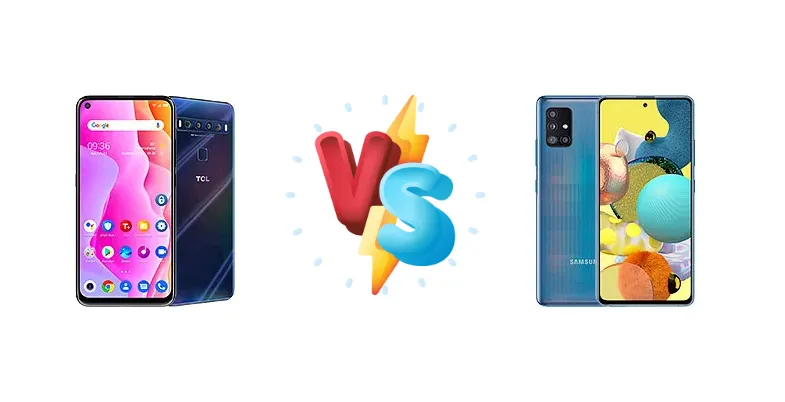
The TCL 10L and Samsung Galaxy A51 5G UW represent different approaches to the mid-range smartphone market. The TCL 10L aimed for affordability with a focus on core features, while the A51 5G UW brought 5G connectivity and a more polished experience to a slightly higher price point. This comparison dissects the key differences, focusing on the performance implications of their respective chipsets.
🏆 Quick Verdict
For the average user prioritizing future-proofing and smoother multitasking, the Samsung Galaxy A51 5G UW is the better choice. Its Snapdragon 765G offers a significant performance uplift over the TCL 10L’s Snapdragon 665, justifying the price difference for those who demand more from their smartphone.
| Network |
|---|
| 2G bands | GSM 850 / 900 / 1800 / 1900 | GSM 850 / 900 / 1800 / 1900 |
| 3G bands | HSDPA 850 / 900 / 1700(AWS) / 1900 / 2100 | HSDPA 850 / 900 / 1900 / 2100 |
| 4G bands | 1, 2, 3, 4, 5, 7, 8, 12, 13, 17, 25, 26, 28, 38, 40, 41, 66 | 2, 4, 5, 13, 66 |
| 5G bands | - | 260, 261 mmWave |
| Speed | HSPA 42.2/5.76 Mbps, LTE (2CA) Cat13 400/75 Mbps | HSPA, LTE, 5G |
| Technology | GSM / HSPA / LTE | GSM / HSPA / LTE / 5G |
| | 1, 3, 5, 7, 8, 20, 28, 38, 40, 41 | - |
| Launch |
|---|
| Announced | 2020, April 06. Released 2020, May 19 | 2020, August 14 |
| Status | Discontinued | Available. Released 2020, August 14 |
| Body |
|---|
| Build | - | Glass front (Gorilla Glass 3), plastic back, aluminum frame |
| Dimensions | 162.2 x 75.6 x 8.4 mm (6.39 x 2.98 x 0.33 in) | 158.8 x 73.4 x 8.6 mm (6.25 x 2.89 x 0.34 in) |
| SIM | · Nano-SIM· Nano-SIM + Nano-SIM | Nano-SIM (pre-installed) |
| Weight | 180 g (6.35 oz) | 188.8 g (6.67 oz) |
| Display |
|---|
| Protection | - | Corning Gorilla Glass 3 |
| Resolution | 1080 x 2340 pixels, 19.5:9 ratio (~395 ppi density) | 1080 x 2400 pixels, 20:9 ratio (~405 ppi density) |
| Size | 6.53 inches, 104.7 cm2 (~85.4% screen-to-body ratio) | 6.5 inches, 102.0 cm2 (~87.5% screen-to-body ratio) |
| Type | IPS LCD, HDR | Super AMOLED |
| Platform |
|---|
| CPU | Octa-core (4x2.0 GHz Kryo 260 Gold & 4x1.8 GHz Kryo 260 Silver) | Octa-core (1x2.4 GHz Kryo 475 Prime & 1x2.2 GHz Kryo 475 Gold & 6x1.8 GHz Kryo 475 Silver) |
| Chipset | Qualcomm SM6125 Snapdragon 665 (11 nm) | Qualcomm SM7250 Snapdragon 765G 5G (7 nm) |
| GPU | Adreno 610 | Adreno 620 |
| OS | Android 10, upgradable to Android 11, TCL UI | Android 10, One UI 2 |
| Memory |
|---|
| Card slot | microSDXC (uses shared SIM slot) | microSDXC (uses shared SIM slot) |
| Internal | 64GB 6GB RAM, 128GB 6GB RAM, 256GB 6GB RAM | 128GB 6GB RAM |
| | 64GB eMMC 5.1, 128/256GB UFS 2.1 | UFS 2.1 |
| Main Camera |
|---|
| Features | Dual-LED flash, HDR, panorama | LED flash, panorama, HDR |
| Quad | 48 MP, f/1.8, 26mm (wide), 1/2.25", 0.8µm, PDAF
8 MP, f/2.2, 13mm (ultrawide), 1/4.0", 1.12µm
2 MP (macro)
Auxiliary lens | 48 MP, f/2.0, 26mm (wide), 1/2.0", 0.8µm, PDAF
12 MP, f/2.2, 123˚ (ultrawide)
5 MP (macro)
Auxiliary lens |
| Single | - | 5 MP, AF |
| Video | 4K@30fps, 1080p@30/120fps | 4K@30fps, 1080p@30/120fps; gyro-EIS |
| Selfie camera |
|---|
| Features | - | HDR |
| Single | 16 MP, f/2.2, 28mm (wide), 1/3.06", 1.0µm | 32 MP, f/2.2, 26mm (wide), 1/2.8", 0.8µm |
| Video | 1080p@30fps | 4K@30fps, 1080p@30fps |
| Sound |
|---|
| 3.5mm jack | Yes | Yes |
| 35mm jack | Yes | Yes |
| Loudspeaker | Yes | Yes |
| Comms |
|---|
| Bluetooth | 5.0, A2DP, LE, aptX | 5.0, A2DP, LE |
| NFC | Yes | Yes |
| Positioning | GPS, GALILEO | GPS, GLONASS, GALILEO, BDS |
| Radio | FM radio | FM radio, RDS, recording |
| USB | USB Type-C 2.0, OTG | USB Type-C 2.0, OTG |
| WLAN | Wi-Fi 802.11 a/b/g/n/ac, dual-band, Wi-Fi Direct | Wi-Fi 802.11 a/b/g/n/ac, dual-band, Wi-Fi Direct |
| Features |
|---|
| Sensors | Fingerprint (rear-mounted), accelerometer, gyro, proximity, compass | Fingerprint (under display, optical), accelerometer, gyro, proximity, compass |
| | - | ANT+ |
| Battery |
|---|
| Charging | - | 15W wired |
| Stand-by | - | Up to 672 h |
| Talk time | - | Up to 5 h |
| Type | Li-Po 4000 mAh | Li-Po 4500 mAh |
| Misc |
|---|
| Colors | Arctic White, Mariana Blue | Prism Bricks Blue |
| Models | T770H, T770B, 4187U | SM-A516V |
| Price | About 140 EUR | About 470 EUR |
| SAR | - | 0.70 W/kg (head) 1.25 W/kg (body) |
| SAR EU | - | 0.59 W/kg (head) 1.32 W/kg (body) |
TCL 10L
- Potentially lower price point
- Functional and reliable for basic tasks
- May offer expandable storage (typical for TCL)
- Significantly weaker performance compared to the A51 5G UW
- Less efficient chipset leading to potentially shorter battery life
- Limited gaming capabilities
Samsung Galaxy A51 5G UW
- Faster and more responsive performance with Snapdragon 765G
- 5G connectivity for faster data speeds
- More efficient chipset for better battery life
- Higher price point
- 15W charging is relatively slow
- Samsung’s software can be bloated
Display Comparison
Neither TCL nor Samsung provided display specs beyond the device names. Assuming typical LCD panels for this price bracket, the display experience will likely be similar in terms of color accuracy. However, the A51 5G UW’s potential for a higher refresh rate (common in the A51 series, though not confirmed for this UW variant) would provide a smoother scrolling experience. Bezels are likely comparable, reflecting the mid-range positioning of both devices.
Camera Comparison
Without detailed sensor information, a direct camera comparison is difficult. However, Samsung generally excels in image processing, and the A51 5G UW likely benefits from more sophisticated algorithms. The Snapdragon 765G’s image signal processor (ISP) is also more advanced than the 665’s, potentially leading to better dynamic range and low-light performance. The TCL 10L likely relies on software enhancements to compensate for a potentially less capable sensor. The presence of a 2MP macro lens on either device is largely a marketing gimmick and offers minimal practical benefit.
Performance
The core difference lies in the chipsets. The Samsung Galaxy A51 5G UW’s Snapdragon 765G, built on a 7nm process, represents a substantial leap over the TCL 10L’s Snapdragon 665 (11nm). The 765G’s Kryo 475 Prime core at 2.4GHz provides a significant single-core performance advantage, crucial for app launch speeds and responsiveness. The 765G also boasts a more powerful Adreno 620 GPU, enabling smoother gaming experiences. The 7nm process also translates to better thermal efficiency, reducing the likelihood of throttling during sustained workloads. The TCL 10L’s Snapdragon 665, while capable for everyday tasks, will struggle with demanding games and multitasking.
Battery Life
Battery capacity is not specified for either device. However, the Snapdragon 765G’s 7nm process contributes to better power efficiency, potentially offsetting a smaller battery capacity in the A51 5G UW. The A51 5G UW’s 15W wired charging is a standard offering, while the TCL 10L’s charging speed is unknown. Real-world battery life will depend heavily on usage patterns, but the A51 5G UW’s more efficient chipset gives it an edge.
Buying Guide
Buy the TCL 10L if you need a functional, affordable smartphone for basic tasks like calling, texting, and light social media use, and 5G isn't a priority. Buy the Samsung Galaxy A51 5G UW if you want a more responsive experience, benefit from 5G connectivity, and anticipate using more demanding apps or occasional gaming. The A51 5G UW is also the better option for users who value a more established brand ecosystem.
Frequently Asked Questions
❓ Will the Samsung Galaxy A51 5G UW overheat during extended gaming sessions?
The Snapdragon 765G’s 7nm process and Samsung’s thermal management solutions should prevent significant overheating during typical gaming sessions. While some throttling may occur during prolonged, demanding gameplay, it’s unlikely to be a major issue compared to the TCL 10L’s Snapdragon 665.
❓ Is the 5G connectivity on the A51 5G UW worth the extra cost if I don't have widespread 5G coverage in my area?
If 5G coverage is limited, the immediate benefit is reduced. However, purchasing the A51 5G UW future-proofs your device for when 5G becomes more prevalent. The Snapdragon 765G also offers improved 4G LTE performance compared to the Snapdragon 665, providing a benefit even without 5G.
❓ Can the TCL 10L handle popular games like PUBG Mobile or Call of Duty Mobile?
The TCL 10L can *run* these games, but expect significantly lower graphics settings and frame rates compared to the A51 5G UW. The Snapdragon 665 struggles with demanding titles, leading to stuttering and a less enjoyable gaming experience. It's best suited for casual gaming.