
TCL 10L vs OnePlus Nord N100: A Deep Dive into Budget Chipsets
| Phones Images | |||||
|---|---|---|---|---|---|
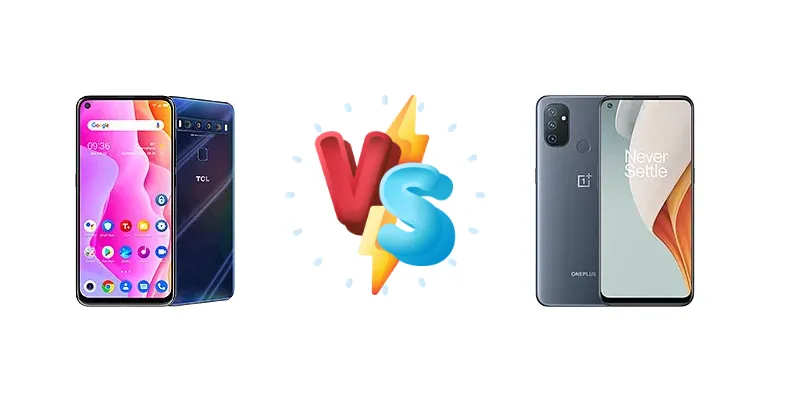
|
🏆 Quick Verdict
For the average user prioritizing responsiveness and smoother multitasking, the TCL 10L emerges as the better choice. Its Snapdragon 665, despite being an older architecture, offers a noticeable performance advantage over the Nord N100’s Snapdragon 460. While the Nord N100 gains 18W charging, the performance trade-off isn't worth it for most.
| PHONES | ||
|---|---|---|
| Phone Names | TCL 10L | OnePlus Nord N100 |
| Network | ||
|---|---|---|
| 2G bands | GSM 850 / 900 / 1800 / 1900 | GSM 850 / 900 / 1800 / 1900 |
| 3G bands | HSDPA 850 / 900 / 1700(AWS) / 1900 / 2100 | HSDPA 850 / 900 / 1700(AWS) / 1900 / 2100 |
| 4G bands | 1, 2, 3, 4, 5, 7, 8, 12, 13, 17, 25, 26, 28, 38, 40, 41, 66 | 1, 2, 3, 4, 5, 7, 8, 12, 17, 20, 28, 38, 40, 41 - International |
| Speed | HSPA 42.2/5.76 Mbps, LTE (2CA) Cat13 400/75 Mbps | HSPA 42.2/5.76 Mbps, LTE Cat13 400/50 Mbps |
| Technology | GSM / HSPA / LTE | GSM / CDMA / HSPA / LTE |
| 1, 3, 5, 7, 8, 20, 28, 38, 40, 41 | 1, 2, 3, 4, 5, 7, 8, 12, 13, 17, 20, 25, 26, 28, 38, 41, 66, 71 - USA | |
| Launch | ||
|---|---|---|
| Announced | 2020, April 06. Released 2020, May 19 | 2020, October 26 |
| Status | Discontinued | Available. Released 2020, November 11 |
| Body | ||
|---|---|---|
| Build | - | Glass front (Gorilla Glass 3), plastic frame |
| Dimensions | 162.2 x 75.6 x 8.4 mm (6.39 x 2.98 x 0.33 in) | 164.9 x 75.1 x 8.5 mm (6.49 x 2.96 x 0.33 in) |
| SIM | · Nano-SIM· Nano-SIM + Nano-SIM | Nano-SIM + Nano-SIM |
| Weight | 180 g (6.35 oz) | 188 g (6.63 oz) |
| Display | ||
|---|---|---|
| Protection | - | Corning Gorilla Glass 3 |
| Resolution | 1080 x 2340 pixels, 19.5:9 ratio (~395 ppi density) | 720 x 1600 pixels, 20:9 ratio (~269 ppi density) |
| Size | 6.53 inches, 104.7 cm2 (~85.4% screen-to-body ratio) | 6.52 inches, 102.6 cm2 (~82.9% screen-to-body ratio) |
| Type | IPS LCD, HDR | IPS LCD, 90Hz |
| Platform | ||
|---|---|---|
| CPU | Octa-core (4x2.0 GHz Kryo 260 Gold & 4x1.8 GHz Kryo 260 Silver) | Octa-core (4x1.8 GHz Kryo 240 & 4x1.6 GHz Kryo 240) |
| Chipset | Qualcomm SM6125 Snapdragon 665 (11 nm) | Qualcomm SM4250 Snapdragon 460 (11 nm) |
| GPU | Adreno 610 | Adreno 610 |
| OS | Android 10, upgradable to Android 11, TCL UI | Android 10, OxygenOS 10.5.9 |
| Memory | ||
|---|---|---|
| Card slot | microSDXC (uses shared SIM slot) | microSDXC |
| Internal | 64GB 6GB RAM, 128GB 6GB RAM, 256GB 6GB RAM | 64GB 4GB RAM |
| 64GB eMMC 5.1, 128/256GB UFS 2.1 | UFS 2.1 | |
| Main Camera | ||
|---|---|---|
| Features | Dual-LED flash, HDR, panorama | LED flash, HDR, panorama |
| Quad | 48 MP, f/1.8, 26mm (wide), 1/2.25", 0.8µm, PDAF 8 MP, f/2.2, 13mm (ultrawide), 1/4.0", 1.12µm 2 MP (macro) Auxiliary lens | - |
| Triple | - | 13 MP, f/2.2, (wide), PDAF 2 MP (macro) Auxiliary lens |
| Video | 4K@30fps, 1080p@30/120fps | 1080p@30fps, gyro-EIS |
| Selfie camera | ||
|---|---|---|
| Features | - | HDR |
| Single | 16 MP, f/2.2, 28mm (wide), 1/3.06", 1.0µm | 8 MP, f/2.0 |
| Video | 1080p@30fps | 1080p@30fps |
| Sound | ||
|---|---|---|
| 3.5mm jack | Yes | Yes |
| 35mm jack | Yes | Yes |
| Loudspeaker | Yes | Yes, with stereo speakers |
| Comms | ||
|---|---|---|
| Bluetooth | 5.0, A2DP, LE, aptX | 5.0, A2DP, LE |
| NFC | Yes | - |
| Positioning | GPS, GALILEO | GPS, GLONASS, GALILEO, BDS |
| Radio | FM radio | FM radio |
| USB | USB Type-C 2.0, OTG | USB Type-C 2.0, OTG |
| WLAN | Wi-Fi 802.11 a/b/g/n/ac, dual-band, Wi-Fi Direct | Wi-Fi 802.11 a/b/g/n/ac, dual-band, Wi-Fi Direct |
| Features | ||
|---|---|---|
| Sensors | Fingerprint (rear-mounted), accelerometer, gyro, proximity, compass | Fingerprint (rear-mounted), accelerometer, gyro, proximity, compass |
| Battery | ||
|---|---|---|
| Charging | - | 18W wired |
| Type | Li-Po 4000 mAh | Li-Po 5000 mAh |
| Misc | ||
|---|---|---|
| Colors | Arctic White, Mariana Blue | Midnight Frost |
| Models | T770H, T770B, 4187U | BE2013, BE2015, BE2011, BE2012 |
| Price | About 140 EUR | About 80 EUR |
| Pricing | ||
|---|---|---|
| 64GB 4GB RAM | - | $ 125.00 |
| RENEWED | - | $ 129.00 |
TCL 10L
- More powerful Snapdragon 665 chipset
- Potentially better camera image processing
- Smoother multitasking experience
- Likely lacks fast charging support
- May have a less modern design
OnePlus Nord N100
- 18W fast charging support
- Potentially lower price point
- More readily available in some markets
- Less powerful Snapdragon 460 chipset
- Slower app loading times
- Less responsive user interface
Display Comparison
Neither TCL nor OnePlus provide display specs beyond resolution in their marketing materials. However, both likely utilize IPS LCD panels common in this price bracket. The key difference lies in the processing power driving them. The Snapdragon 665 in the TCL 10L has a more powerful GPU, potentially leading to slightly smoother scrolling and animations, even with similar panel characteristics. Without detailed brightness or color accuracy data, it’s difficult to declare a clear winner, but the TCL 10L’s chipset gives it a slight edge in potential display performance.
Camera Comparison
Detailed camera specs are lacking for both devices. However, given the price point, it’s safe to assume both rely on budget sensors. The focus should be on image processing capabilities, which are tied to the chipset. The Snapdragon 665’s superior image signal processor (ISP) in the TCL 10L will likely result in better dynamic range and noise reduction compared to the Nord N100. Without sample images, it’s impossible to definitively say, but the TCL 10L has a hardware advantage in this area.
Performance
The core of this comparison is the chipset. The TCL 10L’s Snapdragon 665 features an octa-core CPU with 4x2.0 GHz Kryo 260 Gold and 4x1.8 GHz Kryo 260 Silver cores, built on an 11nm process. The OnePlus Nord N100’s Snapdragon 460 uses an octa-core CPU with 4x1.8 GHz Kryo 240 and 4x1.6 GHz Kryo 240 cores, also on an 11nm process. While both are 11nm, the Kryo 260 cores in the 665 are architecturally more advanced, offering better single-core and multi-core performance. This translates to faster app loading times and a more fluid experience when multitasking. The Snapdragon 665 also boasts a more capable Adreno 610 GPU compared to the 460’s Adreno 610, providing a better gaming experience, though neither phone is a gaming powerhouse.
Battery Life
Battery capacity isn’t specified for the TCL 10L, but the Nord N100’s battery life will be heavily influenced by the less efficient Snapdragon 460. While the Nord N100 offers 18W wired charging, a feature absent in the TCL 10L, the Snapdragon 665’s efficiency could potentially offset the charging advantage. The 18W charging on the Nord N100 will reduce charging times, but the overall daily battery experience will depend on usage patterns and the TCL 10L’s actual battery capacity.
Buying Guide
Buy the TCL 10L if you need a phone that feels more responsive for everyday tasks like browsing, social media, and light gaming. It’s the better option for users who value a smoother user experience. Buy the OnePlus Nord N100 if you prioritize faster charging and are willing to accept a slight performance hit. It’s a reasonable choice for users who primarily use their phone for calls, texts, and very basic app usage.