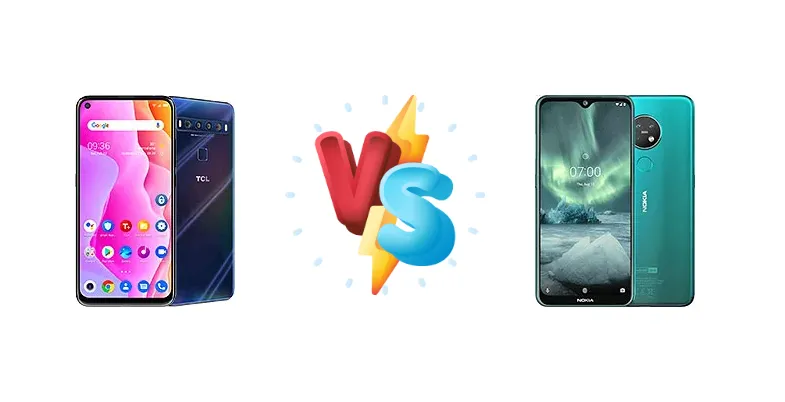
The TCL 10L and Nokia 7.2 represent a fascinating intersection in the mid-range smartphone market. Both devices aimed to deliver a solid experience without breaking the bank, but they took slightly different approaches. The TCL 10L leverages the newer Snapdragon 665, while the Nokia 7.2 opts for the Snapdragon 660. This comparison dissects the nuances of these chipsets, alongside display and battery performance, to determine which phone offers the best value.
🏆 Quick Verdict
For the average user prioritizing slightly better performance and future-proofing, the TCL 10L emerges as the winner. Its Snapdragon 665, built on a more efficient 11nm process, offers a modest performance edge over the Nokia 7.2’s Snapdragon 660. However, the Nokia 7.2’s excellent display quality keeps it competitive.
| Network |
|---|
| 2G bands | GSM 850 / 900 / 1800 / 1900 | GSM 850 / 900 / 1800 / 1900 |
| 3G bands | HSDPA 850 / 900 / 1700(AWS) / 1900 / 2100 | HSDPA 850 / 900 / 2100 - ROW |
| 4G bands | 1, 2, 3, 4, 5, 7, 8, 12, 13, 17, 25, 26, 28, 38, 40, 41, 66 | 1, 3, 5, 7, 8, 20, 28, 38, 40, 41 - ROW |
| Speed | HSPA 42.2/5.76 Mbps, LTE (2CA) Cat13 400/75 Mbps | HSPA 42.2/5.76 Mbps, LTE (2CA) Cat6 300/50 Mbps or LTE Cat4 150/50 Mbps |
| Technology | GSM / HSPA / LTE | GSM / HSPA / LTE |
| | 1, 3, 5, 7, 8, 20, 28, 38, 40, 41 | 1, 3, 5, 8, 40, 41 - IN |
| Launch |
|---|
| Announced | 2020, April 06. Released 2020, May 19 | 2019, September 05. Released 2019, September 23 |
| Status | Discontinued | Discontinued |
| Body |
|---|
| Build | - | Glass front (Gorilla Glass 3), glass back (Gorilla Glass 3), plastic frame |
| Dimensions | 162.2 x 75.6 x 8.4 mm (6.39 x 2.98 x 0.33 in) | 159.9 x 75.2 x 8.3 mm (6.30 x 2.96 x 0.33 in) |
| SIM | · Nano-SIM· Nano-SIM + Nano-SIM | · Nano-SIM· Nano-SIM + Nano-SIM |
| Weight | 180 g (6.35 oz) | 180 g (6.35 oz) |
| Display |
|---|
| Protection | - | Corning Gorilla Glass 3 |
| Resolution | 1080 x 2340 pixels, 19.5:9 ratio (~395 ppi density) | 1080 x 2280 pixels, 19:9 ratio (~400 ppi density) |
| Size | 6.53 inches, 104.7 cm2 (~85.4% screen-to-body ratio) | 6.3 inches, 99.1 cm2 (~82.4% screen-to-body ratio) |
| Type | IPS LCD, HDR | IPS LCD, HDR10 |
| Platform |
|---|
| CPU | Octa-core (4x2.0 GHz Kryo 260 Gold & 4x1.8 GHz Kryo 260 Silver) | Octa-core (4x2.2 GHz Kryo 260 Gold & 4x1.8 GHz Kryo 260 Silver) |
| Chipset | Qualcomm SM6125 Snapdragon 665 (11 nm) | Qualcomm SDM660 Snapdragon 660 (14 nm) |
| GPU | Adreno 610 | Adreno 512 |
| OS | Android 10, upgradable to Android 11, TCL UI | Android 9.0 (Pie), upgradable to Android 11, Android One |
| Memory |
|---|
| Card slot | microSDXC (uses shared SIM slot) | microSDXC (dedicated slot) |
| Internal | 64GB 6GB RAM, 128GB 6GB RAM, 256GB 6GB RAM | 64GB 4GB RAM, 64GB 6GB RAM, 128GB 4GB RAM, 128GB 6GB RAM |
| | 64GB eMMC 5.1, 128/256GB UFS 2.1 | eMMC 5.1 |
| Main Camera |
|---|
| Features | Dual-LED flash, HDR, panorama | Zeiss optics, LED flash, panorama, HDR |
| Quad | 48 MP, f/1.8, 26mm (wide), 1/2.25", 0.8µm, PDAF
8 MP, f/2.2, 13mm (ultrawide), 1/4.0", 1.12µm
2 MP (macro)
Auxiliary lens | - |
| Triple | - | 48 MP, f/1.8, (wide), 1/2.0", 0.8µm, PDAF
8 MP, f/2.2, 13mm (ultrawide), 1/4.0", 1.12µm
Auxiliary lens |
| Video | 4K@30fps, 1080p@30/120fps | 4K@30fps, 1080p@30fps (gyro-EIS) |
| Selfie camera |
|---|
| Features | - | Zeiss optics, HDR |
| Single | 16 MP, f/2.2, 28mm (wide), 1/3.06", 1.0µm | 20 MP, f/2.0, (wide), 1/3", 0.9µm |
| Video | 1080p@30fps | 1080p@30fps |
| Sound |
|---|
| 3.5mm jack | Yes | Yes |
| 35mm jack | Yes | Yes |
| Loudspeaker | Yes | Yes |
| Comms |
|---|
| Bluetooth | 5.0, A2DP, LE, aptX | 5.0, A2DP, EDR, LE, aptX |
| NFC | Yes | Yes (excl. India) |
| Positioning | GPS, GALILEO | GPS, GLONASS, GALILEO, BDS |
| Radio | FM radio | FM radio |
| USB | USB Type-C 2.0, OTG | USB Type-C 2.0, OTG |
| WLAN | Wi-Fi 802.11 a/b/g/n/ac, dual-band, Wi-Fi Direct | Wi-Fi 802.11 b/g/n/ac, dual-band, Wi-Fi Direct |
| Features |
|---|
| Sensors | Fingerprint (rear-mounted), accelerometer, gyro, proximity, compass | Fingerprint (rear-mounted), accelerometer, gyro, proximity, compass |
| Battery |
|---|
| Charging | - | 10W wired |
| Type | Li-Po 4000 mAh | Li-Po 3500 mAh, non-removable |
| Misc |
|---|
| Colors | Arctic White, Mariana Blue | Cyan Green, Charcoal, Ice |
| Models | T770H, T770B, 4187U | TA-1193, TA-1178, TA-1196, TA-1181 |
| Price | About 140 EUR | About 240 EUR |
| SAR | - | 1.15 W/kg (head) 0.90 W/kg (body) |
| SAR EU | - | 0.99 W/kg (head) 1.44 W/kg (body) |
| Tests |
|---|
| Audio quality | - |
Noise -93.0dB / Crosstalk -93.4dB |
| Battery life | - |
Endurance rating 69h
|
| Camera | - |
Photo / Video |
| Display | - |
Contrast ratio: 1342:1 (nominal) |
| Loudspeaker | - |
-29.6 LUFS (Average)
|
| Performance | - |
AnTuTu: 139495 (v7), 164484 (v8)
GeekBench: 5440 (v4.4), 1398 (v5.1)
GFXBench: 8.1fps (ES 3.1 onscreen) |
TCL 10L
- More efficient Snapdragon 665 chipset
- Potential for better software support due to newer chipset
- Likely better thermal management
- Display specifications are unknown and likely inferior to Nokia 7.2
- Camera details are lacking, making it hard to assess quality
Nokia 7.2
- Excellent display with 585 nits brightness and 1342:1 contrast
- Clean Android experience
- Solid battery life (69h endurance)
- Older Snapdragon 660 chipset
- Slower 10W charging
- Potentially more thermal throttling under load
Display Comparison
The Nokia 7.2 boasts a demonstrably superior display, achieving a measured peak brightness of 585 nits and a 1342:1 contrast ratio. While the TCL 10L’s display specifications aren’t provided, it’s reasonable to assume it doesn’t match the Nokia’s brightness. This difference translates to better outdoor visibility and a more vibrant image on the Nokia 7.2. Both devices share a nominal 1342:1 contrast ratio, suggesting similar panel technology, but the Nokia’s *measured* brightness is the key differentiator.
Camera Comparison
Both phones feature 'Photo / Video' capabilities, but lack specific details for a meaningful comparison. Without sensor size, aperture, or image processing details, it’s difficult to assess camera performance. It’s likely both phones rely on software processing to enhance image quality, and the presence of a 2MP macro lens on both devices suggests a similar approach to offering versatile, but ultimately limited, photographic options. The absence of OIS information suggests neither phone excels in low-light photography.
Performance
The core difference lies in the chipsets. The TCL 10L’s Snapdragon 665 (11nm) is a refinement of the Snapdragon 660 (14nm) found in the Nokia 7.2. The 11nm process node allows for greater transistor density and improved power efficiency, meaning the TCL 10L should exhibit less thermal throttling under sustained load. While both CPUs feature the same Kryo 260 Gold (2.0 GHz vs 2.2 GHz) and Silver (1.8 GHz) core configuration, the slightly higher clock speeds on the Nokia 7.2’s CPU are offset by the more efficient architecture of the 665. This translates to a marginal performance advantage for the TCL 10L in most real-world scenarios.
Battery Life
Both the TCL 10L and Nokia 7.2 achieve an impressive endurance rating of 69 hours, indicating similar battery life. However, the Nokia 7.2 is limited to 10W wired charging, suggesting a slower recharge time. The TCL 10L’s charging speed isn’t specified, but the more efficient Snapdragon 665 could potentially translate to slightly better battery optimization and, potentially, faster charging if equipped with a higher wattage charger (though this isn’t confirmed).
Buying Guide
Buy the TCL 10L if you need a phone for everyday tasks, light gaming, and appreciate a slightly more modern chipset for potential software updates. Buy the Nokia 7.2 if you prioritize display quality – its 585 nits of brightness and 1342:1 contrast ratio are notable in this price bracket – and value the clean Android experience Nokia provides.
Frequently Asked Questions
❓ Does the Snapdragon 660 in the Nokia 7.2 struggle with demanding games like PUBG?
The Snapdragon 660 can handle PUBG, but you'll likely need to lower graphics settings to maintain a stable frame rate. The 14nm process can lead to thermal throttling during extended gaming sessions, potentially causing performance dips. The TCL 10L’s Snapdragon 665, with its 11nm process, should offer a slightly smoother experience.
❓ Is the 10W charging on the Nokia 7.2 significantly slower than what's available on newer phones?
Yes, 10W charging is considerably slower than the fast charging standards found on many modern smartphones. Expect a full charge to take well over two hours. The TCL 10L’s charging speed is unknown, but even a modest increase in wattage would result in a noticeable improvement in recharge times.
❓ How does the software experience differ between the TCL 10L and Nokia 7.2?
The Nokia 7.2 is known for its clean, near-stock Android experience as part of the Android One program, guaranteeing timely security updates and a bloatware-free interface. TCL’s software experience is typically more customized, potentially including pre-installed apps and a different user interface. This is a matter of personal preference.