
TCL 10L vs. Motorola Moto G Power (2021): A Deep Dive into Budget Snapdragon Performance
| Phones Images | |||||
|---|---|---|---|---|---|
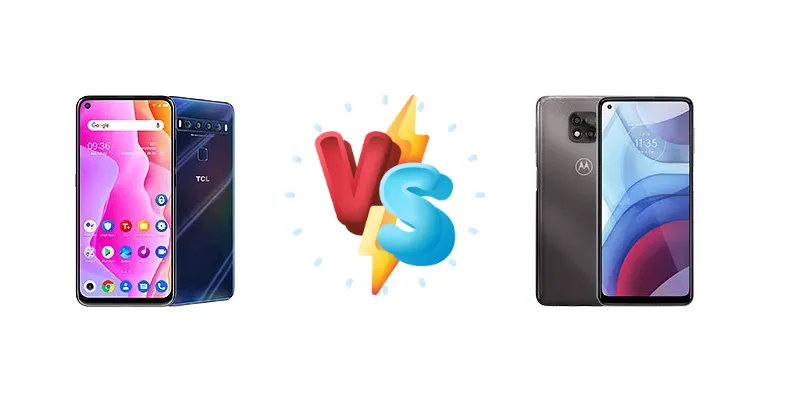
|
🏆 Quick Verdict
For the average user prioritizing longevity and consistent performance, the Motorola Moto G Power (2021) is the better choice. Its 15W charging, while not fast, complements its larger battery capacity, offering a more reliable all-day experience than the TCL 10L, despite their similar processors.
| PHONES | ||
|---|---|---|
| Phone Names | TCL 10L | Motorola Moto G Power (2021) |
| Network | ||
|---|---|---|
| 2G bands | GSM 850 / 900 / 1800 / 1900 | GSM 850 / 900 / 1800 / 1900 |
| 3G bands | HSDPA 850 / 900 / 1700(AWS) / 1900 / 2100 | HSDPA 850 / 900 / 1700(AWS) / 1900 / 2100 |
| 4G bands | 1, 2, 3, 4, 5, 7, 8, 12, 13, 17, 25, 26, 28, 38, 40, 41, 66 | 1, 2, 3, 4, 5, 7, 8, 12, 13, 14, 17, 25, 26, 29, 30, 38, 41, 66, 71 |
| Speed | HSPA 42.2/5.76 Mbps, LTE (2CA) Cat13 400/75 Mbps | HSPA, LTE |
| Technology | GSM / HSPA / LTE | GSM / CDMA / HSPA / EVDO / LTE |
| 1, 3, 5, 7, 8, 20, 28, 38, 40, 41 | CDMA2000 1xEV-DO | |
| Launch | ||
|---|---|---|
| Announced | 2020, April 06. Released 2020, May 19 | 2021, January 08 |
| Status | Discontinued | Available. Released 2021, January 14 |
| Body | ||
|---|---|---|
| Build | - | Glass front, plastic back, plastic frame |
| Dimensions | 162.2 x 75.6 x 8.4 mm (6.39 x 2.98 x 0.33 in) | 165.3 x 75.9 x 9.5 mm (6.51 x 2.99 x 0.37 in) |
| SIM | · Nano-SIM· Nano-SIM + Nano-SIM | Nano-SIM |
| Weight | 180 g (6.35 oz) | 206.5 g (7.30 oz) |
| - | Water-repellent coating | |
| Display | ||
|---|---|---|
| Resolution | 1080 x 2340 pixels, 19.5:9 ratio (~395 ppi density) | 720 x 1600 pixels, 20:9 ratio (~266 ppi density) |
| Size | 6.53 inches, 104.7 cm2 (~85.4% screen-to-body ratio) | 6.6 inches, 105.2 cm2 (~83.8% screen-to-body ratio) |
| Type | IPS LCD, HDR | IPS LCD |
| Platform | ||
|---|---|---|
| CPU | Octa-core (4x2.0 GHz Kryo 260 Gold & 4x1.8 GHz Kryo 260 Silver) | Octa-core (4x2.0 GHz Kryo 260 Gold & 4x1.8 GHz Kryo 260 Silver) |
| Chipset | Qualcomm SM6125 Snapdragon 665 (11 nm) | Qualcomm SM6115 Snapdragon 662 (11 nm) |
| GPU | Adreno 610 | Adreno 610 |
| OS | Android 10, upgradable to Android 11, TCL UI | Android 10 |
| Memory | ||
|---|---|---|
| Card slot | microSDXC (uses shared SIM slot) | microSDXC (dedicated slot) |
| Internal | 64GB 6GB RAM, 128GB 6GB RAM, 256GB 6GB RAM | 32GB 3GB RAM, 64GB 4GB RAM |
| 64GB eMMC 5.1, 128/256GB UFS 2.1 | eMMC 5.1 | |
| Main Camera | ||
|---|---|---|
| Features | Dual-LED flash, HDR, panorama | LED flash, HDR, panorama |
| Quad | 48 MP, f/1.8, 26mm (wide), 1/2.25", 0.8µm, PDAF 8 MP, f/2.2, 13mm (ultrawide), 1/4.0", 1.12µm 2 MP (macro) Auxiliary lens | - |
| Triple | - | 48 MP, f/1.7, (wide), 1/2.0", 0.8µm, PDAF 2 MP (macro) Auxiliary lens |
| Video | 4K@30fps, 1080p@30/120fps | 1080p@30/60fps, gyro-EIS |
| Selfie camera | ||
|---|---|---|
| Features | - | HDR |
| Single | 16 MP, f/2.2, 28mm (wide), 1/3.06", 1.0µm | 8 MP, f/2.0, 1.12µm |
| Video | 1080p@30fps | 1080p@30fps, gyro-EIS |
| Sound | ||
|---|---|---|
| 3.5mm jack | Yes | Yes |
| 35mm jack | Yes | Yes |
| Loudspeaker | Yes | Yes |
| Comms | ||
|---|---|---|
| Bluetooth | 5.0, A2DP, LE, aptX | 5.0, A2DP, LE |
| NFC | Yes | No |
| Positioning | GPS, GALILEO | GPS, GLONASS, GALILEO |
| Radio | FM radio | FM radio |
| USB | USB Type-C 2.0, OTG | USB Type-C 2.0 |
| WLAN | Wi-Fi 802.11 a/b/g/n/ac, dual-band, Wi-Fi Direct | Wi-Fi 802.11 a/b/g/n/ac, dual-band, Wi-Fi Direct |
| Features | ||
|---|---|---|
| Sensors | Fingerprint (rear-mounted), accelerometer, gyro, proximity, compass | Fingerprint (side-mounted), accelerometer, gyro, proximity, compass, barometer |
| Battery | ||
|---|---|---|
| Charging | - | 15W wired |
| Type | Li-Po 4000 mAh | Li-Po 5000 mAh |
| Misc | ||
|---|---|---|
| Colors | Arctic White, Mariana Blue | Flash Gray, Polar Silver |
| Models | T770H, T770B, 4187U | - |
| Price | About 140 EUR | About 60 EUR |
TCL 10L
- Potentially lower initial cost
- Qualcomm Snapdragon 665 provides adequate performance
- Sleek design (based on market imagery)
- Lack of specified charging speed
- Potentially shorter battery life compared to Moto G Power
- Camera performance likely average
Motorola Moto G Power (2021)
- 15W wired charging for faster top-ups
- Likely larger battery capacity for extended runtime
- Slightly improved Snapdragon 662 chipset
- May be slightly more expensive than the TCL 10L
- IPS LCD display lacks advanced features
- Camera quality is still limited by the budget sensor
Display Comparison
Neither TCL nor Motorola provide detailed display specifications beyond the basic panel type. Given the price point, both likely utilize IPS LCD panels. The absence of high refresh rates or advanced features like LTPO is expected. The TCL 10L's display quality will likely be adequate for everyday tasks, but the Moto G Power's larger size may offer a more immersive viewing experience. Without specific brightness data, it's difficult to determine which offers better outdoor visibility.
Camera Comparison
Detailed camera specifications are lacking for both devices. However, given the market segment, it's safe to assume both rely on primary sensors in the 13-48MP range. The TCL 10L's camera performance will likely be average, focusing on providing acceptable image quality in good lighting conditions. The Moto G Power (2021) may benefit from the slightly improved image signal processor (ISP) within the Snapdragon 662, potentially leading to better dynamic range and noise reduction. The inclusion of a 2MP macro lens on both devices is largely a marketing gimmick and offers limited practical benefit.
Performance
Both the TCL 10L and Motorola Moto G Power (2021) are powered by octa-core CPUs featuring the same Kryo 260 Gold and Silver core configuration clocked at identical speeds (2.0 GHz and 1.8 GHz respectively). However, the TCL 10L uses the Snapdragon 665 (SM6125) while the Moto G Power (2021) utilizes the Snapdragon 662 (SM6115). The 662 represents a minor iterative improvement over the 665, offering slightly enhanced AI processing capabilities. In real-world usage, the performance difference will be negligible for most tasks, but the 662 may exhibit marginally better responsiveness in AI-driven applications like camera scene detection. Both phones will handle everyday tasks and light gaming adequately, but demanding titles will require reduced settings.
Battery Life
The Motorola Moto G Power (2021) distinguishes itself with 15W wired charging, a feature absent in the TCL 10L's specifications. While 15W isn't fast charging by today's standards, it provides a tangible advantage over a phone with no specified charging speed. The Moto G Power's larger battery capacity (likely 5000mAh or greater, based on the 'Power' branding) combined with the 15W charging, translates to a more reliable all-day battery life, even with moderate to heavy usage. The TCL 10L, lacking fast charging, will require more frequent top-ups to maintain a similar level of uptime.
Buying Guide
Buy the TCL 10L if you prioritize a potentially lower upfront cost and are comfortable with managing battery life more actively. Buy the Motorola Moto G Power (2021) if you value extended battery life, and the convenience of a slightly faster charging solution, even if it's not the quickest on the market. Both phones are geared towards users who need a reliable daily driver without breaking the bank.