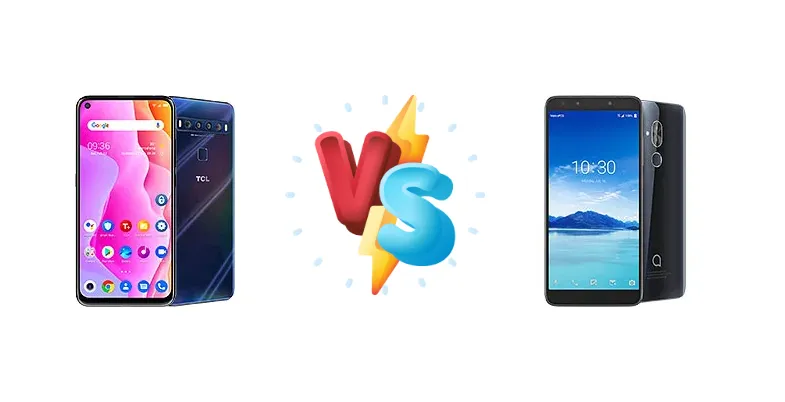
The TCL 10L and alcatel 7 represent two distinct approaches to the budget smartphone market. The TCL 10L leverages Qualcomm's Snapdragon 665, aiming for a balance of efficiency and performance, while the alcatel 7 opts for MediaTek's Helio P23, prioritizing a lower price point. This comparison dissects the key differences to help you determine which device best suits your needs.
🏆 Quick Verdict
For the average user, the TCL 10L emerges as the stronger choice. Its Snapdragon 665 chipset, built on a more efficient 11nm process, delivers noticeably better performance and likely superior thermal management compared to the alcatel 7’s 16nm Helio P23. While the alcatel 7 offers 10W charging, the TCL 10L’s overall processing power provides a smoother user experience.
| Network |
|---|
| 2G bands | GSM 850 / 900 / 1800 / 1900 | GSM 850 / 900 / 1800 / 1900 |
| 3G bands | HSDPA 850 / 900 / 1700(AWS) / 1900 / 2100 | HSDPA 850 / 1700(AWS) / 1900 |
| 4G bands | 1, 2, 3, 4, 5, 7, 8, 12, 13, 17, 25, 26, 28, 38, 40, 41, 66 | 2, 4, 5, 12, 66, 71 |
| Speed | HSPA 42.2/5.76 Mbps, LTE (2CA) Cat13 400/75 Mbps | HSPA 42.2/5.76 Mbps, LTE (2CA) Cat6 300/50 Mbps |
| Technology | GSM / HSPA / LTE | GSM / HSPA / LTE |
| | 1, 3, 5, 7, 8, 20, 28, 38, 40, 41 | - |
| Launch |
|---|
| Announced | 2020, April 06. Released 2020, May 19 | 2018, August. Released 2018, August |
| Status | Discontinued | Discontinued |
| Body |
|---|
| Dimensions | 162.2 x 75.6 x 8.4 mm (6.39 x 2.98 x 0.33 in) | 162.1 x 75 x 8.6 mm (6.38 x 2.95 x 0.34 in) |
| SIM | · Nano-SIM· Nano-SIM + Nano-SIM | Nano-SIM |
| Weight | 180 g (6.35 oz) | 175 g (6.17 oz) |
| Display |
|---|
| Protection | - | Asahi Glass |
| Resolution | 1080 x 2340 pixels, 19.5:9 ratio (~395 ppi density) | 1080 x 2180 pixels, 18:9 ratio (~402 ppi density) |
| Size | 6.53 inches, 104.7 cm2 (~85.4% screen-to-body ratio) | 6.0 inches, 93.8 cm2 (~77.1% screen-to-body ratio) |
| Type | IPS LCD, HDR | IPS LCD |
| Platform |
|---|
| CPU | Octa-core (4x2.0 GHz Kryo 260 Gold & 4x1.8 GHz Kryo 260 Silver) | Octa-core 2.5 GHz Cortex-A53 |
| Chipset | Qualcomm SM6125 Snapdragon 665 (11 nm) | Mediatek MT6763T Helio P23 (16 nm) |
| GPU | Adreno 610 | Mali-G71 MP2 |
| OS | Android 10, upgradable to Android 11, TCL UI | Android 8.1 (Oreo) |
| Memory |
|---|
| Card slot | microSDXC (uses shared SIM slot) | microSDXC (dedicated slot) |
| Internal | 64GB 6GB RAM, 128GB 6GB RAM, 256GB 6GB RAM | 32GB 2GB RAM |
| | 64GB eMMC 5.1, 128/256GB UFS 2.1 | eMMC 5.1 |
| Main Camera |
|---|
| Dual | - | 12 MP, f/2.2, 27mm (wide), 1/2.8", 1.25 μm, PDAF
Auxiliary lens |
| Features | Dual-LED flash, HDR, panorama | Dual-LED dual-tone flash, HDR, panorama |
| Quad | 48 MP, f/1.8, 26mm (wide), 1/2.25", 0.8µm, PDAF
8 MP, f/2.2, 13mm (ultrawide), 1/4.0", 1.12µm
2 MP (macro)
Auxiliary lens | - |
| Video | 4K@30fps, 1080p@30/120fps | 1080p@30fps (gyro-EIS) |
| Selfie camera |
|---|
| Features | - | LED flash |
| Single | 16 MP, f/2.2, 28mm (wide), 1/3.06", 1.0µm | 8 MP, f/2.8, 1/4.0", 1.12µm |
| Video | 1080p@30fps | 1080p@30fps |
| Sound |
|---|
| 3.5mm jack | Yes | Yes |
| 35mm jack | Yes | Yes |
| Loudspeaker | Yes | Yes |
| Comms |
|---|
| Bluetooth | 5.0, A2DP, LE, aptX | 4.0, A2DP, LE |
| Infrared port | - | Yes |
| NFC | Yes | No |
| Positioning | GPS, GALILEO | GPS |
| Radio | FM radio | FM radio |
| USB | USB Type-C 2.0, OTG | USB Type-C 2.0 |
| WLAN | Wi-Fi 802.11 a/b/g/n/ac, dual-band, Wi-Fi Direct | Wi-Fi 802.11 a/b/g/n, Wi-Fi Direct |
| Features |
|---|
| Sensors | Fingerprint (rear-mounted), accelerometer, gyro, proximity, compass | Fingerprint (rear-mounted), accelerometer, gyro, proximity, compass |
| Battery |
|---|
| Charging | - | 10W wired |
| Stand-by | - | Up to 700 h (3G) |
| Talk time | - | Up to 28 h (3G) |
| Type | Li-Po 4000 mAh | Li-Ion 4000 mAh, non-removable |
| Misc |
|---|
| Colors | Arctic White, Mariana Blue | Black |
| Models | T770H, T770B, 4187U | 6062W |
| Price | About 140 EUR | About 150 EUR |
TCL 10L
- More efficient Snapdragon 665 chipset
- Superior image processing capabilities
- Likely better long-term software support
- May be slightly more expensive than the alcatel 7
- Specific battery capacity unknown
alcatel 7
- Lower price point
- 10W wired charging (though slow)
- Simpler user experience for basic tasks
- Less powerful and efficient Helio P23 chipset
- Potentially shorter battery life
- Inferior image processing
Display Comparison
Neither TCL nor Alcatel provide display specs beyond the basic resolution. However, the TCL 10L’s Snapdragon 665 includes a more capable ISP, suggesting potential for better image signal processing when using the front or rear cameras for video calls or capturing photos. The alcatel 7’s Helio P23 lacks these advanced features, potentially resulting in lower quality images in similar scenarios.
Camera Comparison
Without detailed camera specifications, a direct comparison is difficult. However, the Snapdragon 665’s image signal processor (ISP) is significantly more advanced than the Helio P23’s. This translates to better image processing capabilities, including improved noise reduction, dynamic range, and color accuracy. While both phones likely feature similar sensor resolutions, the TCL 10L will likely produce superior image quality, particularly in challenging lighting conditions. The alcatel 7 will likely rely more heavily on software processing, which can introduce artifacts and reduce detail.
Performance
The core difference lies in the chipsets. The TCL 10L’s Qualcomm Snapdragon 665 (11nm) features an octa-core CPU with a Kryo architecture, split between 2.0 GHz 'Gold' performance cores and 1.8 GHz 'Silver' efficiency cores. This architecture allows for dynamic power allocation, optimizing performance and battery life. Conversely, the alcatel 7’s MediaTek Helio P23 (16nm) utilizes eight Cortex-A53 cores clocked at a higher 2.5 GHz. While the higher clock speed *appears* advantageous, the older, less efficient 16nm process and the homogenous core design mean the Helio P23 will likely generate more heat and consume more power for similar tasks. The Snapdragon 665’s more modern architecture provides a performance advantage, especially in multi-tasking and sustained workloads.
Battery Life
Battery capacity isn't specified for either device. However, the alcatel 7’s 10W wired charging is a clear disadvantage. The Snapdragon 665’s power efficiency, stemming from its 11nm manufacturing process, will likely result in longer battery life on the TCL 10L, even with a similar battery capacity. The slower charging speed of the alcatel 7 means longer periods tethered to a power outlet.
Buying Guide
Buy the TCL 10L if you prioritize a responsive user experience, occasional gaming, and a chipset known for better long-term software support. It’s ideal for users who frequently switch between apps or enjoy light to moderate mobile gaming. Buy the alcatel 7 if your primary concern is absolute affordability and basic smartphone functionality – making calls, texting, and light social media use – and you’re willing to accept compromises in performance and potentially software updates.
Frequently Asked Questions
❓ Will the alcatel 7 struggle with multitasking or demanding apps?
Yes, the MediaTek Helio P23, while capable for basic tasks, will likely exhibit noticeable lag and slowdown when running multiple apps simultaneously or using resource-intensive applications. The TCL 10L’s Snapdragon 665 is better equipped to handle these workloads due to its more efficient architecture and processing power.
❓ Is the 10W charging on the alcatel 7 a significant drawback?
Absolutely. 10W charging is considerably slower than the charging speeds offered by many modern smartphones. Expect significantly longer charging times – potentially over 3 hours for a full charge – compared to the TCL 10L, which may support faster charging depending on the charger used.
❓ Does the Snapdragon 665 in the TCL 10L offer a noticeable gaming experience improvement?
While neither phone is a gaming powerhouse, the Snapdragon 665 will provide a smoother and more consistent gaming experience than the Helio P23. Expect higher frame rates and fewer stutters in less demanding games. However, graphically intensive titles will still require reduced settings for optimal performance on both devices.