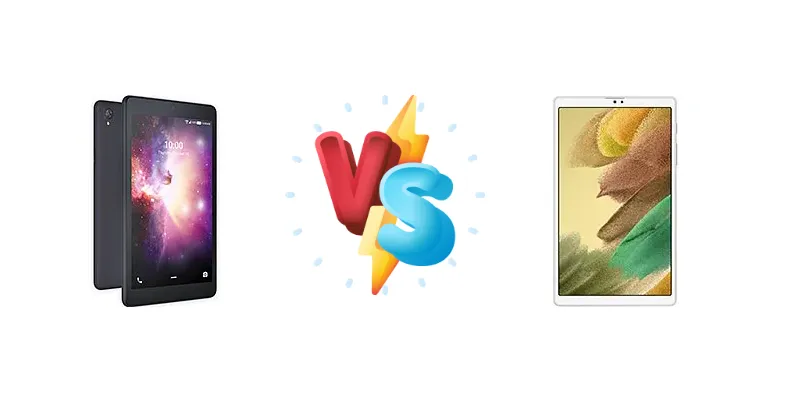
The sub-$200 tablet market is fiercely competitive, offering a compelling entry point for casual users, students, and families. The TCL 10 TabMid and Samsung Galaxy Tab A7 Lite represent two strong contenders, each leveraging different chipsets and design philosophies. This comparison dissects their strengths and weaknesses to determine which tablet delivers the best overall experience.
🏆 Quick Verdict
For most users, the TCL 10 TabMid emerges as the stronger choice. Its Qualcomm Snapdragon 665 chipset, built on an 11nm process, provides a noticeable performance edge over the Samsung Galaxy Tab A7 Lite’s MediaTek Helio P22T (12nm), translating to smoother multitasking and a more responsive user interface. While charging is slightly slower, the performance benefit justifies the trade-off.
| Network |
|---|
| 2G bands | GSM 850 / 900 / 1800 / 1900 | GSM 850 / 900 / 1800 / 1900 |
| 3G bands | HSDPA 850 / 900 / 1900 / 2100 | HSDPA 850 / 900 / 1700(AWS) / 1900 / 2100 |
| 4G bands | 1, 3, 5, 7, 8, 18, 19, 20, 26, 28, 34, 38, 39, 40, 41 | 1, 2, 3, 4, 5, 7, 8, 12, 17, 20, 28, 38, 40, 66 |
| Speed | HSPA 42.2/11.5 Mbps, LTE Cat4 150/50 Mbps | HSPA, LTE - cellular model only |
| Technology | GSM / HSPA / LTE | GSM / HSPA / LTE |
| Launch |
|---|
| Announced | 2020, September 03. Released 2021, Q1 | 2021, May 27 |
| Status | Discontinued | Available. Released 2021, June 18 |
| Body |
|---|
| Build | - | Glass front, aluminum back, aluminum frame, plastic ends |
| Dimensions | 209.4 x 125.2 x 8.6 mm (8.24 x 4.93 x 0.34 in) | 212.5 x 124.7 x 8 mm (8.37 x 4.91 x 0.31 in) |
| SIM | Nano-SIM | Nano-SIM (cellular model only) |
| Weight | 325 g (11.46 oz) | 366 g (Wi-Fi), 371 g (LTE) (12.91 oz) |
| Display |
|---|
| Resolution | 1200 x 1920 pixels, 16:10 ratio (~283 ppi density) | 800 x 1340 pixels, 5:3 ratio (~179 ppi density) |
| Size | 8.0 inches, 185.6 cm2 (~70.8% screen-to-body ratio) | 8.7 inches, 214.9 cm2 (~81.1% screen-to-body ratio) |
| Type | IPS LCD | TFT LCD |
| Platform |
|---|
| CPU | Octa-core (4x2.0 GHz Kryo 260 Gold & 4x1.8 GHz Kryo 260 Silver) | Octa-core (4x2.3 GHz Cortex-A53 & 4x1.8 GHz Cortex-A53) |
| Chipset | Qualcomm SM6125 Snapdragon 665 (11 nm) | Mediatek MT8768T Helio P22T (12 nm) |
| GPU | Adreno 610 | PowerVR GE8320 |
| OS | Android 10, TCL UI | Android 11, upgradable to Android 14, One UI 6.1 |
| Memory |
|---|
| Card slot | microSDXC (dedicated slot) | microSDXC (dedicated slot) |
| Internal | 32GB 3GB RAM | 32GB 2GB RAM, 32GB 3GB RAM, 64GB 4GB RAM |
| | eMMC 5.1 | eMMC 5.1 |
| Main Camera |
|---|
| Features | LED flash | - |
| Single | 5 MP, f/2.0, (wide), 1/4.0", 1.12µm | 8 MP, AF |
| Video | 1080p@30fps | 1080p@30fps |
| Selfie camera |
|---|
| Single | 5 MP, f/2.4, (wide), 1/5.0", 1.12µm | 2 MP |
| Video | 1080p@30fps | - |
| Sound |
|---|
| 3.5mm jack | Yes | Yes |
| 35mm jack | Yes | Yes |
| Loudspeaker | Yes | Yes, with stereo speakers |
| Comms |
|---|
| Bluetooth | 5.0, A2DP, LE | 5.0, A2DP, LE |
| NFC | No | No |
| Positioning | GPS | GPS, GLONASS, BDS, GALILEO - cellular model only |
| Radio | No | No |
| USB | USB Type-C 2.0, OTG | USB Type-C 2.0 |
| WLAN | Wi-Fi 802.11 a/b/g/n/ac, dual-band, Wi-Fi Direct | Wi-Fi 802.11 a/b/g/n/ac, dual-band, Wi-Fi Direct |
| Features |
|---|
| Sensors | Accelerometer | Accelerometer, compass |
| Battery |
|---|
| Charging | 18W wired
Reverse wired | 15W wired |
| Type | Li-Po 5500 mAh | Li-Po 5100 mAh |
| Misc |
|---|
| Colors | Prime Black | Gray, Silver |
| Models | - | SM-T225, SM-T220, SM-T225N, SM-T227U |
| Price | About 230 EUR | About 140 EUR |
| SAR | - | 0.68 W/kg (body) |
| SAR EU | - | 0.64 W/kg (head) 0.99 W/kg (body) |
TCL 10 TabMid
- Stronger processor for smoother performance
- Faster 18W charging
- Reverse wired charging capability
- Brand recognition is lower than Samsung
- Software updates may be less frequent
Samsung Galaxy Tab A7 Lite
- Well-known Samsung brand and ecosystem
- Potentially more refined software experience (One UI)
- Compact and lightweight design
- Less powerful processor
- Slower 15W charging
- May exhibit more throttling under sustained load
Display Comparison
Neither TCL nor Samsung provide detailed display specs beyond resolution. However, the choice of panel technology and manufacturing process impacts performance. While both likely utilize IPS LCDs, the lack of information on peak brightness and color gamut makes a direct comparison difficult. Bezels are expected to be similar on both devices, typical for this price point. The absence of high refresh rate panels is standard, focusing on power efficiency.
Camera Comparison
Camera performance is unlikely to be a deciding factor for either tablet. Both are equipped with basic camera setups geared towards casual snapshots. Detailed sensor information is unavailable, but given the price point, expectations should be tempered. Focusing on the primary sensor is key; any secondary sensors (often 2MP macro lenses) are unlikely to deliver significant value. Image processing will likely favor Samsung’s typically vibrant style, while TCL may lean towards a more natural look.
Performance
The core difference lies in the chipsets. The TCL 10 TabMid’s Qualcomm Snapdragon 665, fabricated on an 11nm process, boasts a more efficient architecture than the Samsung Galaxy Tab A7 Lite’s MediaTek Helio P22T (12nm). The Snapdragon 665’s Kryo 260 cores (4x2.0 GHz Gold & 4x1.8 GHz Silver) offer a performance advantage over the Helio P22T’s Cortex-A53 cores (4x2.3 GHz & 4x1.8 GHz). While the Helio P22T has a slightly higher clock speed on its performance cores, the Snapdragon 665’s architecture and process node provide superior sustained performance and efficiency. This translates to less throttling during prolonged use and a smoother overall experience.
Battery Life
Battery life will depend heavily on usage patterns. While specific mAh capacities are not provided, the TCL 10 TabMid’s 18W wired charging offers a slight advantage over the Samsung Galaxy Tab A7 Lite’s 15W charging. The more efficient Snapdragon 665 chipset in the TCL TabMid may also contribute to longer battery life during typical use, offsetting any potential capacity differences. Expect approximately 3-4 hours of screen-on time for both devices with moderate usage.
Buying Guide
Buy the TCL 10 TabMid if you prioritize performance for light gaming, multitasking, and a generally smoother Android experience. It’s ideal for users who want a tablet that feels responsive and can handle more than just basic media consumption. Buy the Samsung Galaxy Tab A7 Lite if you value brand recognition, a potentially more refined software experience (depending on One UI preference), and a slightly more compact form factor. It’s a solid choice for users primarily focused on streaming video and light web browsing.
Frequently Asked Questions
❓ Will the MediaTek Helio P22T in the Samsung Tab A7 Lite struggle with multitasking?
The Helio P22T is a capable processor for basic tasks like web browsing and video playback. However, it may exhibit noticeable slowdowns when running multiple apps simultaneously or switching between them frequently. The TCL 10 TabMid’s Snapdragon 665 handles multitasking more efficiently due to its superior architecture.
❓ Does the TCL 10 TabMid’s reverse wired charging feature actually add value?
Yes, the reverse wired charging feature allows you to use the TCL 10 TabMid as a power bank to charge other devices, such as your smartphone or wireless earbuds. While not a primary feature, it can be incredibly useful in emergency situations or when traveling.
❓ How does the software experience differ between the two tablets?
The Samsung Galaxy Tab A7 Lite runs Samsung’s One UI, which offers a feature-rich and customizable experience. The TCL 10 TabMid runs a near-stock version of Android, providing a cleaner and more streamlined interface. Preference here is subjective; some users prefer the added features of One UI, while others prefer the simplicity of stock Android.