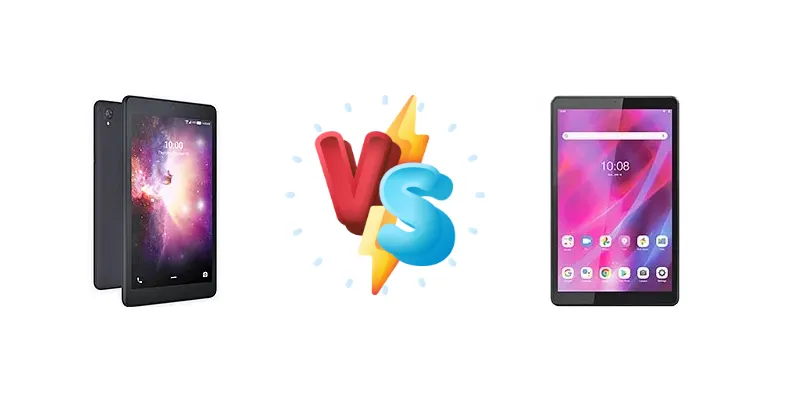
The sub-$200 Android tablet market is fiercely competitive. Both the TCL 10 TabMid and the Lenovo Tab M8 (3rd Gen) aim to deliver a functional tablet experience without breaking the bank. However, they take different approaches to achieving this, primarily through their chipset choices. This comparison dissects the key differences to help you determine which tablet best suits your needs.
🏆 Quick Verdict
For most users, the TCL 10 TabMid emerges as the better choice. Its Qualcomm Snapdragon 665 chipset, built on an 11nm process, provides a noticeable performance advantage over the Lenovo Tab M8’s MediaTek Helio P22T, translating to smoother multitasking and a more responsive user experience. While both tablets are geared towards basic tasks, the TCL offers a more future-proof platform.
| Network |
|---|
| 2G bands | GSM 850 / 900 / 1800 / 1900 | GSM 850 / 900 / 1800 / 1900 |
| 3G bands | HSDPA 850 / 900 / 1900 / 2100 | HSDPA 850 / 900 / 1700(AWS) / 1900 / 2100 - International |
| 4G bands | 1, 3, 5, 7, 8, 18, 19, 20, 26, 28, 34, 38, 39, 40, 41 | 1, 2, 3, 4, 5, 19, 7, 8, 20, 26, 28, 38, 40, 41 - International |
| Speed | HSPA 42.2/11.5 Mbps, LTE Cat4 150/50 Mbps | HSPA, LTE - cellular model only |
| Technology | GSM / HSPA / LTE | GSM / CDMA / HSPA / LTE |
| | - | 1, 3, 5, 7, 8, 34, 38, 39, 40, 41 - China |
| Launch |
|---|
| Announced | 2020, September 03. Released 2021, Q1 | 2021, June 28 |
| Status | Discontinued | Available. Released 2022, February |
| Body |
|---|
| Build | - | Glass front, aluminum back, aluminum frame |
| Dimensions | 209.4 x 125.2 x 8.6 mm (8.24 x 4.93 x 0.34 in) | 199.1 x 121.8 x 8.2 mm (7.84 x 4.80 x 0.32 in) |
| SIM | Nano-SIM | Nano-SIM (cellular model only) |
| Weight | 325 g (11.46 oz) | 305 g (10.76 oz) |
| Display |
|---|
| Resolution | 1200 x 1920 pixels, 16:10 ratio (~283 ppi density) | 800 x 1280 pixels, 16:10 ratio (~189 ppi density) |
| Size | 8.0 inches, 185.6 cm2 (~70.8% screen-to-body ratio) | 8.0 inches, 185.6 cm2 (~76.5% screen-to-body ratio) |
| Type | IPS LCD | TDDI IPS LCD, 350 nits (typ) |
| Platform |
|---|
| CPU | Octa-core (4x2.0 GHz Kryo 260 Gold & 4x1.8 GHz Kryo 260 Silver) | Octa-core (4x2.3 GHz Cortex-A53 & 4x1.8 GHz Cortex-A53) |
| Chipset | Qualcomm SM6125 Snapdragon 665 (11 nm) | Mediatek MT8768T Helio P22T (12 nm) |
| GPU | Adreno 610 | PowerVR GE8320 |
| OS | Android 10, TCL UI | Android 11 (Go edition) - 2 GB RAM versionAndroid 11 - 3 GB RAM version |
| Memory |
|---|
| Card slot | microSDXC (dedicated slot) | microSDXC (dedicated slot) |
| Internal | 32GB 3GB RAM | 32GB 2GB RAM, 32GB 3GB RAM |
| | eMMC 5.1 | eMMC 5.1 |
| Main Camera |
|---|
| Features | LED flash | - |
| Single | 5 MP, f/2.0, (wide), 1/4.0", 1.12µm | 5 MP, AF |
| Video | 1080p@30fps | 1080p |
| Selfie camera |
|---|
| Single | 5 MP, f/2.4, (wide), 1/5.0", 1.12µm | 2 MP |
| Video | 1080p@30fps | 720p |
| Sound |
|---|
| 3.5mm jack | Yes | Yes |
| 35mm jack | Yes | Yes |
| Loudspeaker | Yes | Yes |
| Comms |
|---|
| Bluetooth | 5.0, A2DP, LE | 5.0, A2DP, LE |
| NFC | No | No |
| Positioning | GPS | GPS, GLONASS, BDS - cellular model only |
| Radio | No | FM radio |
| USB | USB Type-C 2.0, OTG | USB Type-C 2.0, OTG |
| WLAN | Wi-Fi 802.11 a/b/g/n/ac, dual-band, Wi-Fi Direct | Wi-Fi 802.11 a/b/g/n, dual-band, Wi-Fi Direct |
| Features |
|---|
| Sensors | Accelerometer | Accelerometer, proximity |
| Battery |
|---|
| Charging | 18W wired
Reverse wired | - |
| Type | Li-Po 5500 mAh | Li-Po 5100 mAh |
| Misc |
|---|
| Colors | Prime Black | Iron Grey, Platinum Grey |
| Price | About 230 EUR | - |
TCL 10 TabMid
- More powerful Snapdragon 665 chipset
- 18W fast charging with reverse wired charging
- Potentially smoother multitasking experience
- May have slightly lower battery life under heavy load
- Limited detailed specifications available
Lenovo Tab M8 (3rd Gen)
- Potentially slightly better battery life under light use
- Lower price point (likely)
- Compact and portable design
- Less powerful MediaTek Helio P22T chipset
- Slower overall performance
- No fast charging or reverse charging
Display Comparison
Neither TCL nor Lenovo provide detailed display specifications beyond resolution. However, the display is likely the least differentiating factor. Both will likely feature IPS LCD panels, common in this price bracket. The absence of high refresh rates or advanced features like LTPO is expected. Bezels are likely to be substantial on both devices, maximizing screen real estate within a compact form factor. Color accuracy will likely be standard for budget tablets, prioritizing power efficiency over color fidelity.
Camera Comparison
Camera performance is unlikely to be a deciding factor for either tablet. Both are likely equipped with basic camera sensors suitable for casual snapshots and video calls. Detailed specifications are unavailable, but it’s safe to assume image quality will be adequate in good lighting conditions but suffer in low light. Focusing on megapixel counts would be misleading; image processing and sensor size are far more critical, and information on these is absent. The cameras are primarily for video conferencing and quick photos, not for serious photography.
Performance
The core difference lies in the chipsets. The TCL 10 TabMid’s Qualcomm Snapdragon 665 (11nm) features an octa-core CPU with a Kryo architecture, split into performance (2.0 GHz) and efficiency (1.8 GHz) cores. This contrasts with the Lenovo Tab M8’s MediaTek Helio P22T (12nm), which utilizes eight Cortex-A53 cores clocked at 2.3 GHz and 1.8 GHz. While the Helio P22T has a higher peak clock speed, the Snapdragon 665’s architecture and more efficient 11nm process generally translate to superior sustained performance and better multi-tasking capabilities. The Snapdragon’s Adreno 610 GPU also provides a more capable graphics experience than the Helio P22T’s PowerVR GE8320. This means the TCL will handle games and graphically intensive apps more smoothly.
Battery Life
Battery capacity details are missing for both devices. However, the MediaTek Helio P22T’s 12nm process *could* offer a slight efficiency advantage over the Snapdragon 665’s 11nm process, potentially leading to marginally longer battery life under light usage. The TCL 10 TabMid supports 18W wired charging, and also offers reverse wired charging, a feature absent on the Lenovo Tab M8. This allows the TCL to act as a power bank for other devices, a useful addition. Actual battery life will heavily depend on usage patterns, but the faster charging on the TCL is a clear benefit.
Buying Guide
Buy the TCL 10 TabMid if you prioritize a smoother, more responsive experience for everyday tasks like browsing, streaming, and light gaming. Its Snapdragon 665 offers better long-term performance. Buy the Lenovo Tab M8 (3rd Gen) if your primary use case is extremely light – primarily reading ebooks, basic web browsing, and video playback – and you are on a very tight budget. The M8’s slightly more efficient 12nm process might offer marginally better battery life in these scenarios.
Frequently Asked Questions
❓ Will the TCL 10 TabMid handle demanding games like PUBG Mobile?
While the Snapdragon 665 can run PUBG Mobile, expect to play at lower graphics settings and frame rates for a smooth experience. It's not a gaming powerhouse, but it's significantly more capable than the Helio P22T in the Lenovo Tab M8.
❓ Is the reverse wired charging on the TCL 10 TabMid useful for everyday use?
Yes, the reverse wired charging is a convenient feature for topping up your smartphone or wireless earbuds when you're away from a power outlet. It's not a replacement for a dedicated power bank, but it's a handy addition.
❓ How much storage does each tablet offer, and is it expandable?
Storage configurations are not specified in the provided data. However, budget tablets typically offer 32GB or 64GB of internal storage, with microSD card support for expansion. Check the product listing for specific details.
❓ Which tablet is better for reading ebooks and browsing the web?
Both tablets are suitable for these tasks. However, the TCL 10 TabMid’s smoother performance will provide a more responsive and enjoyable browsing experience, especially with multiple tabs open.