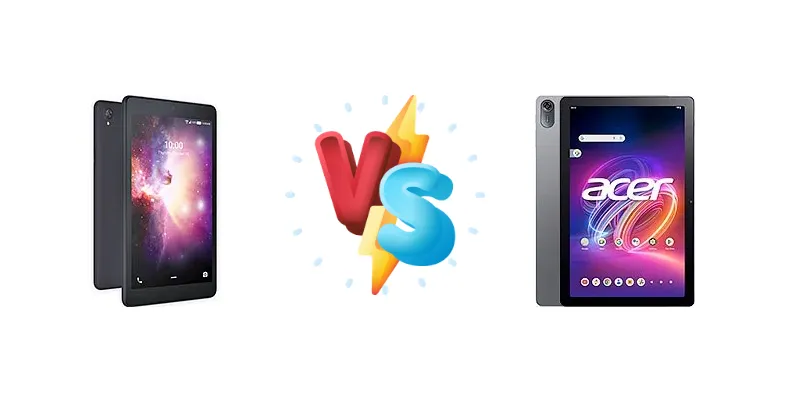
The tablet market is increasingly competitive, offering a range of options at various price points. We're pitting the TCL 10 TabMid, a well-established budget option, against the newer Acer Iconia Tab P10 (2025) to determine which delivers the best experience for everyday users. This comparison focuses on the core performance differences stemming from their respective chipsets and how those translate into real-world usability.
🏆 Quick Verdict
For the average user, the Acer Iconia Tab P10 (2025) is the superior choice. While the TCL 10 TabMid offers reverse wired charging, the Acer’s Mediatek Helio G99, built on a more efficient 6nm process, provides a noticeable performance uplift and future-proofs the device better than the older Snapdragon 665.
| Network |
|---|
| 2G bands | GSM 850 / 900 / 1800 / 1900 | N/A |
| 3G bands | HSDPA 850 / 900 / 1900 / 2100 | N/A |
| 4G bands | 1, 3, 5, 7, 8, 18, 19, 20, 26, 28, 34, 38, 39, 40, 41 | N/A |
| EDGE | - | No |
| GPRS | - | No |
| Speed | HSPA 42.2/11.5 Mbps, LTE Cat4 150/50 Mbps | - |
| Technology | GSM / HSPA / LTE | No cellular connectivity |
| Launch |
|---|
| Announced | 2020, September 03. Released 2021, Q1 | 2025, Q4 |
| Status | Discontinued | Available. Released 2025, Q4 |
| Body |
|---|
| Build | - | Glass front, aluminum alloy frame |
| Dimensions | 209.4 x 125.2 x 8.6 mm (8.24 x 4.93 x 0.34 in) | 8.1 mm thickness |
| SIM | Nano-SIM | No |
| Weight | 325 g (11.46 oz) | 495 g (1.09 lb) |
| Display |
|---|
| Resolution | 1200 x 1920 pixels, 16:10 ratio (~283 ppi density) | 1200 x 2000 pixels, 5:3 ratio (~224 ppi density) |
| Size | 8.0 inches, 185.6 cm2 (~70.8% screen-to-body ratio) | 10.4 inches, 307.9 cm2 |
| Type | IPS LCD | IPS LCD, 90Hz |
| Platform |
|---|
| CPU | Octa-core (4x2.0 GHz Kryo 260 Gold & 4x1.8 GHz Kryo 260 Silver) | Octa-core (2x2.2 GHz Cortex-A76 & 6x2.0 GHz Cortex-A55) |
| Chipset | Qualcomm SM6125 Snapdragon 665 (11 nm) | Mediatek Helio G99 (6 nm) |
| GPU | Adreno 610 | Mali-G57 MC2 |
| OS | Android 10, TCL UI | Android 14 |
| Memory |
|---|
| Card slot | microSDXC (dedicated slot) | microSDXC (dedicated slot) |
| Internal | 32GB 3GB RAM | 128GB 6GB RAM, 256GB 6GB RAM |
| | eMMC 5.1 | - |
| Main Camera |
|---|
| Features | LED flash | - |
| Single | 5 MP, f/2.0, (wide), 1/4.0", 1.12µm | 13 MP |
| Video | 1080p@30fps | 1080p@30fps |
| Selfie camera |
|---|
| Single | 5 MP, f/2.4, (wide), 1/5.0", 1.12µm | 5 MP |
| Video | 1080p@30fps | Yes |
| Sound |
|---|
| 3.5mm jack | Yes | - |
| 35mm jack | Yes | Yes |
| Loudspeaker | Yes | Yes, with stereo speakers |
| Comms |
|---|
| Bluetooth | 5.0, A2DP, LE | 5.0, A2DP, LE |
| NFC | No | No |
| Positioning | GPS | GPS |
| Radio | No | No |
| USB | USB Type-C 2.0, OTG | USB Type-C 2.0 |
| WLAN | Wi-Fi 802.11 a/b/g/n/ac, dual-band, Wi-Fi Direct | Wi-Fi 802.11 a/b/g/n/ac, dual-band |
| Features |
|---|
| Sensors | Accelerometer | Gyro |
| Battery |
|---|
| Charging | 18W wired
Reverse wired | 10W wired |
| Type | Li-Po 5500 mAh | Li-Ion 8000 mAh |
| Misc |
|---|
| Colors | Prime Black | Iron Gray |
| Models | - | P10-21Q-870Q, NT.LHBAA.001 |
| Price | About 230 EUR | About 220 EUR |
TCL 10 TabMid
- Reverse wired charging for accessory top-ups
- Potentially lower initial purchase price
- Established brand in the budget tablet space
- Older, less efficient Snapdragon 665 chipset
- Likely slower performance compared to the Acer
- May receive fewer software updates
Acer Iconia Tab P10 (2025)
- More efficient and powerful Mediatek Helio G99 chipset
- 6nm process for better thermal management and battery life
- Likely longer software support
- Improved multitasking and app responsiveness
- Slower 10W charging
- Lacks reverse wired charging
- Potentially higher initial purchase price
Display Comparison
Neither TCL nor Acer provide display specifications beyond the tablet names. Assuming both utilize standard IPS LCD panels common in this price bracket, the display experience will likely be similar in terms of color accuracy and viewing angles. However, the Acer benefits from a newer chipset potentially allowing for more efficient display power management. Without specific brightness or resolution data, it's difficult to definitively declare a winner.
Camera Comparison
Given the target market of these tablets, camera performance is unlikely to be a key differentiator. Both devices likely feature modest camera setups. Without specific sensor details, it’s safe to assume image quality will be adequate for casual snapshots but not competitive with smartphone cameras. Any claims of advanced features should be viewed skeptically.
Performance
The core difference lies in the chipsets. The Acer Iconia Tab P10 (2025) utilizes the Mediatek Helio G99, fabricated on a 6nm process. This is a significant advantage over the TCL 10 TabMid’s Qualcomm Snapdragon 665, which is built on an older 11nm process. The 6nm node allows for greater transistor density and improved power efficiency, translating to better sustained performance and less thermal throttling. While both are octa-core CPUs, the Acer’s configuration (2x2.2 GHz Cortex-A76 & 6x2.0 GHz Cortex-A55) features more powerful Cortex-A76 cores, offering a substantial boost in single-core performance – crucial for responsive app launching and smoother UI navigation. The Snapdragon 665’s (4x2.0 GHz Kryo 260 Gold & 4x1.8 GHz Kryo 260 Silver) architecture is older and less efficient.
Battery Life
The TCL 10 TabMid offers 18W wired charging and reverse wired charging, a feature absent on the Acer. However, the Acer’s Helio G99 chipset’s 6nm efficiency means it will likely consume less power during typical usage. The Acer’s 10W charging is slower, but the more efficient chipset may offset this, resulting in comparable real-world battery life despite potentially having a smaller battery capacity (spec not provided). The TCL’s reverse charging is a niche feature, useful for charging accessories but not a primary reason to choose it.
Buying Guide
Buy the TCL 10 TabMid if you prioritize reverse wired charging for topping up accessories and are on a very tight budget. It’s a functional tablet for basic tasks. Buy the Acer Iconia Tab P10 (2025) if you value smoother multitasking, improved gaming performance, and a more modern, efficient chipset that will likely receive longer software support. It’s the better long-term investment.
Frequently Asked Questions
❓ Will the Helio G99 in the Acer Iconia Tab P10 (2025) overheat during extended gaming sessions?
The Mediatek Helio G99’s 6nm process is designed for improved thermal efficiency compared to the Snapdragon 665. While sustained gaming will generate heat, the G99 is less prone to significant throttling, allowing for more consistent performance over longer periods. However, passive cooling solutions in tablets can still limit peak performance.
❓ Is the performance difference between the Snapdragon 665 and Helio G99 noticeable for everyday tasks like browsing and video streaming?
Yes, the difference is noticeable. The Helio G99’s more powerful CPU cores and efficient architecture result in snappier app launches, smoother scrolling, and a more responsive user interface. While the Snapdragon 665 is adequate for basic tasks, the G99 provides a more fluid and enjoyable experience, especially when multitasking.
❓ How important is reverse wired charging, and is it worth sacrificing the newer chipset for it?
Reverse wired charging is a niche feature. It's convenient for topping up accessories like earbuds or smartwatches, but it's not a critical feature for most users. The performance and efficiency benefits of the Helio G99 in the Acer Iconia Tab P10 (2025) outweigh the convenience of reverse charging for the vast majority of tablet users.