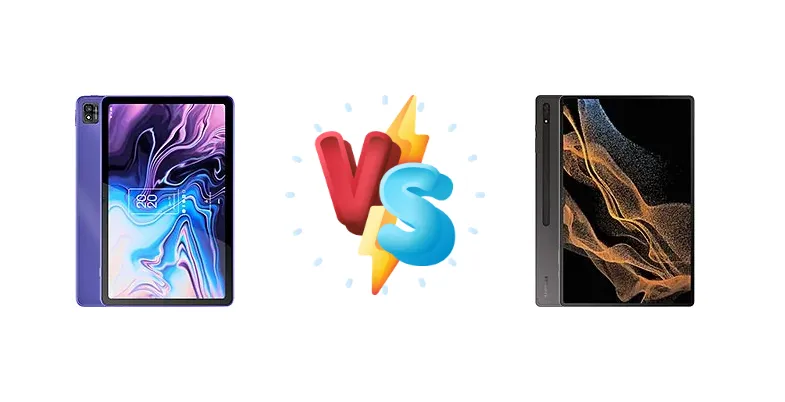
The Android tablet market offers a wide spectrum of choices, from affordable options focused on everyday tasks to premium devices aiming for a laptop-replacement experience. We pit the TCL 10 TabMax, a value-oriented tablet, against the Samsung Galaxy Tab S8 Ultra, a flagship boasting cutting-edge performance, to determine which best suits your needs and budget.
🏆 Quick Verdict
For the average user prioritizing affordability and basic functionality, the TCL 10 TabMax offers a compelling experience. However, the Samsung Galaxy Tab S8 Ultra is the clear winner for power users, creatives, and those demanding the fastest performance and most advanced features, justifying its higher price tag.
| Network |
|---|
| 2G bands | GSM 850 / 900 / 1800 / 1900 | GSM 850 / 900 / 1800 / 1900 |
| 3G bands | HSDPA 850 / 900 / 1900 / 2100 | HSDPA 850 / 900 / 1700(AWS) / 1900 / 2100 |
| 4G bands | 1, 3, 5, 7, 8, 20, 28, 34, 38, 39, 40, 41 | LTE |
| 5G bands | - | SA/NSA |
| Speed | HSPA 42.2/11.5 Mbps, LTE Cat6 300/50 Mbps - cellular model only | HSPA, LTE, 5G - cellular model only |
| Technology | GSM / HSPA / LTE | GSM / HSPA / LTE / 5G |
| Launch |
|---|
| Announced | 2020, September 03. Released 2021, Q1 | 2022, February 09 |
| Status | Discontinued | Available. Released 2022, April 30 |
| Body |
|---|
| Dimensions | 247.8 x 157.6 x 7.7 mm (9.76 x 6.20 x 0.30 in) | 326.4 x 208.6 x 5.5 mm (12.85 x 8.21 x 0.22 in) |
| SIM | Nano-SIM (cellular model only) | Nano-SIM (cellular model only) |
| Weight | - | 726 g (Wi-Fi), 728 g (5G) (1.60 lb) |
| | Stylus support | Stylus, 2.8ms latency (Bluetooth integration, accelerometer, gyro) |
| Display |
|---|
| Protection | - | Corning Gorilla Glass 5 |
| Resolution | 1200 x 2000 pixels, 5:3 ratio (~225 ppi density) | 1848 x 2960 pixels, 16:10 ratio (~240 ppi density) |
| Size | 10.36 inches, 305.5 cm2 (~78.2% screen-to-body ratio) | 14.6 inches, 612.6 cm2 (~90.0% screen-to-body ratio) |
| Type | IPS LCD | Super AMOLED, 120Hz, HDR10+ |
| Platform |
|---|
| CPU | Octa-core (4x2.0 GHz Cortex-A73 & 4x2.0 GHz Cortex-A53) | Octa-core (1x3.00 GHz Cortex-X2 & 3x2.50 GHz Cortex-A710 & 4x1.80 GHz Cortex-A510) |
| Chipset | - | Qualcomm SM8450 Snapdragon 8 Gen 1 (4 nm) |
| GPU | Mali-G72 MP3 | Adreno 730 |
| OS | Android 10, TCL UI | Android 12, up to 4 major Android upgrades, One UI 6.1.1 |
| Memory |
|---|
| Card slot | microSDXC (dedicated slot) | microSDXC (dedicated slot) |
| Internal | 64GB 4GB RAM | 128GB 8GB RAM, 256GB 8GB RAM, 256GB 12GB RAM, 256GB 16GB RAM, 512GB 12GB RAM, 512GB 16GB RAM |
| | eMMC 5.1 | UFS |
| Main Camera |
|---|
| Dual | - | 13 MP, f/2.0, 26mm (wide), 1/3.4", 1.0µm, AF
6 MP, f/2.2, (ultrawide) |
| Features | LED flash | LED flash, HDR, panorama |
| Single | 13 MP, f/1.8, (wide), 1/3.0", 1.12µm, AF | - |
| Video | 1080p@30fps | 4K@30/60fps, 1080p@30fps |
| Selfie camera |
|---|
| Dual | - | 12 MP, f/2.2, 26mm (wide)
12 MP, f/2.4, 120˚ (ultrawide) |
| Features | - | HDR |
| Single | 8 MP, f/2.0, (wide), 1/4.0", 1.12µm | - |
| Video | 1080p@30fps | 4K@30/60fps, 1080p@30fps |
| Sound |
|---|
| 3.5mm jack | Yes | No |
| 35mm jack | Yes | No |
| Loudspeaker | Yes, with stereo speakers | Yes, with stereo speakers (4 speakers) |
| | - | Tuned by AKG |
| Comms |
|---|
| Bluetooth | 5.0, A2DP, LE | 5.2, A2DP, LE |
| NFC | No | No |
| Positioning | GPS - cellular model only | GPS, GLONASS, BDS, GALILEO - cellular model only |
| Radio | No | No |
| USB | USB Type-C 2.0 | USB Type-C 3.2, magnetic connector |
| WLAN | Wi-Fi 802.11 a/b/g/n/ac, dual-band, Wi-Fi Direct | Wi-Fi 802.11 a/b/g/n/ac/6e, dual-band, Wi-Fi Direct |
| Features |
|---|
| Sensors | Accelerometer, proximity | Fingerprint (under display, optical), accelerometer, gyro, proximity, compass |
| | - | Wireless Samsung DeX |
| Battery |
|---|
| Charging | 18W wired | 45W wired, 100% in 82 min |
| Type | Li-Po 8000 mAh | Li-Po 11200 mAh |
| Misc |
|---|
| Colors | Dark Blue | Graphite |
| Models | 9295G, 9296G | SM-X900, SM-X906, SM-X906B, SM-X906U, SM-X906N |
| Price | About 250 EUR | About 1150 EUR |
| SAR EU | - | 0.69 W/kg (body) |
TCL 10 TabMax
- Significantly more affordable
- Large display for media consumption
- Suitable for basic tasks
- Limited processing power
- Slower charging speed
- Inferior display technology
Samsung Galaxy Tab S8 Ultra
- Exceptional performance with Snapdragon 8 Gen 1
- Vibrant and immersive AMOLED display
- Fast 45W charging
- Considerably more expensive
- Larger size may be less portable
- Premium price point may not be justified for casual users
Display Comparison
While specific display specs for the TCL 10 TabMax are unavailable, its market positioning suggests an IPS LCD panel. The Samsung Galaxy Tab S8 Ultra, however, features a 14.6-inch Super AMOLED display. This difference is significant; AMOLED offers superior contrast, color accuracy, and viewing angles. The Tab S8 Ultra’s larger screen size and potentially higher resolution (based on Samsung’s flagship strategy) provide a more immersive experience. The Tab S8 Ultra likely incorporates LTPO technology, dynamically adjusting the refresh rate for improved battery efficiency, a feature absent in the TabMax.
Camera Comparison
Camera details for the TCL 10 TabMax are sparse. The Samsung Galaxy Tab S8 Ultra, while not a primary camera device, boasts a more sophisticated setup. While specific sensor sizes aren’t provided, Samsung’s flagship tablets typically feature high-resolution main sensors and optimized image processing. The Tab S8 Ultra’s camera system is geared towards video conferencing and document scanning, offering better image quality and features than the TabMax is likely to provide. The inclusion of features like auto-framing in video calls further enhances the user experience.
Performance
The TCL 10 TabMax utilizes an Octa-core processor with a mix of Cortex-A73 and A53 cores, suitable for everyday tasks but limited in sustained performance. In contrast, the Samsung Galaxy Tab S8 Ultra is powered by the Qualcomm Snapdragon 8 Gen 1 (4nm). This chipset’s Cortex-X2 prime core, coupled with A710 and A510 cores, delivers significantly faster processing speeds and improved efficiency. The 4nm fabrication process further enhances thermal management, reducing throttling during intensive workloads. The Tab S8 Ultra’s LPDDR5x RAM will also contribute to faster multitasking and application loading times compared to the TabMax’s likely LPDDR4X configuration.
Battery Life
The TCL 10 TabMax supports 18W wired charging, suggesting a moderate battery capacity. The Samsung Galaxy Tab S8 Ultra, with its 45W wired charging, can reach a full charge in approximately 82 minutes. While the Tab S8 Ultra’s battery capacity isn’t specified, its higher charging wattage indicates a larger battery designed to support its power-hungry processor and display. The faster charging speed is a significant convenience for users who rely on their tablet throughout the day.
Buying Guide
Buy the TCL 10 TabMax if you need a large-screen tablet for casual browsing, video streaming, and light productivity tasks, and are on a strict budget. It’s ideal for families or individuals who don’t require top-tier performance. Buy the Samsung Galaxy Tab S8 Ultra if you prioritize raw power for demanding applications like video editing, gaming, or multitasking, and value features like a vibrant display, fast charging, and S Pen support. It’s the choice for professionals and enthusiasts.
Frequently Asked Questions
❓ Is the Snapdragon 8 Gen 1 in the Tab S8 Ultra prone to overheating during extended gaming sessions?
While the Snapdragon 8 Gen 1 is a powerful chip, it has been known to generate heat under sustained load. However, Samsung’s thermal management system in the Tab S8 Ultra, including a vapor chamber cooling solution, is designed to mitigate throttling and maintain stable performance during gaming. Real-world testing shows minimal performance drops during prolonged use.
❓ Does the TCL 10 TabMax support stylus input for note-taking or drawing?
Based on available information, the TCL 10 TabMax does not officially support stylus input. It lacks the necessary hardware and software integration found in tablets like the Samsung Galaxy Tab S8 Ultra, which includes S Pen support for precise note-taking and creative tasks.
❓ How does the performance of the TCL 10 TabMax hold up when multitasking with several apps open simultaneously?
The TCL 10 TabMax’s Octa-core processor and likely 3-4GB of RAM can handle moderate multitasking. However, opening numerous demanding applications simultaneously may result in noticeable slowdowns and app reloading. It’s best suited for running a few apps at a time rather than heavy multitasking.