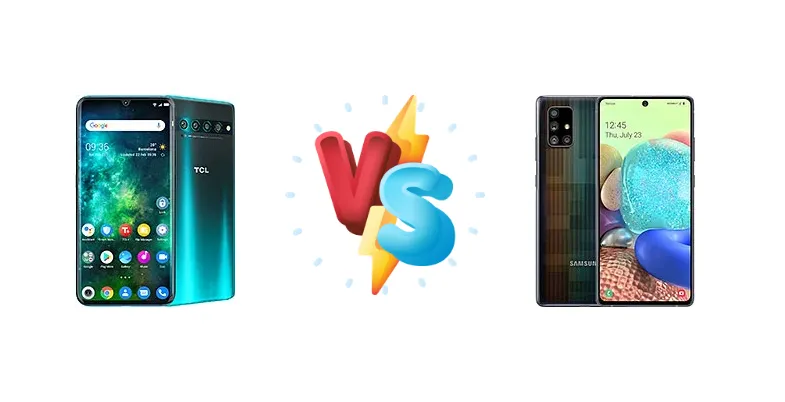
The TCL 10 Pro and Samsung Galaxy A71 5G UW represent distinct approaches to the mid-range 5G market. The TCL 10 Pro, released earlier, aimed to deliver a premium experience at a competitive price. The A71 5G UW, leveraging Samsung’s brand recognition and 5G connectivity, targets users prioritizing network speed and a familiar ecosystem. This comparison dives deep into their core components to determine which phone offers the best value.
🏆 Quick Verdict
For the average user, the Samsung Galaxy A71 5G UW emerges as the stronger choice. Its Snapdragon 765G chipset, built on a more efficient 7nm process, provides a noticeable performance uplift over the TCL 10 Pro’s Snapdragon 675, translating to smoother multitasking and better gaming. While the TCL 10 Pro offers a respectable experience, the A71 5G UW’s superior processing power and faster charging justify the price difference.
| Network |
|---|
| 2G bands | GSM 850 / 900 / 1800 / 1900 | GSM 850 / 900 / 1800 / 1900 |
| 3G bands | HSDPA 850 / 900 / 1700(AWS) / 1900 / 2100 - T799B | HSDPA 850 / 900 / 1900 / 2100 |
| 4G bands | 1, 2, 3, 4, 5, 7, 8, 12, 13, 17, 25, 26, 28, 38, 40, 41, 66 - T799B | 2, 3, 4, 5, 7, 12, 13, 20, 28, 66 |
| 5G bands | - | 260, 261 SA/NSA/mmWave |
| Speed | HSPA 42.2/5.76 Mbps, LTE (2CA) Cat13 400/75 Mbps | HSPA, LTE, 5G |
| Technology | GSM / HSPA / LTE | GSM / HSPA / LTE / 5G |
| | 1, 3, 5, 7, 8, 20, 28, 38, 40, 41 - T799H | - |
| Launch |
|---|
| Announced | 2020, April 06. Released 2020, May 19 | 2020, July 07 |
| Status | Discontinued | Available. Released 2020, July 16 |
| Body |
|---|
| Build | Glass front, glass back, aluminum frame | Glass front (Gorilla Glass 3), plastic back, aluminum frame |
| Dimensions | 158.5 x 72.4 x 9.2 mm (6.24 x 2.85 x 0.36 in) | 162.8 x 75.7 x 8.4 mm (6.41 x 2.98 x 0.33 in) |
| SIM | · Nano-SIM· Nano-SIM + Nano-SIM | Nano-SIM (pre-installed) |
| Weight | 177 g (6.24 oz) | 188 g (6.63 oz) |
| Display |
|---|
| Protection | - | Corning Gorilla Glass 3 |
| Resolution | 1080 x 2340 pixels, 19.5:9 ratio (~398 ppi density) | 1080 x 2400 pixels, 20:9 ratio (~393 ppi density) |
| Size | 6.47 inches, 102.8 cm2 (~89.5% screen-to-body ratio) | 6.7 inches, 108.4 cm2 (~87.9% screen-to-body ratio) |
| Type | AMOLED, HDR10 | Super AMOLED Plus |
| | Always-on-display | - |
| Platform |
|---|
| CPU | Octa-core (2x2.0 GHz Kryo 460 Gold & 6x1.7 GHz Kryo 460 Silver) | Octa-core (1x2.4 GHz Kryo 475 Prime & 1x2.2 GHz Kryo 475 Gold & 6x1.8 GHz Kryo 475 Silver) |
| Chipset | Qualcomm SDM675 Snapdragon 675 (11 nm) | Qualcomm SM7250 Snapdragon 765G 5G (7 nm) |
| GPU | Adreno 612 | Adreno 620 |
| OS | Android 10, planned upgrade to Android 11, TCL UI | Android 10, One UI 2.1 |
| Memory |
|---|
| Card slot | microSDXC (uses shared SIM slot) | microSDXC (dedicated slot) |
| Internal | 128GB 6GB RAM, 256GB 6GB RAM | 128GB 8GB RAM |
| | UFS 2.1 | UFS 2.1 |
| Main Camera |
|---|
| Features | Dual-LED flash, HDR, panorama | LED flash, panorama, HDR |
| Quad | 64 MP, f/1.8, 26mm (wide), 1/1.72", 0.8µm, PDAF
16 MP, f/2.4, 13mm (ultrawide), 1/3.1", 1.0µm
5 MP (macro)
Auxiliary lens | 64 MP, f/1.8, 26mm (wide), 1/1.72", 0.8µm, PDAF
12 MP, f/2.2, 123˚ (ultrawide)
5 MP (macro)
Auxiliary lens |
| Video | 4K@30fps, 1080p@30/60/120fps, 720p@960fps, gyro-EIS | 4K@30fps, 1080p@30/240fps, 1080p@960fps; gyro-EIS |
| Selfie camera |
|---|
| Features | - | HDR |
| Single | 24 MP, f/2.0, 26mm (wide), 1/2.8", 0.9µm | 32 MP, f/2.2, 26mm (wide), 1/2.8", 0.8µm |
| Video | 1080p@30fps | 4K@30fps, 1080p@30fps |
| Sound |
|---|
| 3.5mm jack | Yes | Yes |
| 35mm jack | Yes | Yes |
| Loudspeaker | Yes | Yes |
| Comms |
|---|
| Bluetooth | 5.0, A2DP, LE, aptX HD | 5.0, A2DP, LE |
| Infrared port | Yes | - |
| NFC | Yes | No |
| Positioning | GPS, GLONASS, GALILEO | GPS, GLONASS, GALILEO, BDS |
| Radio | FM radio (market/region dependent) | No |
| USB | USB Type-C 2.0, OTG | USB Type-C 2.0, OTG |
| WLAN | Wi-Fi 802.11 a/b/g/n/ac, dual-band, Wi-Fi Direct | Wi-Fi 802.11 a/b/g/n/ac, dual-band, Wi-Fi Direct |
| Features |
|---|
| Sensors | Fingerprint (under display, optical), accelerometer, gyro, proximity, compass | Fingerprint (under display, optical), accelerometer, gyro, proximity, compass |
| | - | ANT+ |
| Battery |
|---|
| Charging | 18W wired, QC3, 50% in 35 min | 25W wired |
| Type | Li-Po 4500 mAh | Li-Po 4500 mAh |
| Misc |
|---|
| Colors | Gray, Green | Prism Bricks Black |
| Models | T799B, T799H | SM-A716V |
| Price | About 250 EUR | - |
| SAR | - | 0.50 W/kg (head) 0.78 W/kg (body) |
TCL 10 Pro
- Potentially more compact design.
- Competitive price point (likely lower than A71 5G UW).
- QC3 fast charging support.
- Less powerful Snapdragon 675 chipset.
- Slower charging speed (18W).
- Older chipset architecture may limit future software updates.
Samsung Galaxy A71 5G UW
- More powerful Snapdragon 765G chipset.
- Faster 25W charging.
- Superior 5G connectivity.
- Likely larger and heavier design.
- Potentially higher price point.
- Samsung’s software experience isn’t universally preferred.
Display Comparison
Neither TCL nor Samsung specified display details beyond size in their marketing. However, both likely utilize AMOLED panels, common in this price bracket. The TCL 10 Pro’s Snapdragon 675 has a less powerful ISP, potentially impacting image processing for display output. The A71 5G UW benefits from the more advanced ISP within the Snapdragon 765G, potentially leading to more accurate color reproduction and dynamic range. Bezels are likely comparable, typical of mid-range phones from this era.
Camera Comparison
While both phones likely feature multi-camera setups, the Snapdragon 765G’s superior image signal processor (ISP) gives the A71 5G UW an edge. The ISP handles noise reduction, dynamic range, and color accuracy. While megapixel counts aren’t specified, the 765G’s processing capabilities will likely yield better image quality, especially in challenging lighting conditions. The TCL 10 Pro’s ISP, while competent, is limited by the older chipset architecture. We can assume both phones include standard features like HDR and portrait modes, but the A71 5G UW will likely execute them more effectively.
Performance
The core difference lies in the chipsets. The Samsung Galaxy A71 5G UW’s Snapdragon 765G, fabricated on a 7nm process, is a significant upgrade over the TCL 10 Pro’s 11nm Snapdragon 675. The 765G’s Kryo 475 Prime core (2.4 GHz) offers substantially higher single-core performance than the 10 Pro’s Kryo 460 Gold (2.0 GHz). This translates to snappier app launches and smoother overall responsiveness. The 765G also boasts a more capable Adreno 620 GPU, providing a better gaming experience. The 7nm process also contributes to improved thermal efficiency, reducing the likelihood of throttling during sustained workloads.
Battery Life
Battery capacity isn’t specified in the provided data. However, the Samsung Galaxy A71 5G UW’s 25W charging is a clear advantage over the TCL 10 Pro’s 18W charging. This means significantly faster top-ups, reducing downtime. While a larger battery capacity on the TCL 10 Pro could partially offset this, the faster charging of the A71 5G UW is a tangible benefit for users who frequently need to recharge their devices. The 7nm process of the 765G also contributes to better power efficiency, potentially extending battery life under load.
Buying Guide
Buy the TCL 10 Pro if you prioritize a slightly more compact form factor and are primarily focused on everyday tasks like browsing, social media, and light photography, and are comfortable with a slower processor. Buy the Samsung Galaxy A71 5G UW if you demand better performance for gaming and demanding apps, require faster 5G connectivity, and value quicker charging speeds – even if it means a larger device.
Frequently Asked Questions
❓ Will the Snapdragon 675 in the TCL 10 Pro struggle with graphically intensive games like PUBG or Fortnite?
Yes, the Snapdragon 675 is likely to struggle with demanding games at higher settings. While playable, you’ll likely need to reduce graphics settings and frame rates to achieve a smooth experience. The Snapdragon 765G in the A71 5G UW offers a significantly better gaming experience due to its more powerful GPU and efficient architecture.
❓ Does the Samsung Galaxy A71 5G UW support carrier aggregation for faster 5G speeds on Verizon's Ultra Wideband network?
The 'UW' designation in the Samsung Galaxy A71 5G UW specifically indicates support for Verizon’s Ultra Wideband (mmWave) 5G network, which relies heavily on carrier aggregation to achieve its highest speeds. The TCL 10 Pro does not support mmWave 5G and is limited to sub-6GHz frequencies, resulting in slower 5G speeds.
❓ How does the software update policy differ between TCL and Samsung for these models?
Samsung generally provides more consistent and longer-term software support than TCL. While specific update commitments vary, Samsung typically offers at least two major Android updates and several years of security patches. TCL’s update track record is less predictable, and the 10 Pro may receive fewer updates over its lifespan.