
TCL 10 Pro vs OnePlus Nord 5: A Deep Dive into Performance and Value
| Phones Images | |||||
|---|---|---|---|---|---|
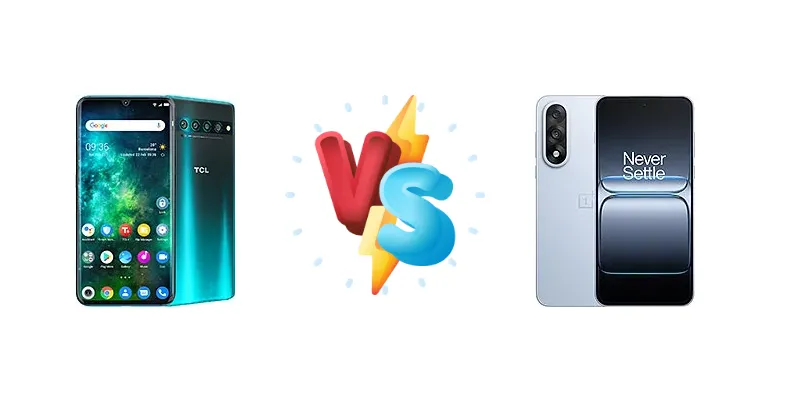
|
🏆 Quick Verdict
For most users, the OnePlus Nord 5 is the clear winner. Its Snapdragon 8s Gen 3 delivers a substantial performance leap over the TCL 10 Pro’s Snapdragon 675, and the 80W charging is a game-changer. While the 10 Pro offers a decent experience, the Nord 5 provides a future-proofed platform and significantly faster power-up times.
| PHONES | ||
|---|---|---|
| Phone Names | TCL 10 Pro | OnePlus Nord 5 |
| Network | ||
|---|---|---|
| 2G bands | GSM 850 / 900 / 1800 / 1900 | GSM 850 / 900 / 1800 / 1900 |
| 3G bands | HSDPA 850 / 900 / 1700(AWS) / 1900 / 2100 - T799B | HSDPA 850 / 900 / 1900 / 2100 |
| 4G bands | 1, 2, 3, 4, 5, 7, 8, 12, 13, 17, 25, 26, 28, 38, 40, 41, 66 - T799B | 1, 2, 3, 4, 5, 7, 8, 12, 17, 18, 19, 20, 26, 28, 32, 38, 39, 40, 41, 42, 66 - International |
| 5G bands | - | 1, 2, 3, 5, 7, 8, 12, 20, 28, 38, 40, 41, 66, 75, 77, 78 SA/NSA - International |
| Speed | HSPA 42.2/5.76 Mbps, LTE (2CA) Cat13 400/75 Mbps | HSPA, LTE, 5G |
| Technology | GSM / HSPA / LTE | GSM / HSPA / LTE / 5G |
| 1, 3, 5, 7, 8, 20, 28, 38, 40, 41 - T799H | - | |
| Launch | ||
|---|---|---|
| Announced | 2020, April 06. Released 2020, May 19 | 2025, July 08 |
| Status | Discontinued | Available. Released 2025, July 08 |
| Body | ||
|---|---|---|
| Build | Glass front, glass back, aluminum frame | Glass front (Gorilla Glass 7i), glass back, plastic frame |
| Dimensions | 158.5 x 72.4 x 9.2 mm (6.24 x 2.85 x 0.36 in) | 163.4 x 77 x 8.1 mm (6.43 x 3.03 x 0.32 in) |
| SIM | · Nano-SIM· Nano-SIM + Nano-SIM | Nano-SIM + Nano-SIM |
| Weight | 177 g (6.24 oz) | 211 g (7.44 oz) |
| Display | ||
|---|---|---|
| Protection | - | Corning Gorilla Glass 7i, Mohs level 6 |
| Resolution | 1080 x 2340 pixels, 19.5:9 ratio (~398 ppi density) | 1272 x 2800 pixels (~450 ppi density) |
| Size | 6.47 inches, 102.8 cm2 (~89.5% screen-to-body ratio) | 6.83 inches, 113.3 cm2 (~90.1% screen-to-body ratio) |
| Type | AMOLED, HDR10 | Swift AMOLED, 1B colors, 144Hz, 3840Hz PWM, HDR10+, 800 nits (typ), 1400 nits (HBM), 1800 nits (peak) |
| Always-on-display | - | |
| Platform | ||
|---|---|---|
| CPU | Octa-core (2x2.0 GHz Kryo 460 Gold & 6x1.7 GHz Kryo 460 Silver) | Octa-core (1x3.0 GHz Cortex-X4 & 4x2.8 GHz Cortex-A720 & 3x2.0 GHz Cortex-A520) |
| Chipset | Qualcomm SDM675 Snapdragon 675 (11 nm) | Qualcomm SM8635 Snapdragon 8s Gen 3 (4 nm) |
| GPU | Adreno 612 | Adreno 735 |
| OS | Android 10, planned upgrade to Android 11, TCL UI | Android 15, up to 4 major Android upgrades, OxygenOS 15 |
| Memory | ||
|---|---|---|
| Card slot | microSDXC (uses shared SIM slot) | No |
| Internal | 128GB 6GB RAM, 256GB 6GB RAM | 256GB 8GB RAM, 256GB 12GB RAM, 512GB 12GB RAM |
| UFS 2.1 | - | |
| Main Camera | ||
|---|---|---|
| Dual | - | 50 MP, f/1.8, 24mm (wide), 1/1.56", 1.0µm, PDAF, OIS 8 MP, f/2.2, 15mm, 116˚ (ultrawide), 1/4.0", 1.12µm, AF |
| Features | Dual-LED flash, HDR, panorama | LED flash, Ultra HDR, panorama |
| Quad | 64 MP, f/1.8, 26mm (wide), 1/1.72", 0.8µm, PDAF 16 MP, f/2.4, 13mm (ultrawide), 1/3.1", 1.0µm 5 MP (macro) Auxiliary lens | - |
| Video | 4K@30fps, 1080p@30/60/120fps, 720p@960fps, gyro-EIS | 4K@30/60fps, 1080p@30/60/120fps, gyro-EIS |
| Selfie camera | ||
|---|---|---|
| Features | - | Panorama |
| Single | 24 MP, f/2.0, 26mm (wide), 1/2.8", 0.9µm | 50 MP, f/2.0, 21mm (wide), 1/2.76", 0.64µm, AF |
| Video | 1080p@30fps | 4K@30/60fps, 1080p@30/60fps; gyro-EIS |
| Sound | ||
|---|---|---|
| 3.5mm jack | Yes | - |
| 35mm jack | Yes | No |
| Loudspeaker | Yes | Yes, with stereo speakers |
| Comms | ||
|---|---|---|
| Bluetooth | 5.0, A2DP, LE, aptX HD | 5.4, A2DP, LE, aptX HD, LHDC 5 |
| Infrared port | Yes | Yes |
| NFC | Yes | Yes |
| Positioning | GPS, GLONASS, GALILEO | GPS, GLONASS, GALILEO, BDS, QZSS, NavIC |
| Radio | FM radio (market/region dependent) | No |
| USB | USB Type-C 2.0, OTG | USB Type-C 2.0 |
| WLAN | Wi-Fi 802.11 a/b/g/n/ac, dual-band, Wi-Fi Direct | Wi-Fi 802.11 a/b/g/n/ac/6, dual-band, Wi-Fi Direct |
| Features | ||
|---|---|---|
| Sensors | Fingerprint (under display, optical), accelerometer, gyro, proximity, compass | Fingerprint (under display, optical), accelerometer, gyro, proximity, compass |
| Battery | ||
|---|---|---|
| Charging | 18W wired, QC3, 50% in 35 min | 80W wired, 33W PPS, 18W PD, 100% in just 54 min 5W reverse wired Bypass charging |
| Type | Li-Po 4500 mAh | Market-dependent versions:· 5200 mAh (Europe)· 6800 mAh (Global) |
| Misc | ||
|---|---|---|
| Colors | Gray, Green | Phantom Grey, Dry Ice, Marble Sands |
| Models | T799B, T799H | CPH2709 |
| Price | About 250 EUR | £ 339.00 / € 294.97 / ₹ 31,998 |
| SAR | - | 1.18 W/kg (head) 0.90 W/kg (body) |
| EU LABEL | ||
|---|---|---|
| Battery | - | 49:12h endurance, 1200 cycles |
| Energy | - | Class B |
| Free fall | - | Class C (90 falls) |
| Repairability | - | Class B |
TCL 10 Pro
- Lower price point
- Potentially more compact design (based on market segment)
- Acceptable performance for basic tasks
- Outdated chipset
- Slow charging speed
- Inferior performance for demanding apps and games
OnePlus Nord 5
- Significantly faster processor
- Ultra-fast 80W charging
- Excellent battery endurance
- Brighter, higher-quality display
- Higher price
- Potentially larger size and weight
- May require a new charger if your existing one doesn't support 80W
Display Comparison
The TCL 10 Pro’s display specifications are not provided, but given its release timeframe, it likely features an LCD panel. In contrast, the OnePlus Nord 5 boasts a significantly brighter display, peaking at 1330 nits. This higher peak brightness translates to vastly improved visibility outdoors under direct sunlight. While the TCL 10 Pro may offer adequate color reproduction for casual viewing, the Nord 5’s superior brightness and potentially higher color accuracy (based on OnePlus’s display history) provide a more immersive and enjoyable visual experience.
Camera Comparison
Camera details for the TCL 10 Pro are unavailable. The OnePlus Nord 5, while lacking specific sensor details in the provided data, likely features a more advanced camera system given its positioning. The Snapdragon 8s Gen 3’s ISP (Image Signal Processor) is far superior to the one found in the Snapdragon 675, enabling better image processing, noise reduction, and dynamic range. While megapixels aren’t everything, the newer chipset’s capabilities will result in noticeably improved photo and video quality on the Nord 5.
Performance
The performance gap between these two devices is substantial. The TCL 10 Pro’s Qualcomm Snapdragon 675 (11nm) utilizes Kryo 460 cores, offering a respectable experience for its time. However, the OnePlus Nord 5’s Snapdragon 8s Gen 3 (4nm) is in a different league. The 8s Gen 3’s Cortex-X4 prime core clocked at 3.0 GHz, coupled with its more efficient 4nm process, delivers significantly faster processing speeds and improved power efficiency. This means smoother app launches, faster multitasking, and a more responsive overall user experience on the Nord 5. The Nord 5’s architecture also benefits from newer CPU core designs (Cortex-A720 and A520) compared to the 10 Pro’s older cores.
Battery Life
The TCL 10 Pro’s 18W charging is slow by today’s standards, taking approximately 35 minutes to reach 50% charge. The OnePlus Nord 5, however, is a charging champion with its 80W wired charging, achieving a full charge in just 54 minutes. Furthermore, the Nord 5 supports 33W PPS and 18W PD, offering versatile charging options. The Nord 5’s battery endurance is rated at 49:12h, with an active use score of 13:47h, indicating excellent battery life. While the TCL 10 Pro’s battery capacity is unknown, the Nord 5’s combination of efficient chipset and fast charging provides a significant advantage.
Buying Guide
Buy the TCL 10 Pro if you prioritize a lower upfront cost and are comfortable with a more basic user experience. It’s suitable for everyday tasks like browsing, social media, and light media consumption. Buy the OnePlus Nord 5 if you demand smooth multitasking, enjoy mobile gaming, and value rapid charging – it’s the better choice for power users and those seeking longevity from their device.