
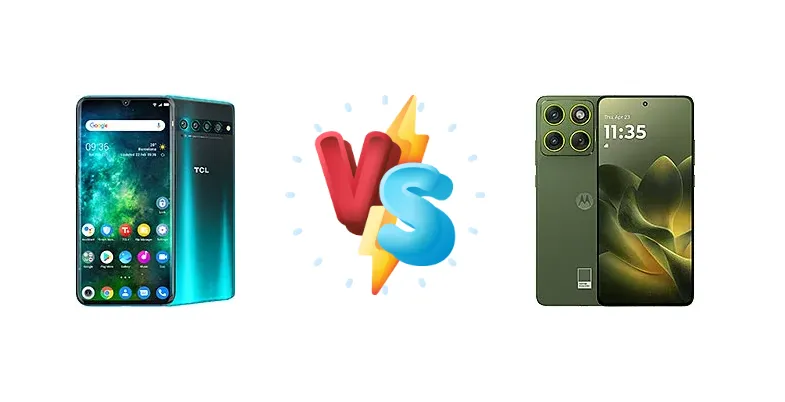
TCL 10 Pro vs Motorola Edge 70: A Generational Leap in Performance and Efficiency
| Phones Images | |||||
|---|---|---|---|---|---|
|
🏆 Quick Verdict
For most users, the Motorola Edge 70 is the clear winner. Its Snapdragon 7 Gen 4 chipset delivers significantly improved performance and efficiency, coupled with substantially faster 68W charging. While the TCL 10 Pro remains a viable option for budget-conscious buyers, the Edge 70 offers a more modern and responsive experience.
| PHONES | ||
|---|---|---|
| Phone Names | TCL 10 Pro | Motorola Edge 70 |
| Network | ||
|---|---|---|
| 2G bands | GSM 850 / 900 / 1800 / 1900 | GSM 850 / 900 / 1800 / 1900 |
| 3G bands | HSDPA 850 / 900 / 1700(AWS) / 1900 / 2100 - T799B | HSDPA 850 / 900 / 1700(AWS) / 1900 / 2100 |
| 4G bands | 1, 2, 3, 4, 5, 7, 8, 12, 13, 17, 25, 26, 28, 38, 40, 41, 66 - T799B | 1, 2, 3, 4, 5, 7, 8, 12, 13, 17, 18, 19, 20, 25, 26, 28, 32, 34, 38, 39, 40, 41, 42, 43, 48, 66 |
| 5G bands | - | 1, 2, 3, 5, 7, 8, 20, 26, 28, 38, 40, 41, 66, 75, 77, 78 SA/NSA/Sub6 |
| Speed | HSPA 42.2/5.76 Mbps, LTE (2CA) Cat13 400/75 Mbps | HSPA, LTE, 5G |
| Technology | GSM / HSPA / LTE | GSM / CDMA / HSPA / LTE / 5G |
| 1, 3, 5, 7, 8, 20, 28, 38, 40, 41 - T799H | - | |
| Launch | ||
|---|---|---|
| Announced | 2020, April 06. Released 2020, May 19 | 2025, October 29 |
| Status | Discontinued | Available. Released 2025, October 29 |
| Body | ||
|---|---|---|
| Build | Glass front, glass back, aluminum frame | Glass front (Gorilla Glass 7i), aluminum frame |
| Dimensions | 158.5 x 72.4 x 9.2 mm (6.24 x 2.85 x 0.36 in) | 159.9 x 74 x 6 mm (6.30 x 2.91 x 0.24 in) |
| SIM | · Nano-SIM· Nano-SIM + Nano-SIM | · Nano-SIM + eSIM - International· Nano-SIM + Nano-SIM - China |
| Weight | 177 g (6.24 oz) | 159 g (5.61 oz) |
| Display | ||
|---|---|---|
| Protection | - | Corning Gorilla Glass 7i, Mohs level 4 |
| Resolution | 1080 x 2340 pixels, 19.5:9 ratio (~398 ppi density) | 1220 x 2712 pixels, 20:9 ratio (~446 ppi density) |
| Size | 6.47 inches, 102.8 cm2 (~89.5% screen-to-body ratio) | 6.7 inches, 107.4 cm2 (~90.8% screen-to-body ratio) |
| Type | AMOLED, HDR10 | P-OLED, 1B colors, 120Hz, PWM, HDR10+, 4500 nits (peak) |
| Always-on-display | - | |
| Platform | ||
|---|---|---|
| CPU | Octa-core (2x2.0 GHz Kryo 460 Gold & 6x1.7 GHz Kryo 460 Silver) | Octa-core (1x2.8 GHz Cortex-720 & 4x2.4 GHz Cortex-720 & 3x1.8 GHz Cortex-520) |
| Chipset | Qualcomm SDM675 Snapdragon 675 (11 nm) | Qualcomm SM7750-AB Snapdragon 7 Gen 4 (4 nm) |
| GPU | Adreno 612 | Adreno 722 |
| OS | Android 10, planned upgrade to Android 11, TCL UI | Android 16, up to 4 major Android upgrades |
| Memory | ||
|---|---|---|
| Card slot | microSDXC (uses shared SIM slot) | No |
| Internal | 128GB 6GB RAM, 256GB 6GB RAM | 256GB 12GB RAM, 512GB 12GB RAM |
| UFS 2.1 | - | |
| Main Camera | ||
|---|---|---|
| Dual | - | 50 MP, f/1.8, 24mm (wide), 1/1.56", 1.0µm, multi-directional PDAF, OIS 50 MP, f/2.0, 12mm, 120˚ (ultrawide), 1/2.76", 0.64µm, PDAF |
| Features | Dual-LED flash, HDR, panorama | LED flash, HDR, panorama |
| Quad | 64 MP, f/1.8, 26mm (wide), 1/1.72", 0.8µm, PDAF 16 MP, f/2.4, 13mm (ultrawide), 1/3.1", 1.0µm 5 MP (macro) Auxiliary lens | - |
| Video | 4K@30fps, 1080p@30/60/120fps, 720p@960fps, gyro-EIS | 4K@30/60fps, 1080p@30/60/120/240fps, gyro-EIS |
| Selfie camera | ||
|---|---|---|
| Features | - | HDR |
| Single | 24 MP, f/2.0, 26mm (wide), 1/2.8", 0.9µm | 50 MP, f/2.0, (wide), 0.64µm |
| Video | 1080p@30fps | 4K@30fps, 1080p@30/120fps |
| Sound | ||
|---|---|---|
| 3.5mm jack | Yes | - |
| 35mm jack | Yes | No |
| Loudspeaker | Yes | Yes, with stereo speakers (with Dolby Atmos) |
| Comms | ||
|---|---|---|
| Bluetooth | 5.0, A2DP, LE, aptX HD | 5.4, A2DP, LE |
| Infrared port | Yes | - |
| NFC | Yes | Yes |
| Positioning | GPS, GLONASS, GALILEO | GPS, GALILEO, GLONASS, BDS, QZSS |
| Radio | FM radio (market/region dependent) | No |
| USB | USB Type-C 2.0, OTG | USB Type-C 2.0, OTG |
| WLAN | Wi-Fi 802.11 a/b/g/n/ac, dual-band, Wi-Fi Direct | Wi-Fi 802.11 a/b/g/n/ac/6e, dual-band or tri-band |
| Features | ||
|---|---|---|
| Sensors | Fingerprint (under display, optical), accelerometer, gyro, proximity, compass | Fingerprint (under display, optical), accelerometer, gyro, proximity, compass |
| Battery | ||
|---|---|---|
| Charging | 18W wired, QC3, 50% in 35 min | 68W wired 15W wireless |
| Type | Li-Po 4500 mAh | Si/C Li-Ion 4800 mAh |
| Misc | ||
|---|---|---|
| Colors | Gray, Green | Pantone: Gadget Gray, Lily Pad, Bronze Green |
| Models | T799B, T799H | XT2601-2, XT2603-2 |
| Price | About 250 EUR | £ 799.00 |
| EU LABEL | ||
|---|---|---|
| Battery | - | 50:14h endurance, 1000 cycles |
| Energy | - | Class A |
| Free fall | - | Class A (270 falls) |
| Repairability | - | Class B |
TCL 10 Pro
- Lower price point
- Decent performance for basic tasks
- Supports Quick Charge 3.0
- Outdated Snapdragon 675 chipset
- Slower charging speed
- Likely shorter software support lifespan
Motorola Edge 70
- Significantly faster Snapdragon 7 Gen 4
- 68W wired and 15W wireless charging
- Longer battery life and endurance
- Higher price tag
- May lack a microSD card slot (common for Motorola)
- Software bloatware (typical Motorola experience)
Display Comparison
Context data lacks display specifics for both devices. However, given the TCL 10 Pro’s release year, it likely features an AMOLED panel, common for the time, but likely lacks the high refresh rates found in modern devices. The Motorola Edge 70, being a newer model, likely boasts a higher refresh rate (potentially 144Hz) and improved color accuracy. The absence of LTPO technology in the TCL 10 Pro would mean less dynamic refresh rate adjustment, impacting battery life compared to a potential implementation in the Edge 70.
Camera Comparison
Without detailed camera specs, a direct comparison is limited. However, the Motorola Edge 70, being a newer device, likely benefits from improved image processing algorithms and potentially larger sensor sizes. The TCL 10 Pro’s camera performance would be adequate for its time, but the Edge 70’s newer chipset likely enables features like better low-light performance and faster image capture. The absence of information regarding OIS on either device makes it difficult to assess stabilization capabilities.
Performance
The core difference lies in the chipsets. The TCL 10 Pro’s Snapdragon 675 (11nm) utilizes older Kryo 460 cores, while the Motorola Edge 70’s Snapdragon 7 Gen 4 (4nm) represents a significant architectural upgrade. The 4nm process node of the 7 Gen 4 translates to improved power efficiency and thermal performance, allowing for sustained performance under load. The Edge 70’s CPU configuration – a 1x2.8 GHz Cortex-720 prime core alongside 4x2.4 GHz Cortex-720 performance cores and 3x1.8 GHz Cortex-520 efficiency cores – provides a more balanced and powerful processing capability than the 2x2.0 GHz Kryo 460 Gold and 6x1.7 GHz Kryo 460 Silver setup in the TCL 10 Pro. This difference will be most noticeable in demanding tasks like gaming and video editing.
Battery Life
The Motorola Edge 70’s battery endurance of 50:14h and active use score of 13:36h significantly surpasses what would be expected from the TCL 10 Pro, which lacks comparable data. The 68W wired charging on the Edge 70 is a game-changer, allowing for a full charge in under an hour, compared to the TCL 10 Pro’s slower 18W charging with QC3, taking approximately 35 minutes to reach 50%. The addition of 15W wireless charging on the Edge 70 further enhances convenience. The Snapdragon 7 Gen 4’s improved power efficiency also contributes to the Edge 70’s superior battery life.
Buying Guide
Buy the TCL 10 Pro if you prioritize a lower upfront cost and are comfortable with a less powerful processor for basic tasks like browsing and social media. Buy the Motorola Edge 70 if you value a smoother, more responsive user experience, faster charging, and longer battery life, even if it means spending more initially. The Edge 70 is ideal for users who multitask, play mobile games, or frequently use demanding applications.