
TCL 10 Pro vs. Google Pixel 4a 5G: A Deep Dive into Mid-Range Performance
| Phones Images | |||||
|---|---|---|---|---|---|
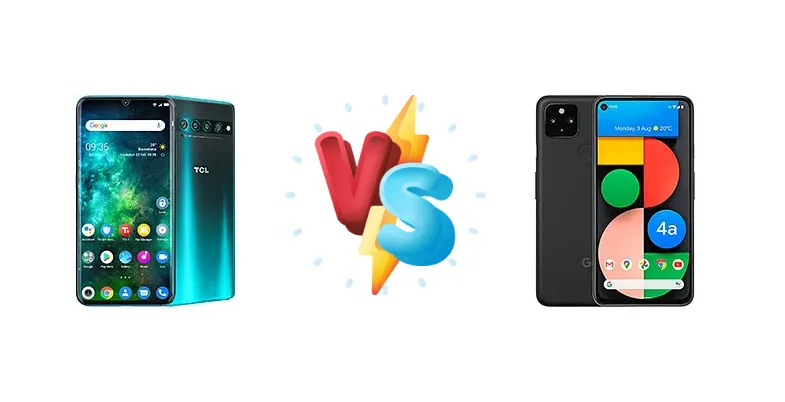
|
🏆 Quick Verdict
For most users, the Google Pixel 4a 5G is the better choice. Its Snapdragon 765G chipset, built on a more efficient 7nm process, provides a noticeable performance boost and 5G support, outweighing the TCL 10 Pro’s larger display. The Pixel’s software experience and camera capabilities further solidify its advantage.
| PHONES | ||
|---|---|---|
| Phone Names | TCL 10 Pro | Google Pixel 4a 5G |
| Network | ||
|---|---|---|
| 2G bands | GSM 850 / 900 / 1800 / 1900 | GSM 850 / 900 / 1800 / 1900 |
| 3G bands | HSDPA 850 / 900 / 1700(AWS) / 1900 / 2100 - T799B | HSDPA 850 / 900 / 1700(AWS) / 1900 / 2100 |
| 4G bands | 1, 2, 3, 4, 5, 7, 8, 12, 13, 17, 25, 26, 28, 38, 40, 41, 66 - T799B | 1, 2, 3, 4, 5, 7, 8, 12, 13, 14, 17, 18, 19, 20, 25, 26, 28, 29, 30, 32, 38, 39, 40, 41, 42, 46, 48, 66, 71 |
| 5G bands | - | 1, 2, 3, 5, 7, 8, 12, 28, 41, 66, 71, 77, 78 Sub6, mmWave (market dependant) |
| Speed | HSPA 42.2/5.76 Mbps, LTE (2CA) Cat13 400/75 Mbps | HSPA, LTE, 5G |
| Technology | GSM / HSPA / LTE | GSM / HSPA / LTE / 5G |
| 1, 3, 5, 7, 8, 20, 28, 38, 40, 41 - T799H | - | |
| Launch | ||
|---|---|---|
| Announced | 2020, April 06. Released 2020, May 19 | 2020, September 30 |
| Status | Discontinued | Available. Released 2020, November 05 |
| Body | ||
|---|---|---|
| Build | Glass front, glass back, aluminum frame | Glass front (Gorilla Glass 3), plastic back, plastic frame |
| Dimensions | 158.5 x 72.4 x 9.2 mm (6.24 x 2.85 x 0.36 in) | 153.9 x 74 x 8.2 mm (Sub-6) or 8.5 mm (Sub-6 and mmWave) |
| SIM | · Nano-SIM· Nano-SIM + Nano-SIM | Nano-SIM + eSIM |
| Weight | 177 g (6.24 oz) | 168 g (5G Sub-6); 171 g ( 5G Sub-6 and mmWave) (5.93 oz) |
| Display | ||
|---|---|---|
| Protection | - | Corning Gorilla Glass 3 |
| Resolution | 1080 x 2340 pixels, 19.5:9 ratio (~398 ppi density) | 1080 x 2340 pixels, 19.5:9 ratio (~413 ppi density) |
| Size | 6.47 inches, 102.8 cm2 (~89.5% screen-to-body ratio) | 6.2 inches, 95.7 cm2 (~84.1% screen-to-body ratio) |
| Type | AMOLED, HDR10 | OLED, HDR |
| Always-on-display | Always-on display | |
| Platform | ||
|---|---|---|
| CPU | Octa-core (2x2.0 GHz Kryo 460 Gold & 6x1.7 GHz Kryo 460 Silver) | Octa-core (1x2.4 GHz Kryo 475 Prime & 1x2.2 GHz Kryo 475 Gold & 6x1.8 GHz Kryo 475 Silver) |
| Chipset | Qualcomm SDM675 Snapdragon 675 (11 nm) | Qualcomm SM7250 Snapdragon 765G 5G (7 nm) |
| GPU | Adreno 612 | Adreno 620 |
| OS | Android 10, planned upgrade to Android 11, TCL UI | Android 11, upgradable to Android 14 |
| Memory | ||
|---|---|---|
| Card slot | microSDXC (uses shared SIM slot) | No |
| Internal | 128GB 6GB RAM, 256GB 6GB RAM | 128GB 6GB RAM |
| UFS 2.1 | UFS 2.1 | |
| Main Camera | ||
|---|---|---|
| Dual | - | 12.2 MP, f/1.7, 27mm (wide), 1/2.55", 1.4µm, dual pixel PDAF, OIS 16 MP, f/2.2, 107˚ (ultrawide), 1.0µm |
| Features | Dual-LED flash, HDR, panorama | LED flash, Pixel Shift, Auto-HDR, panorama |
| Quad | 64 MP, f/1.8, 26mm (wide), 1/1.72", 0.8µm, PDAF 16 MP, f/2.4, 13mm (ultrawide), 1/3.1", 1.0µm 5 MP (macro) Auxiliary lens | - |
| Video | 4K@30fps, 1080p@30/60/120fps, 720p@960fps, gyro-EIS | 4K@30/60fps, 1080p@30/60/120/240fps; gyro-EIS |
| Selfie camera | ||
|---|---|---|
| Features | - | HDR |
| Single | 24 MP, f/2.0, 26mm (wide), 1/2.8", 0.9µm | 8 MP, f/2.0, 24mm (wide), 1/4.0", 1.12µm |
| Video | 1080p@30fps | 1080p@30fps |
| Sound | ||
|---|---|---|
| 3.5mm jack | Yes | Yes |
| 35mm jack | Yes | Yes |
| Loudspeaker | Yes | Yes, with stereo speakers |
| Comms | ||
|---|---|---|
| Bluetooth | 5.0, A2DP, LE, aptX HD | 5.0, A2DP, LE, aptX HD |
| Infrared port | Yes | - |
| NFC | Yes | Yes |
| Positioning | GPS, GLONASS, GALILEO | GPS, GLONASS, GALILEO, QZSS, BDS |
| Radio | FM radio (market/region dependent) | No |
| USB | USB Type-C 2.0, OTG | USB Type-C 3.1 |
| WLAN | Wi-Fi 802.11 a/b/g/n/ac, dual-band, Wi-Fi Direct | Wi-Fi 802.11 a/b/g/n/ac, dual-band, Wi-Fi Direct |
| Features | ||
|---|---|---|
| Sensors | Fingerprint (under display, optical), accelerometer, gyro, proximity, compass | Fingerprint (rear-mounted), accelerometer, gyro, proximity, compass, barometer |
| Battery | ||
|---|---|---|
| Charging | 18W wired, QC3, 50% in 35 min | 18W wired, PD2.0 |
| Type | Li-Po 4500 mAh | Li-Po 3885 mAh |
| Misc | ||
|---|---|---|
| Colors | Gray, Green | Just Black, Clearly White |
| Models | T799B, T799H | GD1YQ, G025I, G025E, G025H, G6QU3 |
| Price | About 250 EUR | About 140 EUR |
TCL 10 Pro
- Potentially larger display size for immersive media consumption.
- Competitive price point.
- QC3 fast charging compatibility.
- Older Snapdragon 675 chipset offers lower performance.
- Lacks 5G connectivity.
- Potentially less efficient power consumption.
Google Pixel 4a 5G
- Faster and more efficient Snapdragon 765G chipset.
- 5G connectivity for faster data speeds.
- Superior camera performance thanks to Google’s software.
- May have a smaller display size.
- PD2.0 charging standard may require a specific charger.
- Potentially higher price point.
Display Comparison
While specific display specs beyond size aren't provided, the TCL 10 Pro likely boasts a larger display, given its overall dimensions. However, the Pixel 4a 5G benefits from a more modern chipset capable of driving higher refresh rates (though not confirmed). The Snapdragon 675 in the TCL 10 Pro, being an older chip, may struggle with demanding graphical tasks on a larger display. Color accuracy and brightness are unknown for both, but the Pixel’s software calibration is generally highly regarded.
Camera Comparison
Without detailed camera specs, it’s difficult to make a definitive judgment. However, Google’s computational photography prowess is a major strength. The Pixel 4a 5G leverages Google’s image processing algorithms to deliver consistently excellent photos, even in challenging lighting conditions. While the TCL 10 Pro may have a higher megapixel count, the Pixel’s software optimization and potentially larger sensor (based on Google’s typical approach) likely result in superior image quality. The 765G’s ISP also offers more advanced image processing capabilities.
Performance
The core difference lies in the chipsets. The Google Pixel 4a 5G’s Snapdragon 765G (7nm) is a significant upgrade over the TCL 10 Pro’s Snapdragon 675 (11nm). The 7nm process allows for greater transistor density and improved power efficiency, translating to better sustained performance and less thermal throttling. The 765G’s Kryo 475 Prime core, clocked at 2.4 GHz, offers a substantial CPU performance advantage over the 2.0 GHz Kryo 460 Gold cores in the TCL 10 Pro. This difference is particularly noticeable in multitasking and demanding applications. The 765G also includes an integrated 5G modem, a feature absent in the TCL 10 Pro.
Battery Life
Both phones feature 18W wired charging with different standards (QC3 for TCL, PD2.0 for Google). While charging speeds are similar (50% in 35 minutes for TCL), the Snapdragon 765G’s superior power efficiency in the Pixel 4a 5G means it will likely offer better real-world battery life despite potentially having a similar or smaller battery capacity. The 7nm process contributes significantly to reduced power consumption during everyday tasks.
Buying Guide
Buy the TCL 10 Pro if you prioritize a larger screen for media consumption and don't require 5G connectivity. It's a solid option for users who primarily use their phone for streaming and browsing. Buy the Google Pixel 4a 5G if you value performance, 5G access, a clean software experience, and a consistently excellent camera – making it ideal for users who multitask, game, or rely heavily on mobile photography.