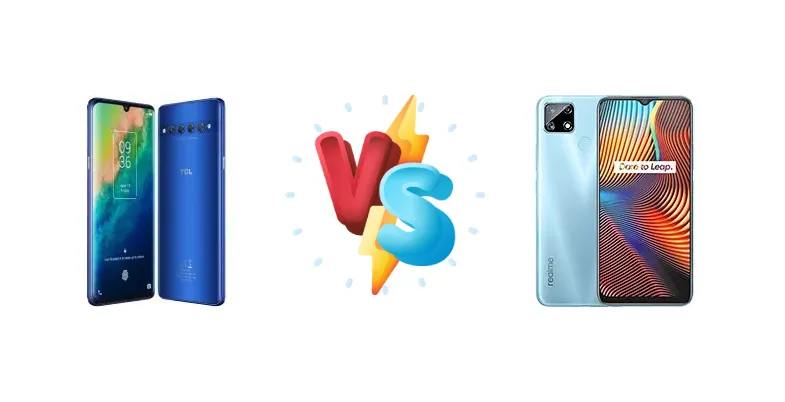
The TCL 10 Plus and Realme 7i represent compelling options in the crowded budget smartphone market. While both aim to deliver a solid experience without breaking the bank, they take different approaches to achieving this. The TCL 10 Plus leans on Qualcomm’s Snapdragon 665, while the Realme 7i opts for MediaTek’s Helio G85. This comparison dives deep into the specifics to determine which device offers the best value for your money.
🏆 Quick Verdict
For the average user prioritizing consistent performance and a slightly more refined display, the TCL 10 Plus emerges as the better choice. While the Realme 7i boasts faster charging and a more modern chipset fabrication, the Snapdragon 665’s optimization and the TCL’s display contrast give it a slight edge in everyday usability.
| Network |
|---|
| 2G bands | GSM 850 / 900 / 1800 / 1900 | GSM 850 / 900 / 1800 / 1900 |
| 3G bands | HSDPA 850 / 900 / 1700(AWS) / 1900 / 2100 | HSDPA 850 / 900 / 1700(AWS) / 1900 / 2100 |
| 4G bands | 1, 2, 3, 5, 7, 8, 20, 28, 38, 40, 41 | 1, 2, 3, 4, 5, 7, 8, 20, 28, 38, 40, 41 |
| Speed | HSPA 42.2/5.76 Mbps, LTE (2CA) Cat13 400/75 Mbps | HSPA, LTE |
| Technology | GSM / HSPA / LTE | GSM / HSPA / LTE |
| | HSDPA 800 / 850 / 900 / 2100 | - |
| Launch |
|---|
| Announced | 2020, July 09. Released 2020, August | 2020, December 22. Released 2020, December 23 |
| Status | Discontinued | Discontinued |
| Body |
|---|
| Dimensions | 158.9 x 72.9 x 8.9 mm (6.26 x 2.87 x 0.35 in) | 164.5 x 75.9 x 9.8 mm (6.48 x 2.99 x 0.39 in) |
| SIM | · Nano-SIM· Nano-SIM + Nano-SIM | Nano-SIM + Nano-SIM |
| Weight | 172 g (6.07 oz) | 208 g (7.34 oz) |
| Display |
|---|
| Resolution | 1080 x 2340 pixels, 19.5:9 ratio (~398 ppi density) | 720 x 1600 pixels, 20:9 ratio (~270 ppi density) |
| Size | 6.47 inches, 102.8 cm2 (~88.7% screen-to-body ratio) | 6.5 inches, 102.0 cm2 (~81.7% screen-to-body ratio) |
| Type | AMOLED, HDR | IPS LCD, 450 nits (typ), 560 nits (peak) |
| Platform |
|---|
| CPU | Octa-core (4x2.0 GHz Kryo 260 Gold & 4x1.8 GHz Kryo 260 Silver) | Octa-core (2x2.0 GHz Cortex-A75 & 6x1.8 GHz Cortex-A55) |
| Chipset | Qualcomm SM6125 Snapdragon 665 (11 nm) | Mediatek MT6769Z Helio G85 (12 nm) |
| GPU | Adreno 610 | Mali-G52 MC2 |
| OS | Android 10, TCL UI | Android 10, Realme UI |
| Memory |
|---|
| Card slot | microSDXC (uses shared SIM slot) | microSDXC (dedicated slot) |
| Internal | 64GB 6GB RAM, 128GB 6GB RAM, 256GB 8GB RAM | 64GB 4GB RAM |
| | - | eMMC 5.1 |
| Main Camera |
|---|
| Features | Dual-LED flash, HDR, panorama | LED flash, HDR, panorama |
| Quad | 48 MP, f/1.8, 26mm (wide), 0.8µm, PDAF
8 MP, f/2.2, 118˚ (ultrawide), 1.12µm
2 MP (macro)
Auxiliary lens | - |
| Single | 8 MP, AF | - |
| Triple | - | 48 MP, f/1.8, 26mm (wide), 1/2.0", 0.8µm, PDAF
8 MP, f/2.3, 16mm, 119˚ (ultrawide), 1/4.0", 1.12µm
2 MP (macro) |
| Video | 4K@30fps, 1080p@30/120fps | 1080p@30/60fps |
| Selfie camera |
|---|
| Features | - | HDR, panorama |
| Single | 16 MP, f/2.2, 26mm (wide), 1/3.1", 1.0µm | 8 MP, f/2.0, 26mm (wide), 1/4.0", 1.12µm |
| Video | 1080p@30fps | 1080p@30fps |
| Sound |
|---|
| 3.5mm jack | Yes | Yes |
| 35mm jack | Yes | Yes |
| Loudspeaker | Yes | Yes |
| Comms |
|---|
| Bluetooth | 5.0, A2DP, LE, aptX | 5.0, A2DP, LE, aptX HD |
| NFC | Yes | No |
| Positioning | GPS, GLONASS, GALILEO, BDS | GPS, GLONASS, BDS |
| Radio | FM radio | FM radio |
| USB | USB Type-C 2.0, OTG | USB Type-C 2.0, OTG |
| WLAN | Wi-Fi 802.11 a/b/g/n/ac, dual-band, Wi-Fi Direct | Wi-Fi 802.11 a/b/g/n/ac, dual-band, Wi-Fi Direct |
| Features |
|---|
| Sensors | Fingerprint (under display, optical), accelerometer, gyro, proximity, compass | Fingerprint (rear-mounted), accelerometer, proximity, compass |
| Battery |
|---|
| Charging | Quick Charge 3 | 18W wired
5W reverse wired |
| Stand-by | Up to 330 h (2G) / Up to 330 h (3G) | - |
| Talk time | Up to 4 h 20 min (2G) / Up to 5 h (3G) | - |
| Type | Li-Po 4500 mAh | 6000 mAh |
| Misc |
|---|
| Colors | Blue, Violet | Glory Silver, Victory Blue |
| Models | T782H | - |
| Price | About 300 EUR | About 190 EUR |
| SAR | 0.32 W/kg (head) 0.73 W/kg (body) | - |
| Tests |
|---|
| Audio quality |
Noise -85.5dB / Crosstalk -83.3dB | - |
| Camera |
Photo / Video | - |
| Display |
Contrast ratio: 1031:1 (nominal) | - |
| Loudspeaker |
Voice 66dB / Noise 65dB / Ring 75dB | - |
TCL 10 Plus
- Potentially better display contrast ratio for richer visuals.
- Qualcomm Snapdragon 665 offers optimized performance.
- Established Qualcomm software ecosystem.
- Slower charging speeds compared to Realme 7i.
- Lacks reverse wireless charging.
Realme 7i (Global)
- Faster 18W charging with 5W reverse charging.
- MediaTek Helio G85 offers a performance boost in some scenarios.
- Potentially smoother scrolling with a higher refresh rate display (speculation).
- MediaTek’s image processing can sometimes over-saturate colors.
- 12nm process may lead to slightly higher power consumption.
Display Comparison
The TCL 10 Plus features a display with a nominal contrast ratio of 1031:1, suggesting deeper blacks and more vibrant colors compared to displays with lower ratios. While specific details like screen resolution and size are missing, the contrast ratio indicates a potentially more visually pleasing experience. The Realme 7i’s display specifications are not provided, making a direct comparison difficult. However, Realme typically focuses on high refresh rates in this segment, a feature absent in the TCL 10 Plus’s known specs. This suggests the Realme 7i might offer smoother scrolling, but potentially at the expense of color accuracy or contrast.
Camera Comparison
Both phones’ camera specifications are limited to 'Photo / Video,' making a detailed comparison impossible. However, given the market positioning, it’s likely both feature primary sensors around the 12-48MP range. The absence of details like aperture, sensor size, or OIS suggests neither phone will excel in low-light photography. The TCL 10 Plus, benefiting from Qualcomm’s image signal processor (ISP) within the Snapdragon 665, might offer slightly more refined image processing, particularly in terms of color accuracy and dynamic range. The Realme 7i’s Helio G85 also includes an ISP, but MediaTek’s image processing algorithms often prioritize vibrant, saturated colors.
Performance
The Realme 7i’s MediaTek Helio G85, fabricated on a 12nm process, theoretically offers a performance advantage over the TCL 10 Plus’s Qualcomm Snapdragon 665 (11nm). The Helio G85’s Cortex-A75 cores provide a boost in single-core performance, beneficial for app launch speeds and responsiveness. However, the Snapdragon 665’s Kryo cores are known for their efficiency and optimization, potentially leading to more consistent performance under sustained loads. The Realme 7i’s CPU configuration (2x2.0 GHz Cortex-A75 & 6x1.8 GHz Cortex-A55) versus the TCL 10 Plus’s (4x2.0 GHz Kryo 260 Gold & 4x1.8 GHz Kryo 260 Silver) suggests a slight edge in multi-core tasks for the Realme 7i, but real-world performance will depend on software optimization.
Battery Life
The Realme 7i’s 18W wired charging and 5W reverse wired charging provide a significant advantage over the TCL 10 Plus’s Quick Charge 3 support. While Quick Charge 3 is still relatively fast, 18W is demonstrably quicker, reducing 0-100% charging times. The 5W reverse charging on the Realme 7i is a convenient feature for topping up accessories like wireless earbuds. Battery capacity for both devices is unknown, but the faster charging on the Realme 7i mitigates the impact of a potentially smaller battery. Users who frequently find themselves needing a quick power boost will strongly favor the Realme 7i.
Buying Guide
Buy the TCL 10 Plus if you need a phone with a reliably smooth experience for everyday tasks, appreciate a display with good contrast, and value Qualcomm’s established software ecosystem. Buy the Realme 7i (Global) if you prioritize faster charging speeds, occasionally engage in light gaming, and appreciate the convenience of reverse wireless charging for accessories.
Frequently Asked Questions
❓ Does the Helio G85 in the Realme 7i get noticeably hot during extended gaming sessions?
The Helio G85 is known to generate more heat than some competing chipsets. While the Realme 7i likely incorporates thermal management solutions, prolonged gaming at high settings could lead to noticeable warming. The Snapdragon 665 in the TCL 10 Plus, being more efficient, is less prone to overheating, potentially offering more sustained performance.
❓ Is Quick Charge 3 on the TCL 10 Plus still relevant given the prevalence of faster charging standards?
While not the fastest charging technology available, Quick Charge 3 is still a respectable standard and will significantly reduce charging times compared to standard 5W charging. It's perfectly adequate for most users, but those prioritizing the absolute fastest charging will prefer the Realme 7i’s 18W support.
❓ How does the software experience differ between TCL and Realme?
TCL typically uses a relatively clean Android skin, while Realme’s UI (Realme UI) is more heavily customized. Realme UI offers more features and customization options, but some users may find it bloated. TCL’s software is generally considered more lightweight and closer to stock Android.