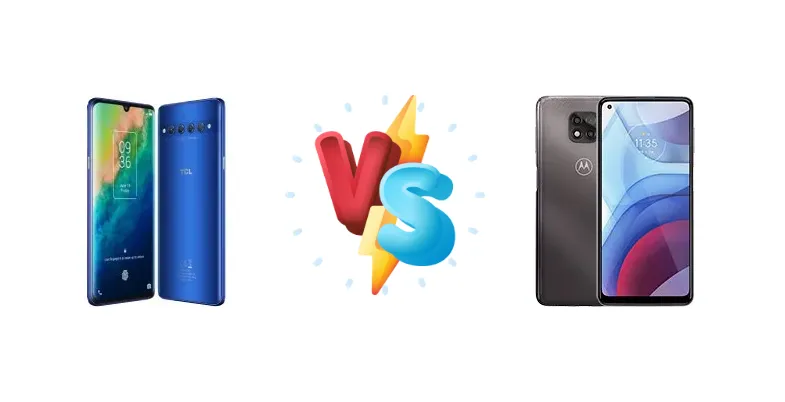
The TCL 10 Plus and Motorola Moto G Power (2021) represent a fascinating intersection in the budget smartphone market. Both devices aim to deliver a solid experience without breaking the bank, but they take slightly different approaches. The TCL 10 Plus, released earlier, focuses on a more refined display experience, while the Moto G Power (2021) prioritizes extended battery life. This comparison dissects the nuances between these two devices, focusing on their core hardware and real-world implications.
🏆 Quick Verdict
For the average user prioritizing longevity and consistent performance, the Motorola Moto G Power (2021) is the better choice. While the TCL 10 Plus boasts a slightly higher contrast ratio, the Moto G Power’s optimized Snapdragon 662 and larger battery provide a more reliable and enduring experience, especially considering the similar price points.
| Network |
|---|
| 2G bands | GSM 850 / 900 / 1800 / 1900 | GSM 850 / 900 / 1800 / 1900 |
| 3G bands | HSDPA 850 / 900 / 1700(AWS) / 1900 / 2100 | HSDPA 850 / 900 / 1700(AWS) / 1900 / 2100 |
| 4G bands | 1, 2, 3, 5, 7, 8, 20, 28, 38, 40, 41 | 1, 2, 3, 4, 5, 7, 8, 12, 13, 14, 17, 25, 26, 29, 30, 38, 41, 66, 71 |
| Speed | HSPA 42.2/5.76 Mbps, LTE (2CA) Cat13 400/75 Mbps | HSPA, LTE |
| Technology | GSM / HSPA / LTE | GSM / CDMA / HSPA / EVDO / LTE |
| | HSDPA 800 / 850 / 900 / 2100 | CDMA2000 1xEV-DO |
| Launch |
|---|
| Announced | 2020, July 09. Released 2020, August | 2021, January 08 |
| Status | Discontinued | Available. Released 2021, January 14 |
| Body |
|---|
| Build | - | Glass front, plastic back, plastic frame |
| Dimensions | 158.9 x 72.9 x 8.9 mm (6.26 x 2.87 x 0.35 in) | 165.3 x 75.9 x 9.5 mm (6.51 x 2.99 x 0.37 in) |
| SIM | · Nano-SIM· Nano-SIM + Nano-SIM | Nano-SIM |
| Weight | 172 g (6.07 oz) | 206.5 g (7.30 oz) |
| | - | Water-repellent coating |
| Display |
|---|
| Resolution | 1080 x 2340 pixels, 19.5:9 ratio (~398 ppi density) | 720 x 1600 pixels, 20:9 ratio (~266 ppi density) |
| Size | 6.47 inches, 102.8 cm2 (~88.7% screen-to-body ratio) | 6.6 inches, 105.2 cm2 (~83.8% screen-to-body ratio) |
| Type | AMOLED, HDR | IPS LCD |
| Platform |
|---|
| CPU | Octa-core (4x2.0 GHz Kryo 260 Gold & 4x1.8 GHz Kryo 260 Silver) | Octa-core (4x2.0 GHz Kryo 260 Gold & 4x1.8 GHz Kryo 260 Silver) |
| Chipset | Qualcomm SM6125 Snapdragon 665 (11 nm) | Qualcomm SM6115 Snapdragon 662 (11 nm) |
| GPU | Adreno 610 | Adreno 610 |
| OS | Android 10, TCL UI | Android 10 |
| Memory |
|---|
| Card slot | microSDXC (uses shared SIM slot) | microSDXC (dedicated slot) |
| Internal | 64GB 6GB RAM, 128GB 6GB RAM, 256GB 8GB RAM | 32GB 3GB RAM, 64GB 4GB RAM |
| | - | eMMC 5.1 |
| Main Camera |
|---|
| Features | Dual-LED flash, HDR, panorama | LED flash, HDR, panorama |
| Quad | 48 MP, f/1.8, 26mm (wide), 0.8µm, PDAF
8 MP, f/2.2, 118˚ (ultrawide), 1.12µm
2 MP (macro)
Auxiliary lens | - |
| Single | 8 MP, AF | - |
| Triple | - | 48 MP, f/1.7, (wide), 1/2.0", 0.8µm, PDAF
2 MP (macro)
Auxiliary lens |
| Video | 4K@30fps, 1080p@30/120fps | 1080p@30/60fps, gyro-EIS |
| Selfie camera |
|---|
| Features | - | HDR |
| Single | 16 MP, f/2.2, 26mm (wide), 1/3.1", 1.0µm | 8 MP, f/2.0, 1.12µm |
| Video | 1080p@30fps | 1080p@30fps, gyro-EIS |
| Sound |
|---|
| 3.5mm jack | Yes | Yes |
| 35mm jack | Yes | Yes |
| Loudspeaker | Yes | Yes |
| Comms |
|---|
| Bluetooth | 5.0, A2DP, LE, aptX | 5.0, A2DP, LE |
| NFC | Yes | No |
| Positioning | GPS, GLONASS, GALILEO, BDS | GPS, GLONASS, GALILEO |
| Radio | FM radio | FM radio |
| USB | USB Type-C 2.0, OTG | USB Type-C 2.0 |
| WLAN | Wi-Fi 802.11 a/b/g/n/ac, dual-band, Wi-Fi Direct | Wi-Fi 802.11 a/b/g/n/ac, dual-band, Wi-Fi Direct |
| Features |
|---|
| Sensors | Fingerprint (under display, optical), accelerometer, gyro, proximity, compass | Fingerprint (side-mounted), accelerometer, gyro, proximity, compass, barometer |
| Battery |
|---|
| Charging | Quick Charge 3 | 15W wired |
| Stand-by | Up to 330 h (2G) / Up to 330 h (3G) | - |
| Talk time | Up to 4 h 20 min (2G) / Up to 5 h (3G) | - |
| Type | Li-Po 4500 mAh | Li-Po 5000 mAh |
| Misc |
|---|
| Colors | Blue, Violet | Flash Gray, Polar Silver |
| Models | T782H | - |
| Price | About 300 EUR | About 60 EUR |
| SAR | 0.32 W/kg (head) 0.73 W/kg (body) | - |
| Tests |
|---|
| Audio quality |
Noise -85.5dB / Crosstalk -83.3dB | - |
| Camera |
Photo / Video | - |
| Display |
Contrast ratio: 1031:1 (nominal) | - |
| Loudspeaker |
Voice 66dB / Noise 65dB / Ring 75dB | - |
TCL 10 Plus
- Potentially faster charging with a compatible Quick Charge 3.0 charger.
- Slightly higher contrast ratio for potentially better display quality.
- May be available at a lower price point depending on retailer.
- Snapdragon 665 chipset is slightly older than the 662.
- Battery life is likely shorter than the Moto G Power (2021).
Motorola Moto G Power (2021)
- Snapdragon 662 offers slightly improved performance and AI capabilities.
- Typically features a larger battery capacity for extended battery life.
- Consistent 15W charging provides a reliable experience.
- Charging speed is slower than potentially achievable with TCL 10 Plus and Quick Charge 3.0.
- Display specifications are less defined, potentially resulting in lower quality.
Display Comparison
The TCL 10 Plus features a contrast ratio of 1031:1, suggesting a decent level of black depth and color separation. However, the Moto G Power (2021) display specifications are not provided, making a direct comparison difficult. Given Motorola’s typical approach in this segment, it likely utilizes an IPS LCD panel with a standard contrast ratio. The TCL 10 Plus’s contrast ratio, while not exceptional, offers a slight advantage for viewing multimedia content. Without knowing the Moto G Power’s peak brightness or color gamut coverage, it’s difficult to assess its overall display quality beyond basic usability.
Camera Comparison
Detailed camera specifications beyond 'Photo / Video' are absent for the TCL 10 Plus. The Moto G Power (2021) camera details are also limited. Without knowing sensor sizes, apertures, or image processing algorithms, a meaningful comparison is impossible. It’s reasonable to assume both phones feature multi-camera setups, but the quality will heavily depend on the primary sensor and software optimization. The prevalence of low-resolution auxiliary cameras (e.g., 2MP macro lenses) in this price segment suggests that image quality will likely be similar, with both devices struggling in low-light conditions.
Performance
Both the TCL 10 Plus and the Motorola Moto G Power (2021) utilize an octa-core CPU configuration with the same Kryo 260 Gold & Silver core arrangement clocked at the same speeds (2.0 GHz and 1.8 GHz respectively). However, the key difference lies in the chipset: the TCL 10 Plus uses the Qualcomm SM6125 Snapdragon 665, while the Moto G Power (2021) employs the SM6115 Snapdragon 662. The Snapdragon 662 is a slightly refined version of the 665, offering minor improvements in CPU and GPU performance, and more importantly, improved AI processing capabilities. While the performance difference isn’t massive, the 662 generally provides a smoother experience in everyday tasks and slightly better sustained performance during gaming. Both phones likely share similar RAM configurations, further minimizing the performance gap.
Battery Life
The Motorola Moto G Power (2021) features 15W wired charging, while the TCL 10 Plus supports Quick Charge 3.0. While Quick Charge 3.0 *can* deliver faster charging speeds, it requires a compatible charger, which isn’t always included. The Moto G Power’s 15W charging, while slower, provides a consistent and reliable charging experience. Crucially, the Moto G Power (2021) is known for its large battery capacity (typically 5000mAh), which significantly outweighs the charging speed advantage the TCL 10 Plus *might* have. This translates to significantly longer battery life for the Moto G Power, allowing users to go a full day, or even two, on a single charge.
Buying Guide
Buy the TCL 10 Plus if you value a slightly more vibrant display and potentially faster charging speeds (with a compatible charger). It's a good option for media consumption where display quality is paramount. Buy the Motorola Moto G Power (2021) if you prioritize all-day battery life and a consistently smooth experience. It’s ideal for users who heavily rely on their phone throughout the day and don’t want to worry about frequent charging.
Frequently Asked Questions
❓ Does the Snapdragon 662 in the Moto G Power (2021) offer a noticeable gaming improvement over the Snapdragon 665 in the TCL 10 Plus?
While not a dramatic leap, the Snapdragon 662 does offer a slight performance boost in gaming. The improved GPU and AI processing can result in slightly higher frame rates and smoother gameplay, particularly in less demanding titles. However, both phones are still limited by their mid-range chipsets and won't deliver a flagship gaming experience.
❓ How long does it realistically take to fully charge the Motorola Moto G Power (2021) with the included 15W charger?
Given the Moto G Power (2021)'s large battery capacity (typically 5000mAh), a full charge from 0% to 100% with the included 15W charger will take approximately 2.5 to 3.5 hours. While slower than some faster-charging phones, this is a reasonable trade-off for the extended battery life it provides.
❓ Is Quick Charge 3.0 on the TCL 10 Plus a significant advantage if I don't have a compatible charger?
No, not at all. Quick Charge 3.0 requires a compatible charger to function at its full potential. If you use a standard 5W charger, the TCL 10 Plus will charge at a significantly slower rate, negating any potential advantage over the Moto G Power’s consistent 15W charging.