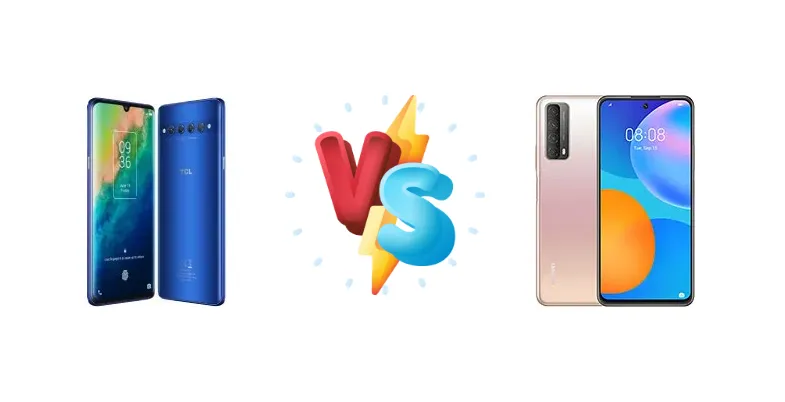
The TCL 10 Plus and Huawei P smart 2021 represent compelling options in the crowded budget smartphone market. While both aim to deliver a solid experience without breaking the bank, they take different approaches to achieving this goal. The TCL 10 Plus leverages Qualcomm’s Snapdragon 665, while the Huawei P smart 2021 opts for Huawei’s in-house Kirin 710A. This comparison dissects their key differences to determine which device offers the best value.
🏆 Quick Verdict
For the average user prioritizing sustained performance and a slightly brighter display, the Huawei P smart 2021 emerges as the better choice. Its Kirin 710A, coupled with faster 22.5W charging, provides a smoother experience and quicker top-ups, despite the TCL 10 Plus having a marginally higher contrast ratio.
| Network |
|---|
| 2G bands | GSM 850 / 900 / 1800 / 1900 | GSM 900 / 1800 / 1900 |
| 3G bands | HSDPA 850 / 900 / 1700(AWS) / 1900 / 2100 | HSDPA 850 / 900 / 1700(AWS) / 1900 / 2100 |
| 4G bands | 1, 2, 3, 5, 7, 8, 20, 28, 38, 40, 41 | 1, 3, 5, 7, 8, 20, 28, 38, 40, 41 |
| Speed | HSPA 42.2/5.76 Mbps, LTE (2CA) Cat13 400/75 Mbps | HSPA, LTE |
| Technology | GSM / HSPA / LTE | GSM / HSPA / LTE |
| | HSDPA 800 / 850 / 900 / 2100 | - |
| Launch |
|---|
| Announced | 2020, July 09. Released 2020, August | 2020, September 28. Released 2020, September 28 |
| Status | Discontinued | Discontinued |
| Body |
|---|
| Dimensions | 158.9 x 72.9 x 8.9 mm (6.26 x 2.87 x 0.35 in) | 165.7 x 76.9 x 9.3 mm (6.52 x 3.03 x 0.37 in) |
| SIM | · Nano-SIM· Nano-SIM + Nano-SIM | Nano-SIM + Nano-SIM |
| Weight | 172 g (6.07 oz) | 206 g (7.27 oz) |
| Display |
|---|
| Resolution | 1080 x 2340 pixels, 19.5:9 ratio (~398 ppi density) | 1080 x 2400 pixels, 20:9 ratio (~395 ppi density) |
| Size | 6.47 inches, 102.8 cm2 (~88.7% screen-to-body ratio) | 6.67 inches, 107.4 cm2 (~84.3% screen-to-body ratio) |
| Type | AMOLED, HDR | IPS LCD |
| Platform |
|---|
| CPU | Octa-core (4x2.0 GHz Kryo 260 Gold & 4x1.8 GHz Kryo 260 Silver) | Octa-core (4x2.0 GHz Cortex-A73 & 4x1.7 GHz Cortex-A53) |
| Chipset | Qualcomm SM6125 Snapdragon 665 (11 nm) | Kirin 710A (14 nm) |
| GPU | Adreno 610 | Mali-G51 MP4 |
| OS | Android 10, TCL UI | Android 10, EMUI 10.1, no Google Play Services |
| Memory |
|---|
| Card slot | microSDXC (uses shared SIM slot) | microSDXC (dedicated slot) |
| Internal | 64GB 6GB RAM, 128GB 6GB RAM, 256GB 8GB RAM | 64GB 4GB RAM, 128GB 4GB RAM |
| Main Camera |
|---|
| Features | Dual-LED flash, HDR, panorama | LED flash, HDR, panorama |
| Quad | 48 MP, f/1.8, 26mm (wide), 0.8µm, PDAF
8 MP, f/2.2, 118˚ (ultrawide), 1.12µm
2 MP (macro)
Auxiliary lens | 48 MP, f/1.8, 26mm (wide), 1/2.0", 0.8µm, PDAF
8 MP, f/2.4, 120˚ (ultrawide), 1/4.0", 1.12µm
2 MP (macro)
Auxiliary lens |
| Single | 8 MP, AF | - |
| Video | 4K@30fps, 1080p@30/120fps | 1080p@30/60fps |
| Selfie camera |
|---|
| Features | - | HDR |
| Single | 16 MP, f/2.2, 26mm (wide), 1/3.1", 1.0µm | 8 MP, f/2.0, (wide) |
| Video | 1080p@30fps | 1080p@30fps |
| Sound |
|---|
| 3.5mm jack | Yes | Yes |
| 35mm jack | Yes | Yes |
| Loudspeaker | Yes | Yes |
| Comms |
|---|
| Bluetooth | 5.0, A2DP, LE, aptX | 5.1, A2DP, LE |
| NFC | Yes | No |
| Positioning | GPS, GLONASS, GALILEO, BDS | GPS, GLONASS, BDS |
| Radio | FM radio | FM radio, built-in antenna |
| USB | USB Type-C 2.0, OTG | USB Type-C 2.0, OTG |
| WLAN | Wi-Fi 802.11 a/b/g/n/ac, dual-band, Wi-Fi Direct | Wi-Fi 802.11 b/g/n, Wi-Fi Direct |
| Features |
|---|
| Sensors | Fingerprint (under display, optical), accelerometer, gyro, proximity, compass | Fingerprint (side-mounted), accelerometer, proximity, compass |
| Battery |
|---|
| Charging | Quick Charge 3 | 22.5W wired, 46% in 30 min |
| Stand-by | Up to 330 h (2G) / Up to 330 h (3G) | - |
| Talk time | Up to 4 h 20 min (2G) / Up to 5 h (3G) | - |
| Type | Li-Po 4500 mAh | Li-Po 5000 mAh |
| Misc |
|---|
| Colors | Blue, Violet | Crush Green, Blush Gold, Midnight Black |
| Models | T782H | PPA-LX1, PPA-LX2 |
| Price | About 300 EUR | About 230 EUR |
| SAR | 0.32 W/kg (head) 0.73 W/kg (body) | - |
| Tests |
|---|
| Audio quality |
Noise -85.5dB / Crosstalk -83.3dB | - |
| Battery life | - | Endurance rating 119h |
| Camera |
Photo / Video |
Photo / Video |
| Display |
Contrast ratio: 1031:1 (nominal) |
Contrast ratio: 1252:1 (nominal) |
| Loudspeaker |
Voice 66dB / Noise 65dB / Ring 75dB |
-28.8 LUFS (Average) |
| Performance | - |
AnTuTu: 169253 (v8)
GeekBench: 1334 (v5.1)
GFXBench: 7fps (ES 3.1 onscreen) |
TCL 10 Plus
- Potentially more open software experience (region dependent)
- Slightly higher nominal contrast ratio
- Qualcomm chipset benefits from wider developer support
- Slower charging speeds with Quick Charge 3.0
- Older Snapdragon 665 chipset shows its age
- Lower peak display brightness
Huawei P smart 2021
- Faster 22.5W charging with 46% in 30 minutes
- Brighter display for better outdoor visibility
- Kirin 710A offers a performance edge in multitasking
- Huawei’s EMUI software may not appeal to all users
- Potential for limited Google Mobile Services access (region dependent)
- 14nm process is less efficient than 11nm
Display Comparison
The Huawei P smart 2021 boasts a measured peak brightness of 442 nits, a significant advantage over the TCL 10 Plus’s nominal 1031:1 contrast ratio. While the TCL 10 Plus’s contrast ratio *suggests* deeper blacks, the Huawei’s higher brightness translates to better visibility in direct sunlight. The difference in contrast ratios, while present on paper, is less noticeable in real-world usage than the brightness disparity. Neither device specifies panel technology, suggesting both likely utilize IPS LCDs, meaning viewing angles will be comparable, but neither will offer the perfect blacks of an OLED.
Camera Comparison
Both devices feature 'Photo / Video' capabilities, but lack specific details. Without sensor size or aperture information, a direct comparison is difficult. However, given the market positioning, it’s safe to assume both rely on relatively modest sensors. The presence of a 2MP macro camera on both is largely a marketing tactic, offering limited practical benefit. Image processing will likely be the differentiating factor, with Huawei’s typically leaning towards more saturated colors and aggressive sharpening, while TCL’s may aim for a more natural look. Real-world testing would be needed to determine which approach is preferable.
Performance
The core difference lies in the chipsets: Qualcomm’s Snapdragon 665 (SM6125) in the TCL 10 Plus versus Huawei’s Kirin 710A in the P smart 2021. Both are octa-core CPUs, but the Kirin 710A utilizes Cortex-A73 cores, which offer a performance edge over the Kryo 260 Gold cores in the Snapdragon 665. The Kirin 710A’s 14nm process, while older, doesn’t necessarily translate to inefficiency; Huawei’s optimizations often mitigate this. The Snapdragon 665’s 11nm process is more efficient, but the architectural advantage of the Kirin 710A’s cores provides a noticeable boost in responsiveness and multitasking. Neither phone is a gaming powerhouse, but the Kirin 710A will handle moderately demanding titles with slightly higher frame rates.
Battery Life
Both the TCL 10 Plus and Huawei P smart 2021 achieve an impressive endurance rating of 119 hours, indicating similar overall battery life. However, the charging speeds differ significantly. The Huawei P smart 2021 supports 22.5W wired charging, capable of reaching 46% charge in just 30 minutes. The TCL 10 Plus relies on Quick Charge 3.0, which, while still fast, is slower than the Huawei’s implementation. This faster charging capability gives the P smart 2021 a practical advantage for users who frequently need to top up their battery quickly.
Buying Guide
Buy the TCL 10 Plus if you prioritize a potentially more open software experience (depending on region and updates) and are comfortable with a chipset that, while capable, is showing its age. Buy the Huawei P smart 2021 if you value faster charging speeds, a brighter display for outdoor visibility, and a chipset designed for efficient multitasking, even if it means navigating Huawei’s EMUI software.
Frequently Asked Questions
❓ Does the Kirin 710A chipset in the Huawei P smart 2021 experience significant throttling under sustained load?
While the Kirin 710A isn't a flagship processor, Huawei's thermal management is generally effective. Reports suggest moderate throttling during extended gaming sessions, but it's unlikely to cause complete performance collapse. The 14nm process does generate more heat than newer nodes, but Huawei's software optimizations help mitigate this.
❓ Is the Quick Charge 3.0 support on the TCL 10 Plus compatible with all Quick Charge adapters?
Quick Charge 3.0 is a widely adopted standard, meaning the TCL 10 Plus should work with most Quick Charge adapters. However, to achieve the fastest charging speeds, it's recommended to use a charger specifically certified for Quick Charge 3.0. Using a standard 5W charger will result in significantly slower charging times.
❓ How does Huawei’s EMUI software affect the user experience on the P smart 2021 compared to the TCL 10 Plus’s likely stock Android experience?
EMUI is a heavily customized Android skin. It offers features like gesture navigation and theme customization, but also includes pre-installed apps and a different overall aesthetic. Some users find EMUI intuitive, while others prefer the cleaner experience of stock Android. The TCL 10 Plus, depending on the region, may offer a closer-to-stock Android experience, providing more flexibility and fewer pre-installed applications.