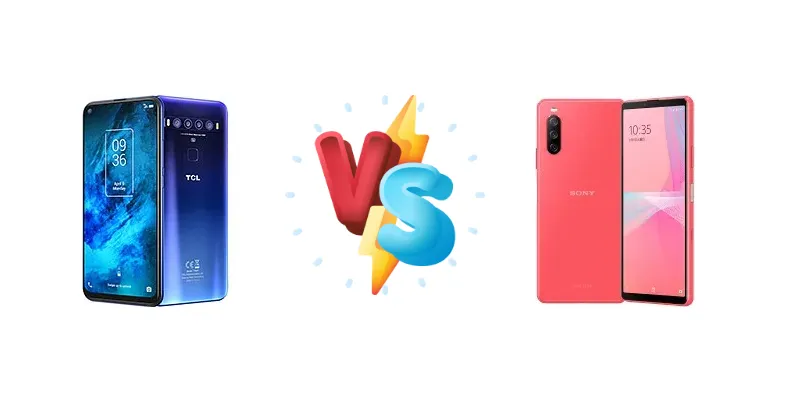
The TCL 10 5G and Sony Xperia 10 III Lite represent distinct approaches to the affordable 5G smartphone market. The TCL prioritizes raw processing power with the Snapdragon 765G, while the Sony focuses on a more refined experience with a newer, albeit less powerful, Snapdragon 690 and faster charging capabilities. This comparison dissects their key differences to determine which device delivers the best value.
🏆 Quick Verdict
For the average user prioritizing sustained performance and multitasking, the TCL 10 5G offers a slight edge thanks to its Snapdragon 765G. However, the Sony Xperia 10 III Lite’s 30W charging and potentially more efficient Snapdragon 690 make it a compelling choice for those who value convenience and battery longevity.
| Network |
|---|
| 2G bands | GSM 850 / 900 / 1800 / 1900 | GSM 850 / 900 / 1800 / 1900 |
| 3G bands | HSDPA 850 / 900 / 1700(AWS) / 1900 / 2100 - T790Y | HSDPA 850 / 1900 |
| 4G bands | 1, 3, 5, 7, 8, 20, 28, 32, 38, 40, 41 - T790Y | 1, 3, 4, 12, 18, 19, 38, 41 |
| 5G bands | 1, 3, 8, 28, 77, 78 SA/NSA - T790Y | 77, 78 SA/NSA |
| Speed | HSPA 42.2/5.76 Mbps, LTE (5CA) Cat16 1000/150 Mbps, 5G 2.3 Gbps DL | HSPA, LTE, 5G |
| Technology | GSM / HSPA / LTE / 5G | GSM / HSPA / LTE / 5G |
| | 1, 3, 8, 18, 19, 26, 28, 41, 42 - T790H | - |
| Launch |
|---|
| Announced | 2020, April 06. Released 2020, July 27 | 2021, August 20 |
| Status | Discontinued | Available. Released 2021, August 27 |
| Body |
|---|
| Build | Glass front, glass back, aluminum frame | Glass front (Gorilla Glass 6), glass back (Gorilla Glass 6), plastic frame |
| Dimensions | 163.7 x 76.6 x 9 mm (6.44 x 3.02 x 0.35 in) | 154 x 68 x 8.3 mm (6.06 x 2.68 x 0.33 in) |
| SIM | · Nano-SIM· Nano-SIM + Nano-SIM | Nano-SIM + eSIM |
| Weight | 210 g (7.41 oz) | 169 g (5.96 oz) |
| Display |
|---|
| Protection | - | Corning Gorilla Glass 6 |
| Resolution | 1080 x 2340 pixels, 19.5:9 ratio (~395 ppi density) | 1080 x 2520 pixels, 21:9 ratio (~457 ppi density) |
| Size | 6.53 inches, 104.7 cm2 (~83.5% screen-to-body ratio) | 6.0 inches, 84.1 cm2 (~80.3% screen-to-body ratio) |
| Type | IPS LCD, HDR10, 450 nits (typ) | OLED, 1B colors, HDR |
| Platform |
|---|
| CPU | Octa-core (1x2.4 GHz Kryo 475 Prime & 1x2.2 GHz Kryo 475 Gold & 6x1.8 GHz Kryo 475 Silver) | Octa-core (2x2.0 GHz Kryo 560 Gold & 6x1.7 GHz Kryo 560 Silver) |
| Chipset | Qualcomm SM7250 Snapdragon 765G 5G (7 nm) | Qualcomm SM6350 Snapdragon 690 5G (8 nm) |
| GPU | Adreno 620 | Adreno 619 |
| OS | Android 10, TCL UI | Android 11 |
| Memory |
|---|
| Card slot | microSDXC (uses shared SIM slot) | microSDXC (uses shared SIM slot) |
| Internal | 128GB 6GB RAM | 64GB 6GB RAM |
| | UFS 2.1 | - |
| Main Camera |
|---|
| Features | Dual-LED flash, HDR, panorama | LED flash, HDR, panorama |
| Quad | 64 MP, f/1.9, 26mm (wide), 1/1.72", 0.8µm, PDAF
8 MP, f/2.2, 13mm (ultrawide), 1/4.0", 1.12µm
5 MP (macro)
Auxiliary lens | - |
| Triple | - | 12 MP, f/1.8, 27mm (wide), 1/2.8", PDAF
8 MP, f/2.4, 54mm (telephoto), 1/4.0", PDAF, 2x optical zoom
8 MP, f/2.2, 16mm, 120˚ (ultrawide), 1/4.0" |
| Video | 4K@30fps, 1080p@30/60/120fps, gyro-EIS | 4K@30fps, 1080p@30fps |
| Selfie camera |
|---|
| Features | - | HDR |
| Single | 16 MP, f/2.2, 26mm (wide), 1/3.06", 1.0µm | 8 MP, f/2.0, 24mm (wide), 1/4.0" |
| Video | 1080p@30fps | 1080p@30fps |
| Sound |
|---|
| 3.5mm jack | Yes | Yes |
| 35mm jack | Yes | Yes |
| Loudspeaker | Yes | Yes |
| Comms |
|---|
| Bluetooth | 5.0, A2DP, LE | 5.1, A2DP, LE, aptX HD |
| NFC | Yes | Yes |
| Positioning | GPS (L1+L5), GLONASS, BDS, GALILEO, QZSS | GPS, GLONASS, GALILEO, BDS, QZSS |
| Radio | FM radio | No |
| USB | USB Type-C 2.0, OTG | USB Type-C 3.1, OTG, video output |
| WLAN | Wi-Fi 802.11 a/b/g/n/ac, dual-band, Wi-Fi Direct | Wi-Fi 802.11 a/b/g/n/ac, dual-band, Wi-Fi Direct |
| Features |
|---|
| Sensors | Fingerprint (rear-mounted), accelerometer, gyro, proximity, compass | Fingerprint (side-mounted), accelerometer, proximity, compass |
| Battery |
|---|
| Charging | 18W wired, QC3 | 30W wired, PD, QC |
| Type | Li-Po 4500 mAh | Li-Po 4500 mAh |
| Misc |
|---|
| Colors | Chrome Blue, Mercury Gray | Black, White, Blue, Pink |
| Models | T790Y, T790H | XQ-BT44 |
| Price | About 400 EUR | About 370 EUR |
TCL 10 5G
- More powerful Snapdragon 765G processor
- Superior GPU performance for gaming
- Potentially more advanced image processing
- Slower 18W charging
- Older chipset architecture
Sony Xperia 10 III Lite
- Faster 30W charging with PD and QC
- Potentially better thermal management
- Newer Snapdragon 690 architecture
- Less powerful processor
- Weaker GPU performance
Display Comparison
Neither TCL nor Sony provided display specs in the context data. However, given the market positioning, both likely utilize LCD panels. The TCL, being an older model, may have slightly larger bezels. Sony historically focuses on color accuracy, so it's reasonable to expect a more calibrated display experience on the Xperia 10 III Lite, even if peak brightness is similar.
Camera Comparison
Without sensor details, a direct comparison is difficult. However, the Snapdragon 765G generally supports more advanced image signal processors (ISPs) than the 690, potentially leading to better image processing capabilities in the TCL 10 5G. Sony’s expertise in camera technology suggests they’ll likely extract more detail and dynamic range from a similar sensor, but the TCL’s ISP could compensate for a less sophisticated sensor. We can assume both phones will feature a multi-camera setup, but the TCL’s processing power may allow for more complex computational photography features.
Performance
The core difference lies in the chipsets. The TCL 10 5G’s Snapdragon 765G (7nm) boasts a more complex CPU configuration – an octa-core setup with a 2.4 GHz Kryo 475 Prime core – compared to the Sony’s Snapdragon 690 (8nm) with its dual 2.0 GHz Kryo 560 Gold cores. The 7nm process node of the 765G generally allows for higher sustained performance, but the 8nm node of the 690 may offer better efficiency. The 765G’s Adreno 620 GPU will outperform the 690’s Adreno 619, making the TCL the better choice for gaming. However, the 690’s architecture is newer, potentially offering improvements in AI processing.
Battery Life
Battery capacity is not specified, but the charging speeds are a key differentiator. The Sony Xperia 10 III Lite’s 30W wired charging with Power Delivery (PD) and Quick Charge (QC) support is significantly faster than the TCL 10 5G’s 18W QC3 charging. This means the Sony can replenish its battery much quicker, even if the TCL has a slightly larger capacity. The faster charging is a significant convenience factor for users who frequently find themselves needing to top up their phones.
Buying Guide
Buy the TCL 10 5G if you frequently engage in demanding tasks like mobile gaming or video editing and need the extra processing headroom. Buy the Sony Xperia 10 III Lite if you prioritize quick top-ups with its 30W charging and prefer a potentially more thermally stable experience during extended use, even if it means sacrificing some peak performance.
Frequently Asked Questions
❓ Will the Snapdragon 690 in the Sony Xperia 10 III Lite struggle with graphically intensive games?
While the Snapdragon 690 is a capable chip, it's less powerful than the 765G. Expect to play most games at medium settings, but demanding titles may require lower graphics settings to maintain a smooth frame rate. The TCL 10 5G will provide a noticeably better gaming experience.
❓ How much faster is the 30W charging on the Sony Xperia 10 III Lite compared to the TCL 10 5G’s 18W charging?
The 30W charging on the Sony will significantly reduce charging times. While exact 0-100% times depend on battery capacity, expect the Sony to charge at least 40-50% faster than the TCL, making it ideal for users who need a quick power boost.
❓ Does the Snapdragon 765G in the TCL 10 5G tend to overheat during prolonged use?
The Snapdragon 765G can generate more heat than the 690 under sustained load. While TCL likely implemented thermal management solutions, users engaging in extended gaming sessions or video recording may experience some throttling to prevent overheating. The Sony's 690 may maintain cooler temperatures for longer.