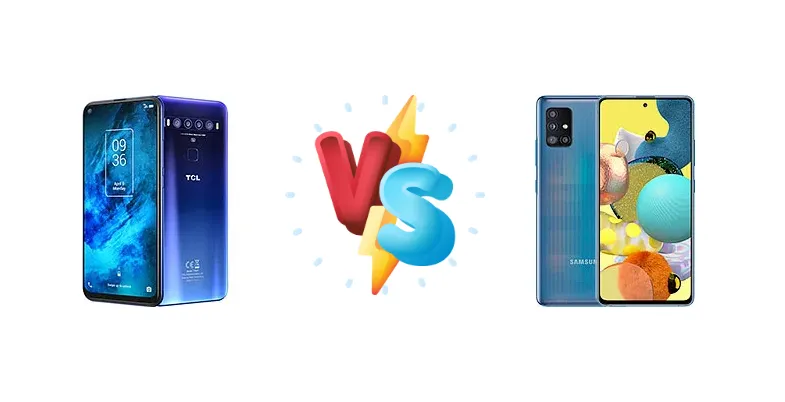
The TCL 10 5G and Samsung Galaxy A51 5G UW represent a fascinating intersection of affordability and 5G connectivity. Both devices leverage the Qualcomm Snapdragon 765G, but diverge in charging capabilities and subtle design choices. This comparison dissects these differences to determine which phone delivers the best value for your money.
🏆 Quick Verdict
For the average user prioritizing faster charging and potentially better long-term software support, the TCL 10 5G emerges as the slightly stronger choice. While both phones offer identical core performance, the 18W charging of the TCL 10 5G provides a tangible benefit over the A51 5G UW’s 15W charging.
| Network |
|---|
| 2G bands | GSM 850 / 900 / 1800 / 1900 | GSM 850 / 900 / 1800 / 1900 |
| 3G bands | HSDPA 850 / 900 / 1700(AWS) / 1900 / 2100 - T790Y | HSDPA 850 / 900 / 1900 / 2100 |
| 4G bands | 1, 3, 5, 7, 8, 20, 28, 32, 38, 40, 41 - T790Y | 2, 4, 5, 13, 66 |
| 5G bands | 1, 3, 8, 28, 77, 78 SA/NSA - T790Y | 260, 261 mmWave |
| Speed | HSPA 42.2/5.76 Mbps, LTE (5CA) Cat16 1000/150 Mbps, 5G 2.3 Gbps DL | HSPA, LTE, 5G |
| Technology | GSM / HSPA / LTE / 5G | GSM / HSPA / LTE / 5G |
| | 1, 3, 8, 18, 19, 26, 28, 41, 42 - T790H | - |
| Launch |
|---|
| Announced | 2020, April 06. Released 2020, July 27 | 2020, August 14 |
| Status | Discontinued | Available. Released 2020, August 14 |
| Body |
|---|
| Build | Glass front, glass back, aluminum frame | Glass front (Gorilla Glass 3), plastic back, aluminum frame |
| Dimensions | 163.7 x 76.6 x 9 mm (6.44 x 3.02 x 0.35 in) | 158.8 x 73.4 x 8.6 mm (6.25 x 2.89 x 0.34 in) |
| SIM | · Nano-SIM· Nano-SIM + Nano-SIM | Nano-SIM (pre-installed) |
| Weight | 210 g (7.41 oz) | 188.8 g (6.67 oz) |
| Display |
|---|
| Protection | - | Corning Gorilla Glass 3 |
| Resolution | 1080 x 2340 pixels, 19.5:9 ratio (~395 ppi density) | 1080 x 2400 pixels, 20:9 ratio (~405 ppi density) |
| Size | 6.53 inches, 104.7 cm2 (~83.5% screen-to-body ratio) | 6.5 inches, 102.0 cm2 (~87.5% screen-to-body ratio) |
| Type | IPS LCD, HDR10, 450 nits (typ) | Super AMOLED |
| Platform |
|---|
| CPU | Octa-core (1x2.4 GHz Kryo 475 Prime & 1x2.2 GHz Kryo 475 Gold & 6x1.8 GHz Kryo 475 Silver) | Octa-core (1x2.4 GHz Kryo 475 Prime & 1x2.2 GHz Kryo 475 Gold & 6x1.8 GHz Kryo 475 Silver) |
| Chipset | Qualcomm SM7250 Snapdragon 765G 5G (7 nm) | Qualcomm SM7250 Snapdragon 765G 5G (7 nm) |
| GPU | Adreno 620 | Adreno 620 |
| OS | Android 10, TCL UI | Android 10, One UI 2 |
| Memory |
|---|
| Card slot | microSDXC (uses shared SIM slot) | microSDXC (uses shared SIM slot) |
| Internal | 128GB 6GB RAM | 128GB 6GB RAM |
| | UFS 2.1 | UFS 2.1 |
| Main Camera |
|---|
| Features | Dual-LED flash, HDR, panorama | LED flash, panorama, HDR |
| Quad | 64 MP, f/1.9, 26mm (wide), 1/1.72", 0.8µm, PDAF
8 MP, f/2.2, 13mm (ultrawide), 1/4.0", 1.12µm
5 MP (macro)
Auxiliary lens | 48 MP, f/2.0, 26mm (wide), 1/2.0", 0.8µm, PDAF
12 MP, f/2.2, 123˚ (ultrawide)
5 MP (macro)
Auxiliary lens |
| Single | - | 5 MP, AF |
| Video | 4K@30fps, 1080p@30/60/120fps, gyro-EIS | 4K@30fps, 1080p@30/120fps; gyro-EIS |
| Selfie camera |
|---|
| Features | - | HDR |
| Single | 16 MP, f/2.2, 26mm (wide), 1/3.06", 1.0µm | 32 MP, f/2.2, 26mm (wide), 1/2.8", 0.8µm |
| Video | 1080p@30fps | 4K@30fps, 1080p@30fps |
| Sound |
|---|
| 3.5mm jack | Yes | Yes |
| 35mm jack | Yes | Yes |
| Loudspeaker | Yes | Yes |
| Comms |
|---|
| Bluetooth | 5.0, A2DP, LE | 5.0, A2DP, LE |
| NFC | Yes | Yes |
| Positioning | GPS (L1+L5), GLONASS, BDS, GALILEO, QZSS | GPS, GLONASS, GALILEO, BDS |
| Radio | FM radio | FM radio, RDS, recording |
| USB | USB Type-C 2.0, OTG | USB Type-C 2.0, OTG |
| WLAN | Wi-Fi 802.11 a/b/g/n/ac, dual-band, Wi-Fi Direct | Wi-Fi 802.11 a/b/g/n/ac, dual-band, Wi-Fi Direct |
| Features |
|---|
| Sensors | Fingerprint (rear-mounted), accelerometer, gyro, proximity, compass | Fingerprint (under display, optical), accelerometer, gyro, proximity, compass |
| | - | ANT+ |
| Battery |
|---|
| Charging | 18W wired, QC3 | 15W wired |
| Stand-by | - | Up to 672 h |
| Talk time | - | Up to 5 h |
| Type | Li-Po 4500 mAh | Li-Po 4500 mAh |
| Misc |
|---|
| Colors | Chrome Blue, Mercury Gray | Prism Bricks Blue |
| Models | T790Y, T790H | SM-A516V |
| Price | About 400 EUR | About 470 EUR |
| SAR | - | 0.70 W/kg (head) 1.25 W/kg (body) |
| SAR EU | - | 0.59 W/kg (head) 1.32 W/kg (body) |
TCL 10 5G
- Faster 18W charging with QC3 support
- Potentially cleaner software experience
- Competitive price point
- Less established brand recognition
- Camera image processing may not appeal to all
Samsung Galaxy A51 5G UW
- Strong brand recognition and ecosystem
- Samsung One UI software features
- Wider carrier compatibility (UW)
- Slower 15W charging
- Potentially more bloatware
- May be slightly more expensive
Display Comparison
Both the TCL 10 5G and Samsung Galaxy A51 5G UW utilize LCD panels, a common choice in this price bracket. While specific nit brightness figures aren't provided, the A51 5G UW's Super AMOLED variant (not the UW model) is known for vibrant colors. The TCL 10 5G likely prioritizes color accuracy over sheer vibrancy. Bezels are comparable, and neither device features a high refresh rate, focusing instead on maximizing battery life. The lack of LTPO technology means neither display dynamically adjusts refresh rates for power savings.
Camera Comparison
Detailed camera specifications are absent, but both phones likely feature multi-camera systems. The image processing style will be a key differentiator. Samsung typically leans towards more saturated and vibrant images, while TCL often aims for a more natural look. Without sensor size or aperture information, it’s difficult to definitively declare a winner. The presence of a 2MP macro camera on either device is largely a marketing tactic, offering limited practical benefit due to the small sensor size and lack of optical image stabilization (OIS).
Performance
The core of both devices is the Qualcomm SM7250 Snapdragon 765G 5G (7 nm) chipset, featuring an identical CPU configuration: an octa-core setup with 1x2.4 GHz Kryo 475 Prime, 1x2.2 GHz Kryo 475 Gold, and 6x1.8 GHz Kryo 475 Silver cores. This means CPU performance will be virtually indistinguishable between the two. The GPU is also identical, ensuring similar gaming capabilities. However, thermal management could vary based on chassis design and cooling solutions, a factor not specified in the provided data. Both devices likely utilize LPDDR4X RAM, as LPDDR5 was uncommon in this price segment at launch.
Battery Life
Battery capacity isn't specified, but both phones likely fall in the 4000-5000 mAh range. The critical difference lies in charging speed: the TCL 10 5G supports 18W wired charging with Quick Charge 3.0 (QC3), while the Samsung Galaxy A51 5G UW is limited to 15W wired charging. This 3W difference translates to a noticeably faster 0-100% charge time on the TCL 10 5G, a significant advantage for users who value convenience.
Buying Guide
Buy the TCL 10 5G if you prioritize faster charging speeds and a potentially cleaner software experience. It’s ideal for users who frequently top up their phones throughout the day. Buy the Samsung Galaxy A51 5G UW if you strongly prefer the Samsung One UI ecosystem and value the broader brand recognition, even if it means sacrificing a bit of charging speed. It’s a good fit for users deeply embedded in the Samsung ecosystem.
Frequently Asked Questions
❓ Does the Snapdragon 765G in either phone struggle with demanding games like Genshin Impact?
The Snapdragon 765G is capable of running Genshin Impact, but you'll likely need to lower graphics settings to medium or low to maintain a stable frame rate. Both phones share the same chipset, so gaming performance will be very similar. Thermal throttling could become a factor during extended gaming sessions, but specific performance will depend on the phone's cooling solution.
❓ What is 'UW' in the Samsung Galaxy A51 5G UW name, and does it matter if I don't have Verizon 5G Ultra Wideband?
The 'UW' designation signifies compatibility with Verizon's 5G Ultra Wideband network. If you don't have Verizon or won't be using their UW network, this distinction is largely irrelevant. The phone will still connect to standard 5G and 4G LTE networks. However, you won't benefit from the faster speeds offered by UW.
❓ Is the software experience significantly different between TCL's UI and Samsung's One UI?
Yes, the software experience is noticeably different. Samsung's One UI is feature-rich and heavily customized, offering a wide range of options and pre-installed apps (often considered bloatware). TCL's UI is generally closer to stock Android, providing a cleaner and more streamlined experience. This difference is a matter of personal preference.