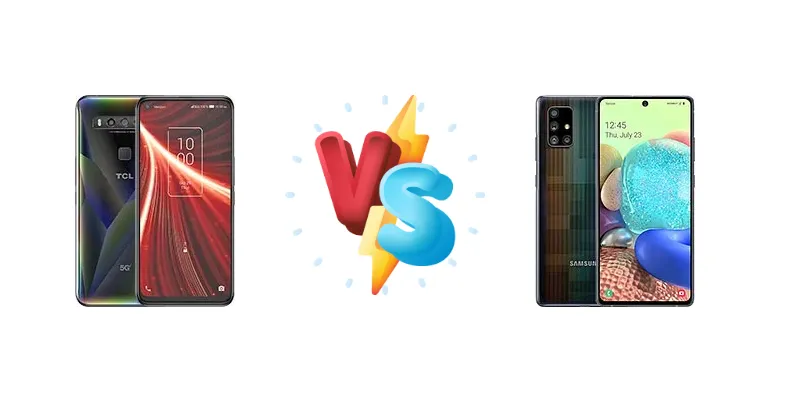
Both the TCL 10 5G UW and the Samsung Galaxy A71 5G UW represent compelling options in the increasingly crowded sub-$300 5G smartphone market. Both leverage the Qualcomm Snapdragon 765G, but diverge in charging capabilities and potentially, software experience. This comparison dissects the nuances to determine which device delivers the best value.
🏆 Quick Verdict
For the average user prioritizing faster refueling, the Samsung Galaxy A71 5G UW is the better choice. Its 25W charging significantly outperforms the TCL 10 5G UW’s 18W, minimizing downtime. However, the TCL offers a competitive package at a potentially lower price point.
| Network |
|---|
| 2G bands | GSM 850 / 900 / 1800 / 1900 | GSM 850 / 900 / 1800 / 1900 |
| 3G bands | HSDPA 850 / 900 / 1700(AWS) / 1900 / 2100 | HSDPA 850 / 900 / 1900 / 2100 |
| 4G bands | 2, 3, 4, 5, 7, 12, 13, 20, 28, 46, 48, 66 | 2, 3, 4, 5, 7, 12, 13, 20, 28, 66 |
| 5G bands | 2, 5, 66, 260, 261 mmWave | 260, 261 SA/NSA/mmWave |
| Speed | HSPA, LTE, 5G | HSPA, LTE, 5G |
| Technology | GSM / HSPA / LTE / 5G | GSM / HSPA / LTE / 5G |
| Launch |
|---|
| Announced | 2020, October 27. Released 2020, October 29 | 2020, July 07 |
| Status | Discontinued | Available. Released 2020, July 16 |
| Body |
|---|
| Build | Glass front, glass back, aluminum frame | Glass front (Gorilla Glass 3), plastic back, aluminum frame |
| Dimensions | 163.6 x 76.5 x 9.4 mm (6.44 x 3.01 x 0.37 in) | 162.8 x 75.7 x 8.4 mm (6.41 x 2.98 x 0.33 in) |
| SIM | Nano-SIM | Nano-SIM (pre-installed) |
| Weight | 210 g (7.41 oz) | 188 g (6.63 oz) |
| Display |
|---|
| Protection | - | Corning Gorilla Glass 3 |
| Resolution | 1080 x 2340 pixels, 19.5:9 ratio (~395 ppi density) | 1080 x 2400 pixels, 20:9 ratio (~393 ppi density) |
| Size | 6.53 inches, 104.7 cm2 (~83.6% screen-to-body ratio) | 6.7 inches, 108.4 cm2 (~87.9% screen-to-body ratio) |
| Type | IPS LCD, HDR10, 450 nits (typ) | Super AMOLED Plus |
| Platform |
|---|
| CPU | Octa-core (1x2.4 GHz Kryo 475 Prime & 1x2.2 GHz Kryo 475 Gold & 6x1.8 GHz Kryo 475 Silver) | Octa-core (1x2.4 GHz Kryo 475 Prime & 1x2.2 GHz Kryo 475 Gold & 6x1.8 GHz Kryo 475 Silver) |
| Chipset | Qualcomm SM7250 Snapdragon 765G 5G (7 nm) | Qualcomm SM7250 Snapdragon 765G 5G (7 nm) |
| GPU | Adreno 620 | Adreno 620 |
| OS | Android 10 | Android 10, One UI 2.1 |
| Memory |
|---|
| Card slot | microSDXC (uses shared SIM slot) | microSDXC (dedicated slot) |
| Internal | 128GB 6GB RAM | 128GB 8GB RAM |
| | UFS 2.1 | UFS 2.1 |
| Main Camera |
|---|
| Features | Dual-LED flash, HDR, panorama | LED flash, panorama, HDR |
| Quad | - | 64 MP, f/1.8, 26mm (wide), 1/1.72", 0.8µm, PDAF
12 MP, f/2.2, 123˚ (ultrawide)
5 MP (macro)
Auxiliary lens |
| Triple | 48 MP, 26mm (wide), 1/2.0", 0.8µm, PDAF
8 MP, f/2.2, 13mm (ultrawide), 1/4.0", 1.12µm
5 MP (macro), AF | - |
| Video | 4K@30fps, 1080p@30/60/120fps, gyro-EIS | 4K@30fps, 1080p@30/240fps, 1080p@960fps; gyro-EIS |
| Selfie camera |
|---|
| Features | - | HDR |
| Single | 16 MP, f/2.2, 26mm (wide), 1/3.06", 1.0µm | 32 MP, f/2.2, 26mm (wide), 1/2.8", 0.8µm |
| Video | 1080p@30fps | 4K@30fps, 1080p@30fps |
| Sound |
|---|
| 3.5mm jack | Yes | Yes |
| 35mm jack | Yes | Yes |
| Loudspeaker | Yes | Yes |
| Comms |
|---|
| Bluetooth | 5.0, A2DP, LE | 5.0, A2DP, LE |
| NFC | - | No |
| Positioning | GPS (L1+L5), GLONASS, GALILEO | GPS, GLONASS, GALILEO, BDS |
| Radio | No | No |
| USB | USB Type-C 2.0, OTG | USB Type-C 2.0, OTG |
| WLAN | Wi-Fi 802.11 a/b/g/n/ac, dual-band, Wi-Fi Direct | Wi-Fi 802.11 a/b/g/n/ac, dual-band, Wi-Fi Direct |
| Features |
|---|
| Sensors | Fingerprint (rear-mounted), accelerometer, gyro, proximity, compass | Fingerprint (under display, optical), accelerometer, gyro, proximity, compass |
| | - | ANT+ |
| Battery |
|---|
| Charging | 18W wired, QC3 | 25W wired |
| Type | Li-Po 4500 mAh | Li-Po 4500 mAh |
| Misc |
|---|
| Colors | Diamond Gray | Prism Bricks Black |
| Models | - | SM-A716V |
| Price | About 340 EUR | - |
| SAR | - | 0.50 W/kg (head) 0.78 W/kg (body) |
TCL 10 5G UW
- Potentially lower price point
- Snapdragon 765G provides solid performance
- 5G connectivity for faster data speeds
- Slower 18W charging
- Less established brand reputation
- Image processing may not appeal to all users
Samsung Galaxy A71 5G UW
- Faster 25W charging
- Established Samsung brand and software support
- Potentially more refined image processing
- Likely higher price than the TCL 10 5G UW
- Snapdragon 765G performance is identical to TCL
- May include more pre-installed bloatware
Display Comparison
Both devices are expected to feature LCD panels, typical for this price bracket. While specific display specs like resolution and refresh rate aren't provided, the focus here is on charging. Display quality will likely be similar, with Samsung potentially offering slightly more accurate color calibration based on their display expertise. Bezels are expected to be comparable, reflecting the mid-range positioning of both phones.
Camera Comparison
Without detailed camera specifications, a direct comparison is difficult. However, both phones likely employ multi-camera systems. The image processing algorithms will differ significantly – Samsung typically leans towards vibrant, saturated images, while TCL often aims for a more natural look. Sensor size and aperture are critical, but absent from the provided data. The presence of Optical Image Stabilization (OIS) on either device would be a significant advantage, but is unknown.
Performance
The core performance is identical: both the TCL 10 5G UW and the Samsung Galaxy A71 5G UW utilize the Qualcomm SM7250 Snapdragon 765G 5G (7 nm) chipset with the same octa-core CPU configuration (1x2.4 GHz Kryo 475 Prime, 1x2.2 GHz Kryo 475 Gold, and 6x1.8 GHz Kryo 475 Silver). This means application launch times, multitasking, and general responsiveness will be nearly indistinguishable. Thermal management will depend on chassis design, but the 7nm process node offers reasonable efficiency. The GPU performance will also be identical, capable of handling most mobile games at medium settings.
Battery Life
The key differentiator lies in charging speed. The Samsung Galaxy A71 5G UW supports 25W wired charging, while the TCL 10 5G UW is limited to 18W with Quick Charge 3.0. This translates to a noticeably faster 0-100% charge time on the Samsung. While battery capacity isn’t specified, the faster charging of the A71 5G UW effectively mitigates any potential disadvantage from a slightly smaller battery, offering more convenient top-ups throughout the day.
Buying Guide
Buy the TCL 10 5G UW if you prioritize maximizing value and are comfortable with potentially slower charging speeds. It’s ideal for users who don’t mind topping up overnight or less frequently. Buy the Samsung Galaxy A71 5G UW if you value quicker charging and a more established brand reputation, making it suitable for users who need to rapidly replenish battery life throughout the day.
Frequently Asked Questions
❓ Will either of these phones overheat during extended gaming sessions?
Both phones utilize the Snapdragon 765G, which is a relatively efficient chipset. Overheating is unlikely during moderate gaming, but prolonged, graphically intensive sessions could lead to some thermal throttling. The chassis design and cooling solutions will play a role, but neither phone is expected to exhibit severe overheating issues.
❓ Does the Samsung Galaxy A71 5G UW support carrier aggregation for improved 5G speeds?
The 'UW' designation typically indicates support for mmWave 5G, which relies heavily on carrier aggregation. Samsung is generally more aggressive in implementing carrier aggregation features. While not explicitly stated, the A71 5G UW is likely to support carrier aggregation on compatible networks, potentially leading to faster 5G speeds in areas with mmWave coverage.
❓ Is the 18W charging on the TCL 10 5G UW still usable for quick top-ups?
While 18W is slower than 25W, it's still a reasonable charging speed. Expect a full charge to take around 2-3 hours. For a quick 30-minute top-up, you can expect to gain around 30-40% battery life, which may be sufficient for many users.