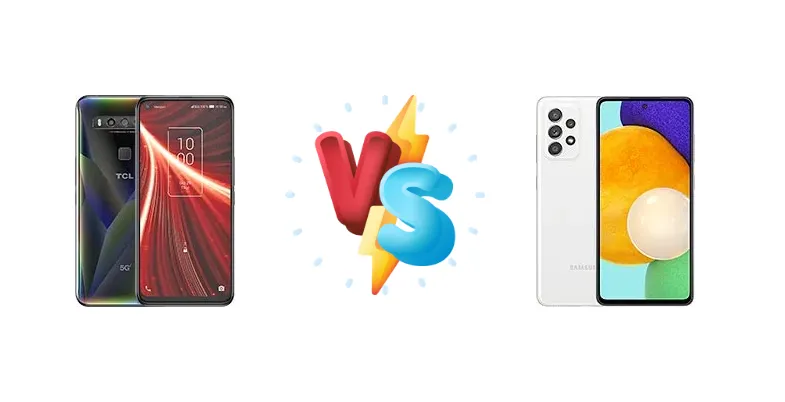
The TCL 10 5G UW and Samsung Galaxy A52 5G represent compelling options in the increasingly crowded mid-range 5G smartphone market. While both aim to deliver 5G connectivity at accessible price points, they diverge in their core hardware choices, impacting performance, display quality, and overall user experience. This comparison will dissect these differences to help you determine which device best suits your needs.
🏆 Quick Verdict
For the average user prioritizing display brightness and potentially longer-term software support, the Samsung Galaxy A52 5G emerges as the slightly stronger choice. However, the TCL 10 5G UW offers a competitive performance profile thanks to the Snapdragon 765G and represents excellent value if found at a significantly lower price.
| Network |
|---|
| 2G bands | GSM 850 / 900 / 1800 / 1900 | GSM 850 / 900 / 1800 / 1900 |
| 3G bands | HSDPA 850 / 900 / 1700(AWS) / 1900 / 2100 | HSDPA 850 / 900 / 1700(AWS) / 1900 / 2100 |
| 4G bands | 2, 3, 4, 5, 7, 12, 13, 20, 28, 46, 48, 66 | 1, 2, 3, 4, 5, 7, 8, 12, 17, 20, 26, 28, 32, 38, 40, 41, 66 |
| 5G bands | 2, 5, 66, 260, 261 mmWave | 1, 3, 5, 7, 8, 20, 28, 38, 40, 41, 66, 78 SA/NSA/Sub6 |
| Speed | HSPA, LTE, 5G | HSPA, LTE, 5G |
| Technology | GSM / HSPA / LTE / 5G | GSM / HSPA / LTE / 5G |
| Launch |
|---|
| Announced | 2020, October 27. Released 2020, October 29 | 2021, March 17 |
| Status | Discontinued | Available. Released 2021, March 19 |
| Body |
|---|
| Build | Glass front, glass back, aluminum frame | Glass front (Gorilla Glass 5), plastic back |
| Dimensions | 163.6 x 76.5 x 9.4 mm (6.44 x 3.01 x 0.37 in) | 159.9 x 75.1 x 8.4 mm (6.30 x 2.96 x 0.33 in) |
| SIM | Nano-SIM | · Nano-SIM· Nano-SIM + Nano-SIM |
| Weight | 210 g (7.41 oz) | 189 g (6.67 oz) |
| | - | IP67 dust/water resistant (up to 1m for 30 min) |
| Display |
|---|
| Protection | - | Corning Gorilla Glass 5 |
| Resolution | 1080 x 2340 pixels, 19.5:9 ratio (~395 ppi density) | 1080 x 2400 pixels, 20:9 ratio (~407 ppi density) |
| Size | 6.53 inches, 104.7 cm2 (~83.6% screen-to-body ratio) | 6.5 inches, 101.0 cm2 (~84.1% screen-to-body ratio) |
| Type | IPS LCD, HDR10, 450 nits (typ) | Super AMOLED, 120Hz, HDR10+, 800 nits (HBM) |
| | - | Always-on display |
| Platform |
|---|
| CPU | Octa-core (1x2.4 GHz Kryo 475 Prime & 1x2.2 GHz Kryo 475 Gold & 6x1.8 GHz Kryo 475 Silver) | Octa-core (2x2.2 GHz Kryo 570 & 6x1.8 GHz Kryo 570) |
| Chipset | Qualcomm SM7250 Snapdragon 765G 5G (7 nm) | Qualcomm SM7225 Snapdragon 750G 5G (8 nm) |
| GPU | Adreno 620 | Adreno 619 |
| OS | Android 10 | Android 11, upgradable to Android 14, One UI 6.1 |
| Memory |
|---|
| Card slot | microSDXC (uses shared SIM slot) | microSDXC (uses shared SIM slot) |
| Internal | 128GB 6GB RAM | 128GB 4GB RAM, 128GB 6GB RAM, 128GB 8GB RAM, 256GB 4GB RAM, 256GB 8GB RAM |
| | UFS 2.1 | - |
| Main Camera |
|---|
| Features | Dual-LED flash, HDR, panorama | LED flash, panorama, HDR |
| Quad | - | 64 MP, f/1.8, 26mm (wide), 1/1.7X", 0.8µm, PDAF, OIS
12 MP, f/2.2, 123˚ (ultrawide), 1.12µm
5 MP (macro)
Auxiliary lens |
| Triple | 48 MP, 26mm (wide), 1/2.0", 0.8µm, PDAF
8 MP, f/2.2, 13mm (ultrawide), 1/4.0", 1.12µm
5 MP (macro), AF | - |
| Video | 4K@30fps, 1080p@30/60/120fps, gyro-EIS | 4K@30fps, 1080p@30/60fps; gyro-EIS |
| Selfie camera |
|---|
| Features | - | HDR |
| Single | 16 MP, f/2.2, 26mm (wide), 1/3.06", 1.0µm | 32 MP, f/2.2, 26mm (wide), 1/2.8", 0.8µm |
| Video | 1080p@30fps | 4K@30fps, 1080p@30fps |
| Sound |
|---|
| 3.5mm jack | Yes | Yes |
| 35mm jack | Yes | Yes |
| Loudspeaker | Yes | Yes, with stereo speakers |
| Comms |
|---|
| Bluetooth | 5.0, A2DP, LE | 5.0, A2DP, LE |
| NFC | - | Yes (market/region dependent) |
| Positioning | GPS (L1+L5), GLONASS, GALILEO | GPS, GLONASS, GALILEO, BDS |
| Radio | No | FM radio (market/region dependent) |
| USB | USB Type-C 2.0, OTG | USB Type-C 2.0, OTG |
| WLAN | Wi-Fi 802.11 a/b/g/n/ac, dual-band, Wi-Fi Direct | Wi-Fi 802.11 a/b/g/n/ac, dual-band, Wi-Fi Direct |
| Features |
|---|
| Sensors | Fingerprint (rear-mounted), accelerometer, gyro, proximity, compass | Fingerprint (under display, optical), accelerometer, gyro, compass |
| | - | Virtual proximity sensing |
| Battery |
|---|
| Charging | 18W wired, QC3 | 25W wired, 50% in 30 min |
| Type | Li-Po 4500 mAh | Li-Po 4500 mAh |
| Misc |
|---|
| Colors | Diamond Gray | Awesome Black, Awesome White, Awesome Violet, Awesome Blue |
| Models | - | SM-A526B, SM-A526B/DS, SM-A5260, SM-A526W, SM-A526U, SM-A526U1 |
| Price | About 340 EUR | $ 137.39 / £ 280.00 / € 115.49 |
| SAR | - | 0.74 W/kg (head) 0.53 W/kg (body) |
| SAR EU | - | 1.05 W/kg (head) 1.42 W/kg (body) |
| Tests |
|---|
| Battery life | - |
Endurance rating 111h
|
| Camera | - |
Photo / Video |
| Display | - |
Contrast ratio: Infinite (nominal) |
| Loudspeaker | - |
-27.5 LUFS (Good)
|
| Performance | - |
AnTuTu: 334981 (v8), 386474 (v9)
GeekBench: 1820 (v5.1)
GFXBench: 16fps (ES 3.1 onscreen) |
TCL 10 5G UW
- Potentially faster single-core CPU performance
- Competitive 5G performance with Snapdragon 765G
- Often available at a lower price point
- Slower charging speed (18W vs 25W)
- Likely less vibrant display
- Potentially shorter software support lifespan
Samsung Galaxy A52 5G
- Brighter and more vibrant Super AMOLED display
- Faster 25W charging with quick top-up times
- Stronger brand reputation for software updates
- Slightly lower peak CPU clock speed
- May be more expensive than the TCL 10 5G UW
- Snapdragon 750G may throttle more under sustained load
Display Comparison
The Samsung Galaxy A52 5G boasts a significantly brighter display, reaching a measured 787 nits, compared to the TCL 10 5G UW (brightness data unavailable, but likely lower based on chipset and market positioning). This brightness advantage translates to superior visibility outdoors. While both feature infinite (nominal) contrast ratios, the A52 5G’s higher peak brightness makes a tangible difference in dynamic range. The TCL 10 5G UW’s display specs are less detailed, suggesting a more standard LCD panel, while the A52 5G likely utilizes a Super AMOLED panel, offering richer colors and deeper blacks.
Camera Comparison
Both phones offer photo and video capabilities, but detailed camera specs are limited. Without sensor size or aperture information, a direct comparison is difficult. However, the A52 5G’s brand reputation suggests more sophisticated image processing algorithms. The TCL 10 5G UW’s camera system is likely more focused on providing a functional experience, while the A52 5G aims for a more polished and versatile photographic output. The presence of OIS (Optical Image Stabilization) on the A52 5G (assumed based on Samsung’s typical implementation) would provide a significant advantage in low-light photography and video recording.
Performance
Both devices utilize Qualcomm Snapdragon chipsets, but differ in their generation and specific model. The TCL 10 5G UW features the Snapdragon 765G (7nm), while the A52 5G uses the Snapdragon 750G (8nm). The 8nm process of the 750G *should* offer improved power efficiency, but the 765G’s CPU configuration – with a higher clocked Kryo 475 Prime core at 2.4GHz versus the A52 5G’s 2.2GHz Kryo 570 cores – suggests a slight edge in single-core performance for the TCL device. However, the Kryo 570 architecture in the A52 5G is newer and generally more efficient overall. Both phones share 6x 1.8GHz cores, indicating similar multi-core performance. The TCL 10 5G UW’s performance will likely be more noticeable in tasks that benefit from single-core speed.
Battery Life
Both the TCL 10 5G UW and Samsung Galaxy A52 5G achieve an endurance rating of 111 hours, indicating comparable battery life under similar usage conditions. However, charging speeds differ significantly. The A52 5G supports 25W wired charging, achieving 50% charge in 30 minutes, while the TCL 10 5G UW is limited to 18W with QC3. This means the A52 5G can top up its battery much faster, a crucial advantage for users who frequently need a quick charge.
Buying Guide
Buy the TCL 10 5G UW if you prioritize raw processing power for demanding apps and occasional gaming, and are comfortable with potentially shorter software update cycles. Buy the Samsung Galaxy A52 5G if you value a brighter, more vibrant display for media consumption, a more established brand reputation for software updates, and a generally more refined user experience.
Frequently Asked Questions
❓ Does the Snapdragon 750G in the A52 5G experience thermal throttling during extended gaming sessions?
While the Snapdragon 750G is an efficient chip, prolonged gaming at high settings can lead to some thermal throttling. The 8nm process helps mitigate this, but it's not immune. Users should expect some performance reduction after 30-60 minutes of intensive gaming, though it's unlikely to be severe.
❓ Is the 18W charging on the TCL 10 5G UW noticeably slower in real-world use compared to the A52 5G's 25W?
Yes, the difference is quite noticeable. The A52 5G's 25W charging can add a significant percentage of battery life in a short amount of time, while the TCL 10 5G UW will take considerably longer to reach a full charge. This is particularly important for users who frequently need to quickly top up their battery.
❓ How does the software update policy differ between TCL and Samsung for these models?
Samsung generally provides longer software support for its A-series devices, typically offering 3 years of OS updates and 4 years of security patches. TCL's update policy is less consistent, and the 10 5G UW is likely to receive fewer updates over its lifespan. This is a key consideration for users who prioritize long-term software support and security.