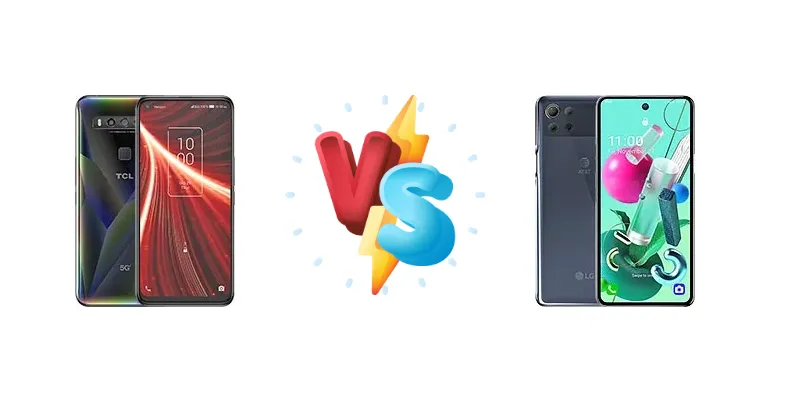
Both the TCL 10 5G UW and the LG K92 5G represent attempts to bring 5G connectivity to a more accessible price point. However, they achieve this with different chipsets – the Qualcomm Snapdragon 765G in the TCL and the Snapdragon 690 in the LG – leading to distinct performance characteristics. This comparison will dissect those differences, focusing on real-world impact for the average user.
🏆 Quick Verdict
For most users, the TCL 10 5G UW emerges as the stronger choice. Its Snapdragon 765G, built on a 7nm process, offers a noticeable performance advantage over the LG K92 5G’s Snapdragon 690 (8nm), particularly in demanding tasks and gaming. While the LG boasts Quick Charge 4.0, the TCL’s overall processing power provides a more well-rounded experience.
| Network |
|---|
| 2G bands | GSM 850 / 900 / 1800 / 1900 | GSM 850 / 900 / 1800 / 1900 |
| 3G bands | HSDPA 850 / 900 / 1700(AWS) / 1900 / 2100 | HSDPA 850 / 900 / 1700(AWS) / 1900 / 2100 |
| 4G bands | 2, 3, 4, 5, 7, 12, 13, 20, 28, 46, 48, 66 | LTE |
| 5G bands | 2, 5, 66, 260, 261 mmWave | SA/NSA/Sub6 |
| Speed | HSPA, LTE, 5G | HSPA, LTE, 5G |
| Technology | GSM / HSPA / LTE / 5G | GSM / HSPA / LTE / 5G |
| Launch |
|---|
| Announced | 2020, October 27. Released 2020, October 29 | 2020, September 29. Released 2020, November 06 |
| Status | Discontinued | Discontinued |
| Body |
|---|
| Build | Glass front, glass back, aluminum frame | - |
| Dimensions | 163.6 x 76.5 x 9.4 mm (6.44 x 3.01 x 0.37 in) | 166.4 x 77.2 x 8.4 mm (6.55 x 3.04 x 0.33 in) |
| SIM | Nano-SIM | Nano-SIM + Nano-SIM |
| Weight | 210 g (7.41 oz) | 202.4 g (7.13 oz) |
| Display |
|---|
| Resolution | 1080 x 2340 pixels, 19.5:9 ratio (~395 ppi density) | 1080 x 2400 pixels, 20:9 ratio (~393 ppi density) |
| Size | 6.53 inches, 104.7 cm2 (~83.6% screen-to-body ratio) | 6.7 inches, 108.4 cm2 (~84.4% screen-to-body ratio) |
| Type | IPS LCD, HDR10, 450 nits (typ) | IPS LCD |
| Platform |
|---|
| CPU | Octa-core (1x2.4 GHz Kryo 475 Prime & 1x2.2 GHz Kryo 475 Gold & 6x1.8 GHz Kryo 475 Silver) | Octa-core (2x2.0 GHz Kryo 560 Gold & 6x1.7 GHz Kryo 560 Silver) |
| Chipset | Qualcomm SM7250 Snapdragon 765G 5G (7 nm) | Qualcomm SM6350 Snapdragon 690 5G (8 nm) |
| GPU | Adreno 620 | Adreno 619L |
| OS | Android 10 | Android 10 |
| Memory |
|---|
| Card slot | microSDXC (uses shared SIM slot) | microSDXC |
| Internal | 128GB 6GB RAM | 128GB 6GB RAM |
| | UFS 2.1 | - |
| Main Camera |
|---|
| Features | Dual-LED flash, HDR, panorama | Quad-LED flash, panorama, HDR |
| Quad | - | 64 MP, f/1.8, 25mm (wide), 1/1.97", 0.7µm, PDAF
5 MP, f/2.2, 115˚ (ultrawide), 1/5.0", 1.12µm
2 MP (macro)
Auxiliary lens |
| Triple | 48 MP, 26mm (wide), 1/2.0", 0.8µm, PDAF
8 MP, f/2.2, 13mm (ultrawide), 1/4.0", 1.12µm
5 MP (macro), AF | - |
| Video | 4K@30fps, 1080p@30/60/120fps, gyro-EIS | 4K@30fps, 1080p@30fps |
| Selfie camera |
|---|
| Single | 16 MP, f/2.2, 26mm (wide), 1/3.06", 1.0µm | 16 MP, f/2.0, 27mm (wide), 1/3.06, 1.0µm |
| Video | 1080p@30fps | 1080p@30fps |
| Sound |
|---|
| 3.5mm jack | Yes | Yes |
| 35mm jack | Yes | Yes |
| Loudspeaker | Yes | Yes, with stereo speakers |
| Comms |
|---|
| Bluetooth | 5.0, A2DP, LE | 5.1, A2DP, LE |
| NFC | - | Yes |
| Positioning | GPS (L1+L5), GLONASS, GALILEO | GPS, GLONASS, GALILEO |
| Radio | No | No |
| USB | USB Type-C 2.0, OTG | USB Type-C 3.1 |
| WLAN | Wi-Fi 802.11 a/b/g/n/ac, dual-band, Wi-Fi Direct | Wi-Fi 802.11 a/b/g/n/ac, dual-band, Wi-Fi Direct |
| Features |
|---|
| Sensors | Fingerprint (rear-mounted), accelerometer, gyro, proximity, compass | Fingerprint (side-mounted), accelerometer, proximity, compass |
| Battery |
|---|
| Charging | 18W wired, QC3 | Quick Charge 4.0 |
| Type | Li-Po 4500 mAh | Li-Po 4000 mAh |
| Misc |
|---|
| Colors | Diamond Gray | Titan Gray |
| Models | - | LMK920, LM-K920 |
| Price | About 340 EUR | About 340 EUR |
TCL 10 5G UW
- More powerful Snapdragon 765G chipset
- 7nm process for better efficiency
- Superior GPU performance for gaming
- Slower charging speed (QC3)
- Potentially less refined software experience
LG K92 5G
- Faster charging with Quick Charge 4.0
- Potentially longer battery life due to charging speed
- More recent release (potentially better software support)
- Less powerful Snapdragon 690 chipset
- 8nm process less efficient
- Inferior GPU performance for gaming
Display Comparison
Neither TCL nor LG provided display specs in the context data. Given the price bracket, both likely utilize LCD panels. However, the TCL, being a slightly older model, may have benefitted from more refinement in color calibration. The absence of high refresh rate information suggests both are likely capped at 60Hz. Bezels are expected to be comparable, typical of mid-range devices.
Camera Comparison
Without detailed sensor information, a direct comparison is limited. However, the Snapdragon 765G generally offers more advanced image signal processing (ISP) capabilities than the 690. This means the TCL 10 5G UW is likely to produce slightly better image quality, particularly in challenging lighting conditions. The absence of OIS information suggests neither phone features optical image stabilization. Focusing on the main sensor is crucial; any 2MP macro or depth sensors are unlikely to significantly impact the overall camera experience.
Performance
The core difference lies in the chipsets. The TCL 10 5G UW’s Snapdragon 765G, fabricated on a 7nm process, features a Kryo 475 CPU with a prime core clocked at 2.4GHz. This contrasts with the LG K92 5G’s Snapdragon 690 (8nm) and its Kryo 560 CPU peaking at 2.0GHz. The 7nm process generally translates to better power efficiency and thermal performance, allowing the 765G to sustain higher clock speeds for longer. The 765G also has a more powerful Adreno 620 GPU compared to the 619 in the 690, resulting in superior gaming performance. The 765G’s architecture, with its dedicated prime core, is geared towards more demanding workloads.
Battery Life
Battery capacity isn't specified, but the Snapdragon 765G’s 7nm efficiency could offset a potentially smaller battery in the TCL 10 5G UW. The LG K92 5G supports Quick Charge 4.0, a faster charging standard than the TCL’s QC3. This means the LG will likely achieve a 0-100% charge faster, but the TCL’s more efficient chipset may result in comparable overall battery life despite the slower charging speed. The real-world impact will depend on usage patterns.
Buying Guide
Buy the TCL 10 5G UW if you prioritize consistent performance for gaming, multitasking, and future-proofing with a more capable chipset. Buy the LG K92 5G if you value faster charging speeds and are primarily focused on basic smartphone tasks like browsing, social media, and light media consumption, and are less concerned with demanding applications.
Frequently Asked Questions
❓ Will the Snapdragon 690 in the LG K92 5G struggle with graphically intensive games like PUBG or Call of Duty?
The Snapdragon 690 is capable of running these games, but you'll likely need to lower the graphics settings to achieve a smooth frame rate. The TCL 10 5G UW’s Snapdragon 765G and Adreno 620 GPU will provide a noticeably better gaming experience with higher settings and more consistent performance.
❓ How much faster is Quick Charge 4.0 on the LG K92 5G compared to Quick Charge 3.0 on the TCL 10 5G UW in real-world usage?
Quick Charge 4.0 can potentially charge a compatible battery from 0-50% in around 30 minutes, while QC3.0 typically takes closer to 45-60 minutes for the same. However, the actual charging time depends on the battery capacity and the charger used. The TCL’s 7nm chipset may mitigate some of the charging speed difference through improved efficiency.
❓ Does the Snapdragon 765G in the TCL 10 5G UW offer any advantages for 5G connectivity compared to the Snapdragon 690 in the LG K92 5G?
Both chipsets support 5G, but the 765G generally has a more advanced 5G modem, potentially offering slightly faster download and upload speeds, and better network aggregation capabilities in areas with strong 5G coverage. However, real-world 5G performance is heavily dependent on carrier infrastructure and location.