
T-Mobile T Phone 3 vs Google Pixel 7a: Which Mid-Range Champion Reigns Supreme?
| Phones Images | |||||
|---|---|---|---|---|---|
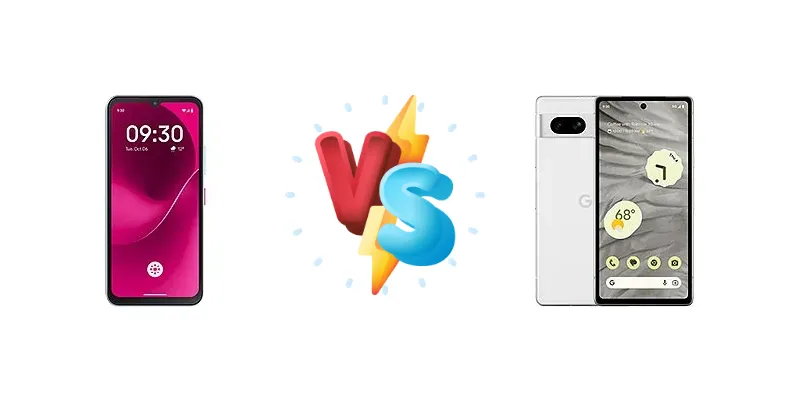
|
🏆 Quick Verdict
For the average user prioritizing all-day battery life and a smooth, efficient experience, the T-Mobile T Phone 3 emerges as the winner. While the Pixel 7a boasts a superior display and camera system powered by the Tensor G2, its battery endurance and slower charging are significant drawbacks compared to the T Phone 3’s impressive 46:58h endurance.
| PHONES | ||
|---|---|---|
| Phone Names | T-Mobile T Phone 3 | Google Pixel 7a |
| Network | ||
|---|---|---|
| 2G bands | GSM 850 / 900 / 1800 / 1900 | GSM 850 / 900 / 1800 / 1900 |
| 3G bands | HSDPA 850 / 900 / 2100 - International | HSDPA 800 / 850 / 900 / 1700(AWS) / 1900 / 2100 |
| 4G bands | 2, 4, 5, 7, 12, 25, 26, 28, 41, 48, 66, 71 - USA | 1, 2, 3, 4, 5, 7, 8, 12, 13, 14, 17, 20, 25, 26, 28, 29, 30, 38, 40, 41, 48, 66, 71 - GWKK3, G0DZQ |
| 5G bands | 1, 3, 7, 28, 38, 75, 78 SA/NSA | 1, 2, 3, 5, 7, 8, 12, 14, 20, 25, 28, 30, 38, 41, 48, 66, 71, 77, 78 SA/NSA/Sub6 - GWKK3 |
| Speed | HSPA, LTE, 5G | HSPA, LTE, 5G |
| Technology | GSM / HSPA / LTE / 5G | GSM / HSPA / LTE / 5G |
| - | 1, 2, 3, 5, 7, 8, 12, 20, 25, 28, 38, 40, 41, 66, 75, 76, 77, 78, 79 SA/NSA/Sub6 - GHL1X, G82U8 | |
| Launch | ||
|---|---|---|
| Announced | 2025, August 14 | 2023, May 10 |
| Status | Available. Released 2025, August 14 | Available. Released 2023, May 10 |
| Body | ||
|---|---|---|
| Build | - | Glass front (Gorilla Glass 3), aluminum frame, plastic back |
| Dimensions | 166.5 x 77.1 x 9.3 mm (6.56 x 3.04 x 0.37 in) | 152 x 72.9 x 9 mm (5.98 x 2.87 x 0.35 in) |
| SIM | Nano-SIM + eSIM | Nano-SIM + eSIM |
| Weight | 218 g (7.69 oz) | 193.5 g (6.84 oz) |
| - | IP67 dust/water resistant (up to 1m for 30 min) | |
| Display | ||
|---|---|---|
| Protection | Mohs level 6 | Corning Gorilla Glass 3 |
| Resolution | 1080 x 2408 pixels, 20:9 ratio (~401 ppi density) | 1080 x 2400 pixels, 20:9 ratio (~429 ppi density) |
| Size | 6.58 inches, 104.3 cm2 (~81.2% screen-to-body ratio) | 6.1 inches, 90.7 cm2 (~81.8% screen-to-body ratio) |
| Type | IPS LCD, 120Hz | OLED, HDR, 90Hz |
| - | Always-on display | |
| Platform | ||
|---|---|---|
| CPU | Octa-core (4x2.4 GHz Cortex-A78 & 4x1.8 GHz Cortex-A55) | Octa-core (2x2.85 GHz Cortex-X1 & 2x2.35 GHz Cortex-A78 & 4x1.80 GHz Cortex-A55) |
| Chipset | Qualcomm SM6475-AB Snapdragon 6 Gen 3 (4 nm) | Google Tensor G2 (5 nm) |
| GPU | Adreno 710 | Mali-G710 MP7 |
| OS | Android 15, up to 3 major Android upgrades | Android 13, upgradable to Android 15, up to 5 major Android upgrades |
| Memory | ||
|---|---|---|
| Card slot | microSDXC | No |
| Internal | 128GB 6GB RAM | 128GB 8GB RAM |
| - | UFS 3.1 | |
| Main Camera | ||
|---|---|---|
| Dual | 50 MP, (wide), PDAF, OIS 2 MP (macro) | 64 MP, f/1.9, 26mm (wide), 1/1.73", 0.8µm, dual pixel PDAF, OIS 13 MP, f/2.2, 120˚ (ultrawide), 1.12µm |
| Features | LED flash, HDR, panorama | Dual-LED flash, Pixel Shift, Auto-HDR, panorama |
| Video | Yes | 4K@30/60fps, 1080p@30/60/120/240fps, OIS |
| Selfie camera | ||
|---|---|---|
| Features | - | HDR, panorama |
| Single | 13 MP | 13 MP, f/2.2, 20mm (ultrawide), 1.12µm |
| Video | 1080p@30fps | 4K@30fps, 1080p@30fps |
| Sound | ||
|---|---|---|
| 3.5mm jack | - | No |
| 35mm jack | Yes | No |
| Loudspeaker | Yes, with stereo speakers | Yes, with stereo speakers |
| Comms | ||
|---|---|---|
| Bluetooth | 5.1, A2DP, LE | 5.3, A2DP, LE |
| NFC | Yes | Yes |
| Positioning | GPS | GPS, GLONASS, GALILEO, BDS, QZSS, NavIC |
| Radio | No | No |
| USB | USB Type-C 2.0 | USB Type-C 3.2 |
| WLAN | Wi-Fi 802.11 a/b/g/n/ac, dual-band | Wi-Fi 802.11 a/b/g/n/ac/6e, tri-band |
| Features | ||
|---|---|---|
| Sensors | Fingerprint (side-mounted); unspecified sensors | Fingerprint (under display, optical), accelerometer, gyro, proximity, compass, barometer |
| Battery | ||
|---|---|---|
| Charging | 25W wired, PD3.0, QC3 | 18W wired, PD3.0 7.5W wireless |
| Type | 5000 mAh | Li-Po 4385 mAh |
| Misc | ||
|---|---|---|
| Colors | Icy Silver | Charcoal, Snow, Sea, Coral |
| Models | - | GWKK3, GHL1X, G0DZQ, G82U8 |
| Price | About 150 EUR | € 179.90 / $ 150.00 / £ 170.00 / ₹ 25,980 |
| EU LABEL | ||
|---|---|---|
| Battery | 46:58h endurance, 1000 cycles | - |
| Energy | Class B | - |
| Free fall | Class A (350 falls) | - |
| Repairability | Class A | - |
T-Mobile T Phone 3
- Exceptional battery life (46:58h endurance)
- Fast 25W wired charging with PD3.0/QC3
- Efficient Snapdragon 6 Gen 3 chipset
- Likely inferior display quality compared to Pixel 7a
- Camera performance likely lags behind Pixel 7a
Google Pixel 7a
- Superior camera system with Google’s computational photography
- Brighter and more vibrant display (1070 nits)
- Powerful Tensor G2 chipset for AI tasks
- Significantly shorter battery life (76h endurance)
- Slower 18W wired charging
Display Comparison
The Pixel 7a significantly outshines the T Phone 3 in display technology, boasting a peak brightness of 1070 nits. While the T Phone 3’s display specs are not provided, the Pixel 7a’s brightness ensures excellent visibility even in direct sunlight. The Pixel 7a likely utilizes an OLED panel, offering superior contrast and color accuracy compared to what is typically found in the T Phone 3’s price bracket. The absence of LTPO technology on either device means neither offers adaptive refresh rates for power saving.
Camera Comparison
The Pixel 7a’s camera system is a clear strength, leveraging Google’s renowned computational photography. While specific sensor details are missing for both devices, the Pixel 7a’s image processing capabilities, powered by the Tensor G2, will deliver superior dynamic range, detail, and low-light performance. The T Phone 3’s camera is likely competent for everyday snapshots, but it won’t match the Pixel 7a’s ability to produce consistently high-quality images. We can assume the Pixel 7a offers advanced features like Magic Eraser and Photo Unblur, unavailable on the T Phone 3.
Performance
The Google Pixel 7a’s Tensor G2 (5nm) chipset, with its Cortex-X1 prime core, offers a performance advantage over the T-Mobile T Phone 3’s Snapdragon 6 Gen 3 (4nm). The Tensor G2’s core configuration (2x2.85 GHz Cortex-X1, 2x2.35 GHz Cortex-A78, 4x1.80 GHz Cortex-A55) is geared towards AI tasks and image processing, while the Snapdragon 6 Gen 3 (4x2.4 GHz Cortex-A78, 4x1.8 GHz Cortex-A55) prioritizes efficiency. The 4nm process node on the Snapdragon 6 Gen 3 contributes to better thermal management and power efficiency, potentially leading to more consistent performance during extended use. The Pixel 7a’s Tensor G2 will excel in tasks like voice recognition and image editing, but the T Phone 3 will likely offer a smoother experience for everyday tasks and less throttling during prolonged gaming.
Battery Life
Battery life is where the T-Mobile T Phone 3 truly shines. Its impressive 46:58h endurance rating significantly surpasses the Pixel 7a’s older 76h rating. This translates to a full day or more of usage on a single charge, even with heavy use. The T Phone 3 also supports 25W wired charging with PD3.0 and QC3, allowing for faster top-ups compared to the Pixel 7a’s 18W wired charging. The Pixel 7a does offer 7.5W wireless charging, a feature absent on the T Phone 3, but the slower charging speed limits its convenience. The T Phone 3’s 1000 charge cycle rating also suggests a longer lifespan for the battery itself.
Buying Guide
Buy the T-Mobile T Phone 3 if you need a phone that consistently lasts through a full day of heavy use, and value long-term battery health with its 1000 cycle rating. You’ll appreciate its efficient Snapdragon 6 Gen 3 chipset and fast 25W charging. Buy the Google Pixel 7a if you prioritize camera quality, especially computational photography features, and enjoy a brighter, more vibrant display. The Tensor G2 offers unique AI-powered experiences, but be prepared for shorter battery life and slower charging speeds.