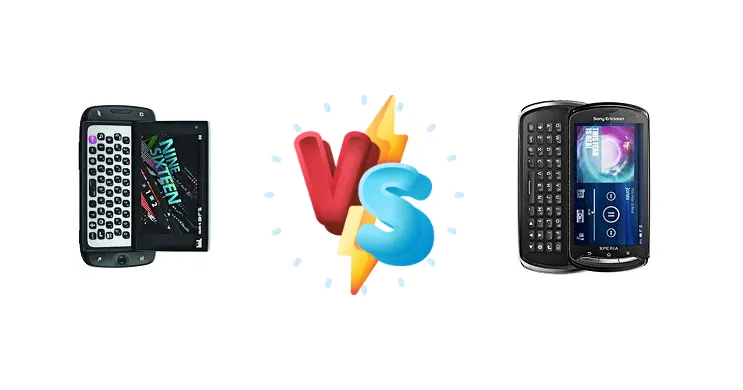
Remember the days of sliders, physical keyboards, and instant messaging dominance? The T-Mobile Sidekick 4G and Sony Ericsson Xperia Pro represent a pivotal moment in mobile history. Let's dive into a detailed comparison to see which of these retro devices holds up today.
🏆 Quick Verdict
The Xperia Pro edges out the Sidekick 4G thanks to its Snapdragon chipset and impressive battery life. While the Sidekick's iconic design and messaging focus are nostalgic, the Xperia Pro offers a more robust and versatile experience for modern use, despite its age.
| Network |
|---|
| 2G bands | GSM 850 / 900 / 1800 / 1900 | GSM 850 / 900 / 1800 / 1900 |
| 3G bands | HSDPA 1700 / 2100 | HSDPA 900 / 2100 - MK16i |
| Speed | HSPA 7.2/5.76 Mbps | HSPA 7.2/5.76 Mbps |
| Technology | GSM / HSPA | GSM / HSPA |
| | HSDPA 2100 | HSDPA 850 / 1900 / 2100 / 800 - MK16a |
| Launch |
|---|
| Announced | 2011, March. Released 2011, April 20 | 2011, February. Released 2011, October |
| Status | Discontinued | Discontinued |
| Body |
|---|
| Dimensions | 127 x 61 x 15 mm (5.0 x 2.40 x 0.59 in) | 120 x 57 x 15.3 mm (4.72 x 2.24 x 0.60 in) |
| Keyboard | QWERTY | QWERTY |
| SIM | Mini-SIM | Mini-SIM |
| Weight | 162 g (5.71 oz) | 142 g (5.01 oz) |
| | Optical trackpad | - |
| Display |
|---|
| Protection | - | Scratch-resistant glass |
| Resolution | 480 x 800 pixels, 5:3 ratio (~267 ppi density) | 480 x 854 pixels, 16:9 ratio (~265 ppi density) |
| Size | 3.5 inches, 34.9 cm2 (~45.0% screen-to-body ratio) | 3.7 inches, 37.7 cm2 (~55.2% screen-to-body ratio) |
| Type | TFT | LED-backlit LCD, |
| Platform |
|---|
| CPU | 1.0 GHz Cortex-A8 | 1.0 GHz Scorpion |
| Chipset | Hummingbird | Qualcomm MSM8255 Snapdragon S2 |
| GPU | PowerVR SGX540 | Adreno 205 |
| OS | Android 2.2 (Froyo) | Android 2.3 (Gingerbread), upgradable to 4.0 (Ice Cream Sandwich) |
| Memory |
|---|
| Card slot | microSDHC (dedicated slot), 2 GB included | microSDHC (dedicated slot), 8 GB included |
| Internal | 1GB 512MB RAM | 1GB (320MB user available), 512MB RAM |
| Main Camera |
|---|
| Features | - | LED flash |
| Single | 3.15 MP, AF | 8 MP, AF |
| Video | 480p@30fps | 720p@30fps |
| Selfie camera |
|---|
| Single | VGA | VGA |
| Sound |
|---|
| 3.5mm jack | Yes | Yes |
| 35mm jack | Yes | Yes |
| Loudspeaker | Yes | Yes |
| Comms |
|---|
| Bluetooth | 3.0, A2DP | 2.1, A2DP |
| Positioning | GPS, A-GPS | GPS, A-GPS; GLONASS |
| Radio | Nо | Stereo FM radio, RDS |
| USB | microUSB 2.0 | microUSB 2.0 |
| WLAN | Wi-Fi 802.11 b/g/n, DLNA, hotspot | Wi-Fi 802.11 b/g/n, DLNA, hotspot |
| Features |
|---|
| Browser | HTML, Adobe Flash | HTML, Adobe Flash |
| Sensors | Accelerometer, proximity | Accelerometer, proximity |
| | T-Mobile TV
MP4/H.264 player
MP3/WAV/eAAC+ player
Organizer
ThinkFree Office document editor , PDF viewer
Voice memo
Predictive text input | ANT+
Type & Send feature
HDMI port
MP4/H.264/WMV player
MP3/WMA/WAV/eAAC+ player
TrackID music recognition
Organizer
Office Suite Pro document viewer/editor
Voice memo/dial/commands
Predictive text input |
| Battery |
|---|
| Music play | - | Up to 31 h |
| Stand-by | Up to 456 h | Up to 430 h (2G) / Up to 400 h (3G) |
| Talk time | Up to 6 h 30 min | Up to 6 h 55 min (2G) / Up to 7 h (3G) |
| Type | Removable Li-Ion 1500 mAh battery | Removable Li-Po 1500 mAh battery |
| Misc |
|---|
| Colors | Matte black, Pearl magenta | Black, Silver, Red |
| Price | About 310 EUR | About 190 EUR |
| SAR | 0.34 W/kg (head) 0.96 W/kg (body) | - |
| SAR EU | - | 0.88 W/kg (head) |
| Tests |
|---|
| Audio quality | - |
Noise -89.7dB / Crosstalk -88.1dB |
| Battery life | - | Endurance rating 37h |
| Camera | - |
Photo / Video |
| Display | - |
Contrast ratio: 928:1 (nominal) |
| Loudspeaker | - |
Voice 75dB / Noise 66dB / Ring 75dB |
T-Mobile Sidekick 4G
- Iconic Design
- Physical Keyboard (Excellent for Messaging)
- Compact Size
- Nostalgic Appeal
- Limited Performance
- Short Battery Life
- Outdated Software
- Low-Resolution Display
Sony Ericsson Xperia pro
- Longer Battery Life
- Slightly Larger Display
- Better Performance (Snapdragon)
- Physical Keyboard
- Outdated Software
- Low-Resolution Display
- Bulky Design Compared to Modern Phones
- Limited App Support
Display Comparison
Both devices feature a nominal contrast ratio of 928:1, indicating decent image quality for their time. The Sidekick 4G had a 3.2-inch display, while the Xperia Pro boasted a 4.1-inch screen, giving it a slight advantage in terms of screen real estate. However, resolution was limited on both, so don't expect modern sharpness.
Camera Comparison
Camera capabilities were basic on both devices. Both featured Photo/Video functionality, but image quality was limited by the sensors and processing power of the time. Expect grainy images and low-light performance that's far from ideal by today's standards. Neither phone was a photography powerhouse.
Performance
The Xperia Pro's Qualcomm Snapdragon S2 chipset (1.0 GHz Scorpion) generally outperformed the Sidekick 4G's Hummingbird (1.0 GHz Cortex-A8). While both CPUs are similarly clocked, the Snapdragon architecture offered better efficiency and performance in real-world usage. App loading times and multitasking were noticeably smoother on the Xperia Pro.
Battery Life
The Xperia Pro shines in this category. Its endurance rating of 37 hours significantly surpasses what the Sidekick 4G could achieve. The Sidekick 4G's battery life was considerably shorter, requiring more frequent charging.
Buying Guide
The T-Mobile Sidekick 4G is for those seeking a nostalgic experience and a dedicated messaging device. The Sony Ericsson Xperia Pro is for users who appreciate a compact form factor, a physical keyboard, and a longer-lasting battery, and are willing to overlook its age.
Frequently Asked Questions
❓ Are these phones still usable in 2024?
Yes, but with significant limitations. Network compatibility is a major concern, as 3G networks are being phased out. Software updates are non-existent, so security vulnerabilities are a risk. They are best suited for nostalgic use or as collector's items.
❓ Which phone is easier to find?
Both are rare, but the Sidekick 4G might be slightly more common due to its wider initial release. Expect to pay a premium for either device due to their collectibility.