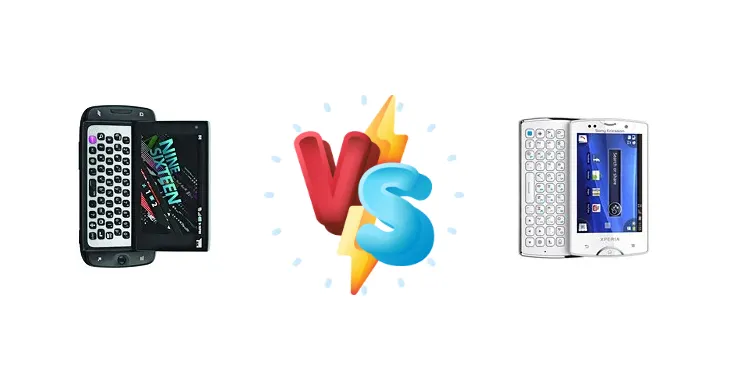
Remember the days of sliders, physical keyboards, and a simpler mobile experience? The T-Mobile Sidekick 4G and Sony Ericsson Xperia mini pro represent that era. Both phones offer a unique blend of nostalgia and functionality, but which one holds up best today? Let's dive into a detailed comparison.
🏆 Quick Verdict
The Xperia mini pro edges out the Sidekick 4G thanks to its Snapdragon chipset offering slightly better performance and a more modern (for the time) feature set. While the Sidekick's iconic design is appealing, the Xperia mini pro provides a more robust and capable experience overall.
| Network |
|---|
| 2G bands | GSM 850 / 900 / 1800 / 1900 | GSM 850 / 900 / 1800 / 1900 |
| 3G bands | HSDPA 1700 / 2100 | HSDPA 900 / 2100 |
| Speed | HSPA 7.2/5.76 Mbps | HSPA 7.2/5.76 Mbps |
| Technology | GSM / HSPA | GSM / HSPA |
| | HSDPA 2100 | HSDPA 850 / 1900 / 2100 |
| Launch |
|---|
| Announced | 2011, March. Released 2011, April 20 | 2011, May. Released 2011, August |
| Status | Discontinued | Discontinued |
| Body |
|---|
| Dimensions | 127 x 61 x 15 mm (5.0 x 2.40 x 0.59 in) | 92 x 53 x 18 mm (3.62 x 2.09 x 0.71 in) |
| Keyboard | QWERTY | QWERTY |
| SIM | Mini-SIM | Mini-SIM |
| Weight | 162 g (5.71 oz) | 136 g (4.80 oz) |
| | Optical trackpad | - |
| Display |
|---|
| Protection | - | Scratch-resistant glass |
| Resolution | 480 x 800 pixels, 5:3 ratio (~267 ppi density) | 320 x 480 pixels, 3:2 ratio (~192 ppi density) |
| Size | 3.5 inches, 34.9 cm2 (~45.0% screen-to-body ratio) | 3.0 inches, 26.8 cm2 (~55.0% screen-to-body ratio) |
| Type | TFT | LED-backlit LCD, |
| Platform |
|---|
| CPU | 1.0 GHz Cortex-A8 | 1.0 GHz Scorpion |
| Chipset | Hummingbird | Qualcomm MSM8255 Snapdragon S2 |
| GPU | PowerVR SGX540 | Adreno 205 |
| OS | Android 2.2 (Froyo) | Android 2.3 (Gingerbread), 4.0 (Ice Cream Sandwich), not upgradable to 4.1 (Jelly Bean) |
| Memory |
|---|
| Card slot | microSDHC (dedicated slot), 2 GB included | microSDHC (dedicated slot), 2 GB included |
| Internal | 1GB 512MB RAM | 512MB RAM, 400MB |
| Main Camera |
|---|
| Features | - | LED flash |
| Single | 3.15 MP, AF | 5 MP, AF |
| Video | 480p@30fps | 720p |
| Selfie camera |
|---|
| Single | VGA | VGA |
| Sound |
|---|
| 3.5mm jack | Yes | Yes |
| 35mm jack | Yes | Yes |
| Loudspeaker | Yes | Yes |
| Comms |
|---|
| Bluetooth | 3.0, A2DP | 2.1, A2DP |
| Positioning | GPS, A-GPS | GPS, A-GPS |
| Radio | Nо | Stereo FM radio, RDS |
| USB | microUSB 2.0 | microUSB 2.0 |
| WLAN | Wi-Fi 802.11 b/g/n, DLNA, hotspot | Wi-Fi 802.11 b/g/n, DLNA, hotspot |
| Features |
|---|
| Browser | HTML, Adobe Flash | HTML, Adobe Flash |
| Sensors | Accelerometer, proximity | Accelerometer, proximity, compass |
| | T-Mobile TV
MP4/H.264 player
MP3/WAV/eAAC+ player
Organizer
ThinkFree Office document editor , PDF viewer
Voice memo
Predictive text input | ANT+
MP4/H.264/WMV player
MP3/eAAC+/WMA/WAV player
TrackID music recognition
Document viewer
Voice memo
Predictive text input |
| Battery |
|---|
| Music play | - | Up to 29 h |
| Stand-by | Up to 456 h | Up to 331 h (2G) / Up to 340 h (3G) |
| Talk time | Up to 6 h 30 min | Up to 5 h 40 min (2G) / Up to 5 h 25 min (3G) |
| Type | Removable Li-Ion 1500 mAh battery | Removable Li-Ion 1200 mAh battery |
| Misc |
|---|
| Colors | Matte black, Pearl magenta | Black, White, Pink, Turquoise |
| Price | About 310 EUR | About 140 EUR |
| SAR | 0.34 W/kg (head) 0.96 W/kg (body) | - |
| SAR EU | - | 0.46 W/kg (head) |
| Tests |
|---|
| Audio quality | - |
Noise -89.7dB / Crosstalk -91.0dB |
| Camera | - |
Photo / Video |
| Display | - |
Contrast ratio: 714:1 (nominal) |
| Loudspeaker | - |
Voice 70dB / Noise 62dB / Ring 70dB |
T-Mobile Sidekick 4G
- Iconic Design
- Physical Keyboard
- Compact Size
- Nostalgic Appeal
- Outdated Performance
- Poor Camera
- Limited App Support
- Fragile Build Quality
Sony Ericsson Xperia mini pro
- Better Performance (Snapdragon)
- Improved Camera
- Physical Keyboard
- Slightly More Modern Features
- Dated Design
- Limited App Support
- Battery Life Could Be Better
- Screen Resolution is Low
Display Comparison
Both devices feature displays with a nominal contrast ratio of 714:1. The Sidekick 4G had a 3.2-inch HVGA display, while the Xperia mini pro boasted a 3.2-inch Reality Display. While both were adequate for their time, the Xperia's Reality Display technology offered slightly better color reproduction and viewing angles, giving it a minor advantage.
Camera Comparison
The Xperia mini pro had a 8.1MP camera with autofocus and LED flash, capable of recording 720p video. The Sidekick 4G's camera was significantly less impressive, offering lower resolution photos and video quality. The Xperia mini pro clearly wins in the camera department.
Performance
The Xperia mini pro's Qualcomm MSM8255 Snapdragon S2 chipset with a 1.0 GHz Scorpion CPU provides a noticeable performance boost over the Sidekick 4G's Hummingbird chipset and 1.0 GHz Cortex-A8 CPU. The Snapdragon offered better graphics capabilities and overall responsiveness, especially when multitasking. The Sidekick 4G could feel sluggish by modern standards.
Battery Life
Battery life was a common concern for both devices. The Sidekick 4G typically offered around 6-8 hours of talk time, while the Xperia mini pro provided a similar range. Neither phone had exceptional battery life by today's standards, but they were comparable.
Buying Guide
The T-Mobile Sidekick 4G is ideal for those seeking a purely nostalgic experience and appreciating its unique form factor. The Xperia mini pro is better suited for users wanting a slightly more functional device with a better camera and potentially faster performance, even by 2010 standards.
Frequently Asked Questions
❓ Are apps available for these phones?
Both phones run older operating systems (Windows Mobile 6.5 for Sidekick 4G and Android 2.1 for Xperia mini pro). App availability is extremely limited and you won't find modern apps.
❓ Can I use these phones on a modern network?
Both phones are 3G devices and may not be compatible with current 4G/5G networks. Check with your carrier for compatibility.