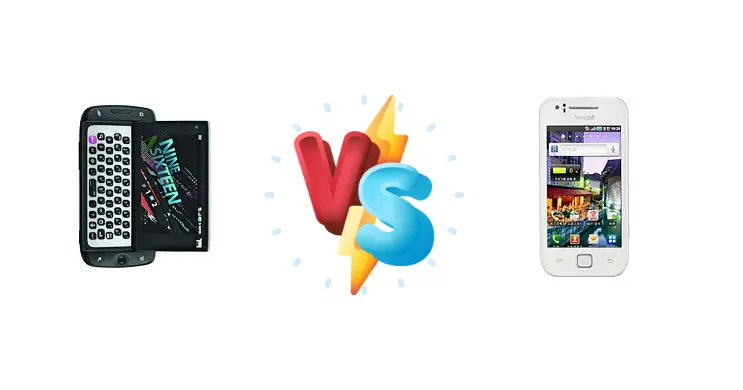
The Sidekick and Galaxy K represent a bygone era of mobile innovation. Both offer a unique blend of nostalgia and functionality, but which one holds up best in a modern context? We're diving deep into a head-to-head comparison to help you decide.
🏆 Quick Verdict
The Samsung Galaxy K edges out the Sidekick 4G thanks to its slightly faster processor and potentially better software support (though both are dated). However, the Sidekick's iconic form factor and QWERTY keyboard remain a strong draw for fans of the original.
| Network |
|---|
| 2G bands | GSM 850 / 900 / 1800 / 1900 | GSM 850 / 900 / 1800 / 1900 |
| 3G bands | HSDPA 1700 / 2100 | HSDPA 900 / 1900 / 2100 |
| Speed | HSPA 7.2/5.76 Mbps | HSPA 7.2/5.76 Mbps |
| Technology | GSM / HSPA | GSM / HSPA |
| | HSDPA 2100 | - |
| Launch |
|---|
| Announced | 2011, March. Released 2011, April 20 | 2010, October. Released 2010, Q4 |
| Status | Discontinued | Discontinued |
| Body |
|---|
| Dimensions | 127 x 61 x 15 mm (5.0 x 2.40 x 0.59 in) | 119.5 x 59.6 x 12.4 mm (4.70 x 2.35 x 0.49 in) |
| Keyboard | QWERTY | - |
| SIM | Mini-SIM | Mini-SIM |
| Weight | 162 g (5.71 oz) | 131 g (4.62 oz) |
| | Optical trackpad | - |
| Display |
|---|
| Resolution | 480 x 800 pixels, 5:3 ratio (~267 ppi density) | 480 x 800 pixels, 5:3 ratio (~252 ppi density) |
| Size | 3.5 inches, 34.9 cm2 (~45.0% screen-to-body ratio) | 3.7 inches, 39.0 cm2 (~54.7% screen-to-body ratio) |
| Type | TFT | Super AMOLED |
| | - | TouchWiz 3.0 UI
|
| Platform |
|---|
| CPU | 1.0 GHz Cortex-A8 | 1.2 GHz Cortex-A8 |
| Chipset | Hummingbird | Hummingbird |
| GPU | PowerVR SGX540 | PowerVR SGX540 |
| OS | Android 2.2 (Froyo) | Android 2.2 (Froyo) |
| Memory |
|---|
| Card slot | microSDHC (dedicated slot), 2 GB included | microSDHC (dedicated slot) |
| Internal | 1GB 512MB RAM | 8GB |
| Main Camera |
|---|
| Single | 3.15 MP, AF | 5 MP, AF |
| Video | 480p@30fps | 720p |
| Selfie camera |
|---|
| Single | VGA | VGA |
| Sound |
|---|
| 3.5mm jack | Yes | Yes |
| 35mm jack | Yes | Yes |
| Loudspeaker | Yes | Yes |
| Comms |
|---|
| Bluetooth | 3.0, A2DP | 3.0, A2DP |
| Positioning | GPS, A-GPS | GPS, A-GPS |
| Radio | Nо | FM radio, RDS |
| USB | microUSB 2.0 | microUSB 2.0 |
| WLAN | Wi-Fi 802.11 b/g/n, DLNA, hotspot | Wi-Fi 802.11 b/g/n, DLNA, hotspot |
| Features |
|---|
| Browser | HTML, Adobe Flash | HTML, Adobe Flash |
| Sensors | Accelerometer, proximity | Accelerometer, proximity, compass |
| | T-Mobile TV
MP4/H.264 player
MP3/WAV/eAAC+ player
Organizer
ThinkFree Office document editor , PDF viewer
Voice memo
Predictive text input | T-DMB TV tuner
MP4/DivX/WMV/H.264 player
MP3/WAV/eAAC+/FLAC player
TV-out
Photo/video editor
Document editor |
| Battery |
|---|
| Stand-by | Up to 456 h | Up to 570 h (2G) / Up to 410 h (3G) |
| Talk time | Up to 6 h 30 min | Up to 13 h 30 min (2G) / Up to 7 h 30 min (3G) |
| Type | Removable Li-Ion 1500 mAh battery | Removable Li-Ion 1500 mAh battery |
| Misc |
|---|
| Colors | Matte black, Pearl magenta | Black and Grey |
| Price | About 310 EUR | About 180 EUR |
| SAR | 0.34 W/kg (head) 0.96 W/kg (body) | 0.62 W/kg (head) 0.65 W/kg (body) |
| SAR EU | - | 0.82 W/kg (head) |
T-Mobile Sidekick 4G
- Iconic QWERTY keyboard
- Classic Sidekick design
- Compact size
- Relatively durable build
- Low-resolution display
- Limited app support
- Slow performance
- Poor camera quality
- Battery degradation
Samsung M130K Galaxy K
- Slightly faster processor
- Potentially better software support (though limited)
- Compact size
- Decent battery life (when new)
- Low-resolution display
- Limited app support
- Slow performance
- Poor camera quality
- Battery degradation
Display Comparison
Both phones feature relatively small, low-resolution displays typical of their time. The Sidekick 4G's screen is generally considered slightly better in terms of viewing angles, but both suffer from limited brightness and color accuracy by today's standards. Expect a basic, functional display experience on either device.
Camera Comparison
Camera quality on both devices is extremely limited. Expect low-resolution images with poor dynamic range and noise. Neither phone is suitable for serious photography. The Sidekick 4G's camera is generally considered slightly inferior.
Performance
The Samsung Galaxy K has a slight advantage with its 1.2 GHz Cortex-A8 CPU compared to the Sidekick 4G's 1.0 GHz Cortex-A8. This translates to marginally faster app loading times and smoother multitasking, though neither phone is a powerhouse by modern standards. Both will struggle with demanding apps.
Battery Life
Battery life was a strong point for both devices in their time. However, battery degradation over the years is a significant factor. Expect a few hours of moderate use on either phone. The Samsung Galaxy K *might* have a slightly larger battery capacity, but this is unconfirmed.
Buying Guide
The T-Mobile Sidekick 4G is for die-hard Sidekick enthusiasts who prioritize the keyboard and iconic design. The Samsung Galaxy K is a better choice for those seeking slightly better performance and potentially more readily available (though still limited) software resources, while still appreciating a retro aesthetic.
Frequently Asked Questions
❓ Are these phones still usable with a modern SIM card?
Likely not without significant effort and potentially custom ROMs. They were designed for older network technologies and may not be compatible with current 4G/5G networks. Check with your carrier.
❓ Can I download apps on these phones?
App support is extremely limited. You'll be restricted to the apps available on their original operating systems, which are very outdated.