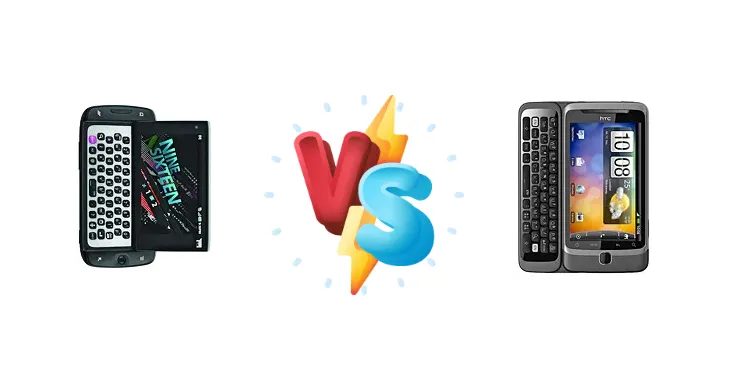
The early 2010s were a wild time for smartphones. Two devices, the T-Mobile Sidekick 4G and the HTC Desire Z, offered unique approaches to mobile communication. This review pits these nostalgic phones against each other, examining their strengths and weaknesses to help you decide which one might be a fun retro project.
🏆 Quick Verdict
The Sidekick 4G boasts a slightly faster processor and a more modern OS, offering a marginally smoother experience. However, the Desire Z's slide-out QWERTY keyboard and generally more robust build quality give it a competitive edge for those prioritizing physical input and durability. It's a close call, leaning slightly towards the Desire Z.
| Network |
|---|
| 2G bands | GSM 850 / 900 / 1800 / 1900 | GSM 850 / 900 / 1800 / 1900 |
| 3G bands | HSDPA 1700 / 2100 | HSDPA 900 / 2100 |
| Speed | HSPA 7.2/5.76 Mbps | HSPA 14.4/5.76 Mbps |
| Technology | GSM / HSPA | GSM / HSPA |
| | HSDPA 2100 | HSDPA 850 / 1900 - North America |
| Launch |
|---|
| Announced | 2011, March. Released 2011, April 20 | 2010, September. Released 2010, November |
| Status | Discontinued | Discontinued |
| Body |
|---|
| Dimensions | 127 x 61 x 15 mm (5.0 x 2.40 x 0.59 in) | 119 x 60.4 x 14.2 mm (4.69 x 2.38 x 0.56 in) |
| Keyboard | QWERTY | QWERTY |
| SIM | Mini-SIM | Mini-SIM |
| Weight | 162 g (5.71 oz) | 180 g (6.35 oz) |
| | Optical trackpad | Optical trackpad |
| Display |
|---|
| Protection | - | Corning Gorilla Glass |
| Resolution | 480 x 800 pixels, 5:3 ratio (~267 ppi density) | 480 x 800 pixels, 5:3 ratio (~252 ppi density) |
| Size | 3.5 inches, 34.9 cm2 (~45.0% screen-to-body ratio) | 3.7 inches, 39.0 cm2 (~54.2% screen-to-body ratio) |
| Type | TFT | S-LCD |
| Platform |
|---|
| CPU | 1.0 GHz Cortex-A8 | 800 MHz Scorpion |
| Chipset | Hummingbird | Qualcomm MSM7230 |
| GPU | PowerVR SGX540 | Adreno 205 |
| OS | Android 2.2 (Froyo) | Android 2.2 (Froyo), upgradable to 2.3 (Gingerbread), Sense UI |
| Memory |
|---|
| Card slot | microSDHC (dedicated slot), 2 GB included | microSDHC (dedicated slot) |
| Internal | 1GB 512MB RAM | 1.5GB; 512MB RAM |
| Main Camera |
|---|
| Features | - | LED flash |
| Single | 3.15 MP, AF | 5 MP, AF |
| Video | 480p@30fps | 720p |
| Selfie camera |
|---|
| Single | VGA | - |
| | - | No |
| Sound |
|---|
| 3.5mm jack | Yes | Yes |
| 35mm jack | Yes | Yes |
| Loudspeaker | Yes | Yes |
| Comms |
|---|
| Bluetooth | 3.0, A2DP | 2.1, A2DP |
| Positioning | GPS, A-GPS | GPS, A-GPS |
| Radio | Nо | Stereo FM radio, RDS |
| USB | microUSB 2.0 | microUSB 2.0 |
| WLAN | Wi-Fi 802.11 b/g/n, DLNA, hotspot | Wi-Fi 802.11 b/g/n, DLNA, hotspot |
| Features |
|---|
| Browser | HTML, Adobe Flash | HTML, Adobe Flash |
| Sensors | Accelerometer, proximity | Accelerometer, proximity, compass |
| | T-Mobile TV
MP4/H.264 player
MP3/WAV/eAAC+ player
Organizer
ThinkFree Office document editor , PDF viewer
Voice memo
Predictive text input | Dedicated search key
MP3/WAV/AAC+ player
MP4/H.264/DivX/XviD player
Voice memo/dial
Predictive text input |
| Battery |
|---|
| Stand-by | Up to 456 h | Up to 430 h (2G) / Up to 430 h (3G) |
| Talk time | Up to 6 h 30 min | Up to 9 h 50 min (2G) / Up to 6 h 40 min (3G) |
| Type | Removable Li-Ion 1500 mAh battery | Removable Li-Ion 1300 mAh battery |
| Misc |
|---|
| Colors | Matte black, Pearl magenta | Black |
| Price | About 310 EUR | About 100 EUR |
| SAR | 0.34 W/kg (head) 0.96 W/kg (body) | - |
| SAR EU | - | 0.86 W/kg (head) |
| Tests |
|---|
| Audio quality | - |
Noise -90.1dB / Crosstalk -90.7dB |
| Camera | - |
Photo |
| Loudspeaker | - |
Voice 72dB / Noise 72dB / Ring 82dB
|
T-Mobile Sidekick 4G
- Slightly faster processor
- Full touchscreen interface
- More modern OS (Windows Mobile 6.5)
- Iconic design
- Limited app support
- Battery life could be better
- Fragile build quality
- Windows Mobile 6.5 is outdated
HTC Desire Z
- Slide-out QWERTY keyboard
- More durable build quality
- Slightly better battery life
- More readily available parts (potentially)
- Slower processor
- Smaller, less vibrant display
- Outdated Android OS (2.1 Eclair)
- Less intuitive interface compared to touchscreen-only devices
Display Comparison
The Sidekick 4G features a 3.5-inch touchscreen display, offering a more modern and intuitive interface. The Desire Z relies on a 3.2-inch HVGA display, which is smaller and less vibrant. Touch responsiveness on the Sidekick 4G is generally better.
Camera Comparison
Both phones feature basic 3.2MP cameras. Image quality is comparable – expect grainy photos in low light and decent results in good lighting conditions. Neither phone excels in photography.
Performance
The Sidekick 4G's 1.0 GHz Cortex-A8 processor gives it a slight edge over the Desire Z's 800 MHz Scorpion. While both phones will struggle with modern apps, the Sidekick 4G handles basic tasks and web browsing a bit more smoothly. Expect some lag on both devices.
Battery Life
The Desire Z generally has slightly better battery life due to its more efficient processor and smaller screen. Expect around 8-10 hours of moderate use on the Desire Z, compared to 6-8 hours on the Sidekick 4G.
Buying Guide
The T-Mobile Sidekick 4G is for those nostalgic for the Sidekick experience and appreciate a full touchscreen. The HTC Desire Z is ideal for users who prefer a physical QWERTY keyboard and a more durable design, even if it means sacrificing some processing power.
Frequently Asked Questions
❓ Are these phones still usable in 2024?
Yes, but with limitations. They won't support modern apps or network technologies. They're best suited for retro enthusiasts or as basic communication devices on older 2G/3G networks.
❓ Can I update the operating system on either phone?
Officially, no. While some community efforts exist to port custom ROMs, it's a complex process and not guaranteed to work reliably.