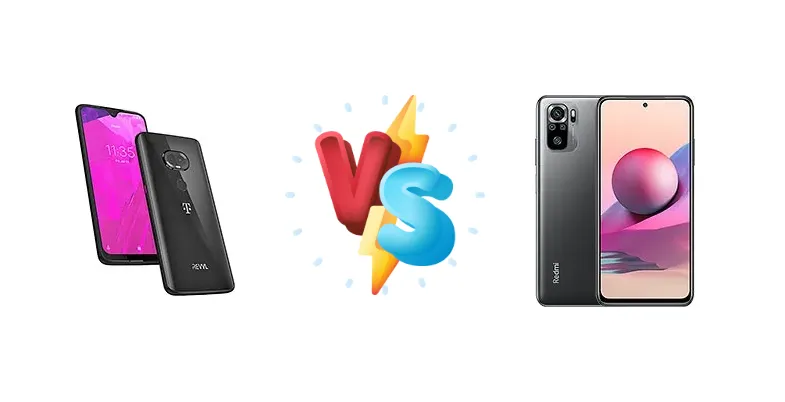
Both the T-Mobile Revvlry+ and the Xiaomi Redmi Note 11 SE (India) target the budget-conscious smartphone user, but they take different approaches to achieving affordability. The Revvlry+ relies on Qualcomm’s Snapdragon 636, a well-established chip, while the Redmi Note 11 SE opts for MediaTek’s Helio G95. This comparison dissects the architectural differences and real-world implications of these choices, helping you determine which device delivers the best value.
🏆 Quick Verdict
For the average user prioritizing consistent performance and a known quantity, the Xiaomi Redmi Note 11 SE (India) emerges as the better choice. Its Helio G95 chipset, built on a smaller 12nm process, offers a noticeable performance uplift over the Snapdragon 636, especially in gaming, and the faster 33W charging is a significant convenience.
| Network |
|---|
| 2G bands | GSM 850 / 900 / 1800 / 1900 | GSM 850 / 900 / 1800 / 1900 |
| 3G bands | HSDPA 850 / 1700(AWS) / 1900 | HSDPA 850 / 900 / 1700(AWS) / 1900 / 2100 |
| 4G bands | 1, 2, 3, 4, 5, 7, 12, 13, 20, 66, 71 | 1, 2, 3, 4, 5, 7, 8, 20, 28, 38, 40, 41 |
| Speed | HSPA 42.2/5.76 Mbps, LTE (2CA) Cat12 600/50 Mbps | HSPA, LTE |
| Technology | GSM / HSPA / LTE | GSM / HSPA / LTE |
| Launch |
|---|
| Announced | 2019, July. Released 2019, July | 2022, August 24 |
| Status | Discontinued | Available. Released 2022, August 31 |
| Body |
|---|
| Dimensions | 158.5 x 75.2 x 8.6 mm (6.24 x 2.96 x 0.34 in) | 160.5 x 74.5 x 8.3 mm (6.32 x 2.93 x 0.33 in) |
| SIM | Nano-SIM | Nano-SIM + Nano-SIM |
| Weight | - | 178.8 g (6.31 oz) |
| | IP54, dust and water resistant | IP53, dust and splash resistant |
| Display |
|---|
| Protection | - | Corning Gorilla Glass 3 |
| Resolution | 1080 x 2270 pixels, 19:9 ratio (~403 ppi density) | 1080 x 2400 pixels, 20:9 ratio (~409 ppi density) |
| Size | 6.24 inches, 97.5 cm2 (~81.8% screen-to-body ratio) | 6.43 inches, 99.8 cm2 (~83.5% screen-to-body ratio) |
| Type | IPS LCD | Super AMOLED, 450 nits (typ), 700 nits (HBM), 1100 nits (peak) |
| Platform |
|---|
| CPU | Octa-core (4x1.8 GHz Kryo 260 Gold & 4x1.6 GHz Kryo 260 Silver) | Octa-core (2x2.05 GHz Cortex-A76 & 6x2.0 GHz Cortex-A55) |
| Chipset | Qualcomm SDM636 Snapdragon 636 (14 nm) | Mediatek MT6785V/CD Helio G95 (12 nm) |
| GPU | Adreno 509 | Mali-G76 MC4 |
| OS | Android 9.0 (Pie) | Android 11, MIUI 12.5 |
| Memory |
|---|
| Card slot | microSDXC (dedicated slot) | microSDXC (dedicated slot) |
| Internal | 64GB 4GB RAM | 64GB 6GB RAM, 128GB 6GB RAM, 128GB 8GB RAM |
| | eMMC 5.1 | UFS 2.2 |
| Main Camera |
|---|
| Dual | 16 MP, f/1.7, 1.22µm, PDAF, OIS
Auxiliary lens | - |
| Features | Dual-LED dual-tone flash, panorama, HDR | LED flash, HDR, panorama |
| Quad | - | 64 MP, f/1.9, 26mm (wide), 1/1.97", 0.7µm, PDAF
8 MP, f/2.2, 118˚ (ultrawide), 1/4.0", 1.12µm
2 MP (macro)
Auxiliary lens |
| Video | 4K@30fps, 1080p@30/60/120fps, gyro-EIS | 4K@30fps, 1080p@30/60fps |
| Selfie camera |
|---|
| Features | HDR | HDR |
| Single | 12 MP, (wide), 1/2.8", 1.25µm | 13 MP, f/2.5, (wide), 1/3.06", 1.12µm |
| Video | 1080p@30fps | 1080p@30fps |
| Sound |
|---|
| 3.5mm jack | Yes | Yes |
| 35mm jack | Yes | Yes |
| Loudspeaker | Yes | Yes, with stereo speakers |
| | - | 24-bit/192kHz audio |
| Comms |
|---|
| Bluetooth | 5.0, A2DP, LE | 5.0, A2DP, LE |
| Infrared port | - | Yes |
| NFC | No | Yes (market/region dependent) |
| Positioning | GPS, GLONASS, GALILEO | GPS, GLONASS, GALILEO, BDS |
| Radio | FM radio | FM radio |
| USB | USB Type-C 2.0 | USB Type-C 2.0 |
| WLAN | Wi-Fi 802.11 a/b/g/n/ac, dual-band, Wi-Fi Direct | Wi-Fi 802.11 a/b/g/n/ac, dual-band, Wi-Fi Direct |
| Features |
|---|
| Sensors | Fingerprint (rear-mounted), accelerometer, gyro, proximity, compass | Fingerprint (side-mounted), accelerometer, gyro, compass |
| | - | Virtual proximity sensing |
| Battery |
|---|
| Charging | 27W wired | 33W wired, 54% in 30 min |
| Type | Li-Ion 3000 mAh, non-removable | Li-Po 5000 mAh |
| Misc |
|---|
| Colors | Black | Thunder Purple, Cosmic White, Shadow Black, Bifrost Blue |
| Models | - | 22087RA4DI |
| Price | About 310 EUR | About 300 EUR |
T-Mobile Revvlry+
- Qualcomm Snapdragon 636 offers a stable and reliable experience.
- Potential for T-Mobile network optimization.
- Likely a clean software experience (less bloatware than Xiaomi).
- Older chipset architecture limits performance.
- Slower 27W charging.
- Less capable GPU for gaming.
Xiaomi Redmi Note 11 SE (India)
- More powerful MediaTek Helio G95 chipset.
- Faster 33W charging with 54% in 30 minutes.
- Superior GPU performance for gaming.
- MIUI software can be resource-intensive and include bloatware.
- MediaTek chipsets sometimes have less consistent software updates.
- Potential for more aggressive battery optimization.
Display Comparison
Neither device boasts a standout display. Both likely feature LCD panels, typical for this price bracket. However, the lack of detailed display specs necessitates a focus on the chipset’s ability to drive the UI smoothly. The Redmi Note 11 SE’s more powerful GPU should translate to slightly smoother animations and transitions, even if the resolution and refresh rate are similar. Bezels are likely comparable, and color accuracy will be standard for budget phones.
Camera Comparison
Without detailed camera specs, a direct comparison is difficult. However, the Redmi Note 11 SE’s chipset generally supports more advanced image signal processing (ISP) capabilities. This could translate to better dynamic range and noise reduction in photos and videos. The aperture and sensor size will be critical factors, but the G95’s ISP gives it an edge. It’s reasonable to assume both phones will include a standard macro lens, but their utility is limited by the sensor quality.
Performance
The core difference lies in the chipsets. The Snapdragon 636 (14nm) utilizes a Kryo 260 architecture, offering a balance of power and efficiency. However, the MediaTek Helio G95 (12nm) in the Redmi Note 11 SE features more modern Cortex-A76 cores, providing a substantial performance advantage in CPU-intensive tasks. The G95’s Mali-G76 MC4 GPU also surpasses the Adreno 509 in the Snapdragon 636, making the Redmi Note 11 SE the clear winner for gaming. While both likely feature 4GB or 6GB of RAM, the G95’s superior processing power will better utilize available memory.
Battery Life
The Redmi Note 11 SE’s 33W charging is a significant advantage over the Revvlry+’s 27W charging. Xiaomi claims a 54% charge in 30 minutes, offering a substantial convenience boost. While battery capacity isn’t specified, the Helio G95’s 12nm process should offer better power efficiency, potentially offsetting a slightly smaller battery size compared to the Revvlry+. The Snapdragon 636, while efficient, is built on a larger 14nm node.
Buying Guide
Buy the T-Mobile Revvlry+ if you prioritize a familiar Qualcomm chipset and a stable software experience, potentially benefiting from T-Mobile’s network optimization. Buy the Xiaomi Redmi Note 11 SE (India) if you prefer a more powerful processor for gaming and demanding apps, coupled with significantly faster charging speeds, and are comfortable with Xiaomi’s MIUI software.
Frequently Asked Questions
❓ Will the Helio G95 in the Redmi Note 11 SE overheat during prolonged gaming sessions?
While the Helio G95 is a capable chip, sustained gaming can generate heat. However, MediaTek’s thermal management features and the 12nm process should mitigate overheating. Expect some throttling after extended play, but it shouldn’t be severe enough to render the phone unusable. The Revvlry+'s Snapdragon 636 will likely throttle sooner due to its older architecture.
❓ Is the difference in charging speed between 27W and 33W really noticeable in everyday use?
Yes, the 6W difference is quite noticeable. The Redmi Note 11 SE’s 33W charging can add a significant amount of battery life in a short period, making it ideal for users who frequently need to top up their phone quickly. The Revvlry+'s 27W charging is adequate, but it will take considerably longer to reach a full charge.
❓ Does the Redmi Note 11 SE support VoLTE on T-Mobile's network in the US?
This is a critical consideration. The Redmi Note 11 SE is primarily designed for the Indian market. While it *may* work on T-Mobile's network, full VoLTE compatibility is not guaranteed and requires checking specific band support. The Revvlry+ is designed specifically for T-Mobile and will have guaranteed VoLTE support.