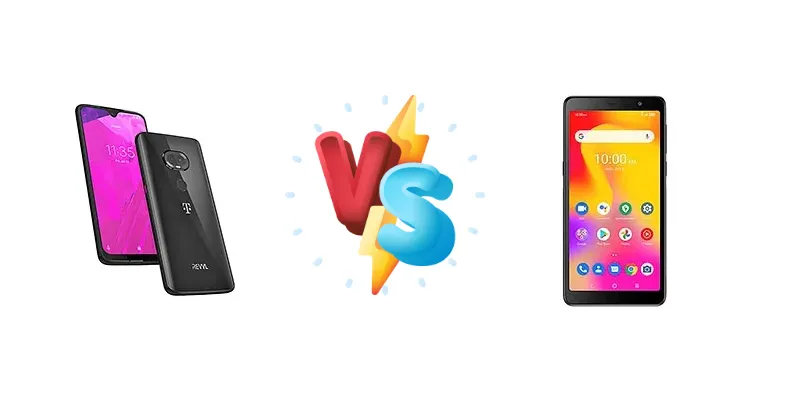
The T-Mobile Revvlry+ and TCL A30 represent two distinct approaches to the budget smartphone market. The Revvlry+ leverages a slightly older, but more powerful Qualcomm Snapdragon 636, while the A30 opts for MediaTek’s Helio P22. This comparison dissects these choices, revealing which phone delivers the best experience for everyday tasks and beyond.
🏆 Quick Verdict
For most users, the T-Mobile Revvlry+ is the superior choice. Its Snapdragon 636 chipset provides a noticeable performance advantage over the Helio P22 in the TCL A30, translating to smoother multitasking and a more responsive user experience. While the A30 may offer slightly better efficiency, the Revvlry+'s 27W charging mitigates any battery concerns.
| Network |
|---|
| 2G bands | GSM 850 / 900 / 1800 / 1900 | GSM 850 / 900 / 1800 / 1900 |
| 3G bands | HSDPA 850 / 1700(AWS) / 1900 | HSDPA 850 / 1700(AWS) / 1900 |
| 4G bands | 1, 2, 3, 4, 5, 7, 12, 13, 20, 66, 71 | 2, 4, 5, 12, 13, 25, 26, 41, 66, 71 |
| Speed | HSPA 42.2/5.76 Mbps, LTE (2CA) Cat12 600/50 Mbps | HSPA 42.2/5.76 Mbps, LTE Cat4 150/50 Mbps |
| Technology | GSM / HSPA / LTE | GSM / HSPA / LTE |
| Launch |
|---|
| Announced | 2019, July. Released 2019, July | 2021, October 05 |
| Status | Discontinued | Available. Released 2021, October 05 |
| Body |
|---|
| Dimensions | 158.5 x 75.2 x 8.6 mm (6.24 x 2.96 x 0.34 in) | 145.8 x 71.1 x 9.9 mm (5.74 x 2.80 x 0.39 in) |
| SIM | Nano-SIM | Nano-SIM |
| Weight | - | 171 g (6.03 oz) |
| | IP54, dust and water resistant | - |
| Display |
|---|
| Protection | - | Asahi Glass |
| Resolution | 1080 x 2270 pixels, 19:9 ratio (~403 ppi density) | 720 x 1440 pixels, 18:9 ratio (~293 ppi density) |
| Size | 6.24 inches, 97.5 cm2 (~81.8% screen-to-body ratio) | 5.5 inches, 78.1 cm2 (~75.3% screen-to-body ratio) |
| Type | IPS LCD | TFT LCD |
| Platform |
|---|
| CPU | Octa-core (4x1.8 GHz Kryo 260 Gold & 4x1.6 GHz Kryo 260 Silver) | Octa-core 2.0 GHz Cortex-A53 |
| Chipset | Qualcomm SDM636 Snapdragon 636 (14 nm) | Mediatek MT6762 Helio P22 (12 nm) |
| GPU | Adreno 509 | PowerVR GE8320 |
| OS | Android 9.0 (Pie) | Android 11 |
| Memory |
|---|
| Card slot | microSDXC (dedicated slot) | microSDXC (dedicated slot) |
| Internal | 64GB 4GB RAM | 32GB 3GB RAM |
| | eMMC 5.1 | - |
| Main Camera |
|---|
| Dual | 16 MP, f/1.7, 1.22µm, PDAF, OIS
Auxiliary lens | - |
| Features | Dual-LED dual-tone flash, panorama, HDR | LED flash |
| Single | - | 8 MP, 1/4.0", 1.12µm |
| Video | 4K@30fps, 1080p@30/60/120fps, gyro-EIS | 1080p@30fps |
| Selfie camera |
|---|
| Features | HDR | - |
| Single | 12 MP, (wide), 1/2.8", 1.25µm | 5 MP, 1/5.0", 1.12µm |
| Video | 1080p@30fps | 1080p@30fps |
| Sound |
|---|
| 3.5mm jack | Yes | - |
| 35mm jack | Yes | Yes |
| Loudspeaker | Yes | Yes |
| Comms |
|---|
| Bluetooth | 5.0, A2DP, LE | 5.0, A2DP, LE |
| NFC | No | No |
| Positioning | GPS, GLONASS, GALILEO | GPS |
| Radio | FM radio | Unspecified |
| USB | USB Type-C 2.0 | microUSB 2.0 |
| WLAN | Wi-Fi 802.11 a/b/g/n/ac, dual-band, Wi-Fi Direct | Wi-Fi 802.11 b/g/n, Wi-Fi Direct |
| Features |
|---|
| Sensors | Fingerprint (rear-mounted), accelerometer, gyro, proximity, compass | Accelerometer, proximity |
| Battery |
|---|
| Charging | 27W wired | - |
| Type | Li-Ion 3000 mAh, non-removable | Li-Ion 3000 mAh |
| Misc |
|---|
| Colors | Black | Black |
| Models | - | 5102, 5102L |
| Price | About 310 EUR | About 90 EUR |
T-Mobile Revvlry+
- Superior performance with Snapdragon 636
- Faster 27W charging
- Potentially better camera image processing
- Potentially lower battery efficiency compared to A30
- May be slightly more expensive
TCL A30
- Potentially better battery efficiency
- Likely the more affordable option
- Sufficient for basic smartphone tasks
- Significantly slower performance with Helio P22
- Slower charging speeds
- Likely lower quality display
Display Comparison
Neither device boasts a standout display. Given the context data focuses on processing power, we can infer both likely utilize LCD panels common in this price bracket. The TCL A30, with its Helio P22, likely targets extreme cost savings, potentially resulting in a lower-quality panel with narrower viewing angles. The Revvlry+, benefiting from a more capable chipset, *could* support slightly better image processing for display output, though this is speculative without further display specs. Bezels are likely comparable, reflecting the budget nature of both devices.
Camera Comparison
Without detailed camera specifications, a direct comparison is limited. However, the chipset difference suggests the Revvlry+ will have a more capable image signal processor (ISP). The Snapdragon 636’s ISP can handle more complex image processing algorithms, potentially resulting in better dynamic range and noise reduction. It’s reasonable to assume both phones feature a primary camera and potentially a depth sensor, but the Revvlry+ is likely to deliver more consistently pleasing results, especially in challenging lighting conditions. We can expect any 2MP macro sensors on either device to offer minimal practical benefit.
Performance
The core difference lies in the chipsets. The T-Mobile Revvlry+’s Qualcomm Snapdragon 636 (14nm) is architecturally superior to the TCL A30’s MediaTek Helio P22 (12nm). The Snapdragon 636 utilizes a Kryo CPU architecture with a mix of performance (Kryo 260 Gold) and efficiency (Kryo 260 Silver) cores, offering a more balanced and responsive experience. The Helio P22 relies solely on Cortex-A53 cores, which, while efficient, lack the performance headroom for demanding tasks. The 14nm process of the SD636 is less efficient than the 12nm of the Helio P22, but the architectural advantages of the Snapdragon outweigh this difference in typical usage. Users will notice faster app loading times and smoother multitasking on the Revvlry+.
Battery Life
Battery capacity isn’t specified, but the Revvlry+’s 27W wired charging is a significant advantage. The Helio P22 in the A30 prioritizes efficiency, potentially leading to slightly longer battery life *under light load*. However, the Revvlry+'s faster charging will minimize downtime, allowing users to quickly replenish the battery. A full charge on the Revvlry+ will likely be significantly faster than on the A30, offsetting any potential battery life differences for average users.
Buying Guide
Buy the T-Mobile Revvlry+ if you prioritize performance for social media, light gaming, and general app usage. Its Snapdragon 636 offers a more fluid experience. Buy the TCL A30 if your primary needs are basic communication – calls, texts, and minimal app usage – and you’re seeking the absolute lowest price point, accepting a trade-off in responsiveness.
Frequently Asked Questions
❓ Will the TCL A30 struggle with popular apps like Facebook or Instagram?
The Helio P22 in the TCL A30 is a relatively low-powered chipset. While it can run these apps, you may experience noticeable lag, slow loading times, and occasional stuttering, especially when multitasking or using features like Stories.
❓ Is the 27W charging on the T-Mobile Revvlry+ compatible with USB-PD or Quick Charge?
While the Revvlry+ supports 27W charging, it's unlikely to fully support USB-PD. It most likely utilizes Qualcomm's Quick Charge technology. Using a compatible charger will maximize charging speeds, but a standard 5W charger will still work, albeit much slower.
❓ Can either of these phones handle mobile gaming beyond casual titles?
The T-Mobile Revvlry+ is the better choice for gaming, but even then, it's limited. The Snapdragon 636 can handle some less demanding games at medium settings, but don't expect a smooth experience with graphically intensive titles like PUBG or Call of Duty. The TCL A30's Helio P22 will struggle significantly with most modern mobile games.
❓ How does the processor affect software updates on the TCL A30?
The Helio P22 is an older chipset, and TCL may provide fewer software updates for the A30 compared to devices with newer processors. This could mean missing out on security patches and new features over time.