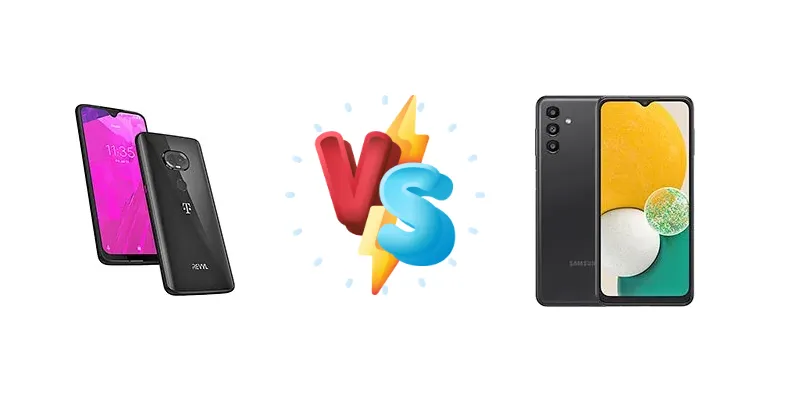
The T-Mobile Revvlry+ and Samsung Galaxy A13 5G represent two approaches to the budget 5G smartphone market. The Revvlry+ leverages a slightly older, but refined Qualcomm chipset, while the A13 5G opts for MediaTek’s Dimensity 700. This comparison dissects the core differences to determine which device delivers the best value for users prioritizing performance, battery life, and connectivity.
🏆 Quick Verdict
For most users, the Samsung Galaxy A13 5G is the better choice. Its Mediatek Dimensity 700 chipset, built on a more efficient 7nm process, provides a noticeable performance uplift over the Revvlry+'s Snapdragon 636, and crucially, offers 5G connectivity. While the Revvlry+ boasts faster 27W charging, the A13 5G’s overall package is more compelling.
| Network |
|---|
| 2G bands | GSM 850 / 900 / 1800 / 1900 | GSM 850 / 900 / 1800 / 1900 |
| 3G bands | HSDPA 850 / 1700(AWS) / 1900 | HSDPA 850 / 1700(AWS) / 1900 / 2100 |
| 4G bands | 1, 2, 3, 4, 5, 7, 12, 13, 20, 66, 71 | 1, 2, 3, 4, 5, 7, 12, 14, 20, 29, 30, 38, 39, 40, 41, 66 |
| 5G bands | - | 2, 5, 66, 77 Sub6/mmWave |
| Speed | HSPA 42.2/5.76 Mbps, LTE (2CA) Cat12 600/50 Mbps | HSPA, LTE, 5G |
| Technology | GSM / HSPA / LTE | GSM / HSPA / LTE / 5G |
| | - | 2, 5, 41, 48, 66, 71, 77 Sub6/mmWave - SM-A136U |
| Launch |
|---|
| Announced | 2019, July. Released 2019, July | 2021, December 02 |
| Status | Discontinued | Available. Released 2021, December 03 |
| Body |
|---|
| Build | - | Glass front, plastic back, plastic frame |
| Dimensions | 158.5 x 75.2 x 8.6 mm (6.24 x 2.96 x 0.34 in) | 164.5 x 76.5 x 8.8 mm (6.48 x 3.01 x 0.35 in) |
| SIM | Nano-SIM | Nano-SIM |
| Weight | - | 195 g (6.88 oz) |
| | IP54, dust and water resistant | - |
| Display |
|---|
| Resolution | 1080 x 2270 pixels, 19:9 ratio (~403 ppi density) | 720 x 1600 pixels, 20:9 ratio (~270 ppi density) |
| Size | 6.24 inches, 97.5 cm2 (~81.8% screen-to-body ratio) | 6.5 inches, 102.0 cm2 (~81.1% screen-to-body ratio) |
| Type | IPS LCD | PLS LCD, 90Hz |
| Platform |
|---|
| CPU | Octa-core (4x1.8 GHz Kryo 260 Gold & 4x1.6 GHz Kryo 260 Silver) | Octa-core (2x2.2 GHz Cortex-A76 & 6x2.0 GHz Cortex-A55) |
| Chipset | Qualcomm SDM636 Snapdragon 636 (14 nm) | Mediatek Dimensity 700 (7 nm) |
| GPU | Adreno 509 | Mali-G57 MC2 |
| OS | Android 9.0 (Pie) | Android 11, upgradable to Android 14, One UI 6.1 |
| Memory |
|---|
| Card slot | microSDXC (dedicated slot) | microSDXC (dedicated slot) |
| Internal | 64GB 4GB RAM | 64GB 4GB RAM, 128GB 4GB RAM, 128GB 6GB RAM |
| | eMMC 5.1 | - |
| Main Camera |
|---|
| Dual | 16 MP, f/1.7, 1.22µm, PDAF, OIS
Auxiliary lens | - |
| Features | Dual-LED dual-tone flash, panorama, HDR | LED flash, panorama, HDR |
| Single | - | 5 MP, f/2.0, (wide) |
| Triple | - | 50 MP, f/1.8, 26mm (wide), PDAF
2 MP (macro)
Auxiliary lens |
| Video | 4K@30fps, 1080p@30/60/120fps, gyro-EIS | 1080p@30fps |
| Selfie camera |
|---|
| Features | HDR | - |
| Single | 12 MP, (wide), 1/2.8", 1.25µm | 5 MP, f/2.0, (wide) |
| Video | 1080p@30fps | 1080p@30fps |
| Sound |
|---|
| 3.5mm jack | Yes | Yes |
| 35mm jack | Yes | Yes |
| Loudspeaker | Yes | Yes |
| Comms |
|---|
| Bluetooth | 5.0, A2DP, LE | 5.0, A2DP, LE |
| NFC | No | Yes |
| Positioning | GPS, GLONASS, GALILEO | GPS, GLONASS, GALILEO |
| Radio | FM radio | Unspecified |
| USB | USB Type-C 2.0 | USB Type-C 2.0 |
| WLAN | Wi-Fi 802.11 a/b/g/n/ac, dual-band, Wi-Fi Direct | Wi-Fi 802.11 a/b/g/n/ac, dual-band, Wi-Fi Direct |
| Features |
|---|
| Sensors | Fingerprint (rear-mounted), accelerometer, gyro, proximity, compass | Fingerprint (side-mounted), accelerometer, gyro, compass, barometer |
| | - | Virtual proximity sensing |
| Battery |
|---|
| Charging | 27W wired | 15W wired |
| Type | Li-Ion 3000 mAh, non-removable | Li-Po 5000 mAh |
| Misc |
|---|
| Colors | Black | Black |
| Models | - | SM-A136U, SM-A136U1, SM-A136W, SM-A136B, SM-S136DL |
| Price | About 310 EUR | € 178.00 / $ 64.00 / £ 72.54 |
| SAR | - | 1.27 W/kg (head) 0.58 W/kg (body) |
T-Mobile Revvlry+
- Faster 27W wired charging
- Potentially lower price point (depending on carrier promotions)
- Qualcomm chipset known for stable software support
- Older, less efficient 14nm Snapdragon 636
- Lacks 5G connectivity
- Lower overall performance compared to the A13 5G
Samsung Galaxy A13 5G
- 5G connectivity for faster data speeds
- More powerful and efficient MediaTek Dimensity 700 (7nm)
- Better performance for multitasking and gaming
- Slower 15W wired charging
- MediaTek chipsets sometimes have less consistent software updates
- Samsung’s software can be resource intensive
Display Comparison
Neither device is expected to deliver a premium display experience. Specifics like panel type (IPS vs. LCD) and resolution are not provided, but both likely target a 720p+ resolution. The key difference lies in the underlying processors impacting UI smoothness. The A13 5G’s Dimensity 700 will likely provide a more responsive experience when scrolling and navigating the interface, even if the panel characteristics are similar.
Camera Comparison
Without detailed camera sensor information, a direct comparison is difficult. However, the market segment suggests both phones will feature modest camera systems. The A13 5G likely benefits from MediaTek’s Imagiq image signal processor, which offers computational photography features that could improve image quality in challenging conditions. The Revvlry+’s image processing will likely be more basic. The presence of a 5G modem in the A13 5G also suggests a more modern ISP, potentially supporting features like faster image capture and improved video stabilization.
Performance
The core of the difference lies in the chipsets. The Samsung Galaxy A13 5G’s MediaTek Dimensity 700 (7nm) significantly outperforms the T-Mobile Revvlry+'s Qualcomm Snapdragon 636 (14nm) in both CPU and GPU performance. The Dimensity 700’s Cortex-A76 cores offer a substantial architectural advantage over the Kryo 260 Gold cores in the Snapdragon 636. This translates to faster app loading times, smoother multitasking, and a better gaming experience. The 7nm process also contributes to better thermal efficiency, potentially reducing throttling during sustained workloads. The Revvlry+ will handle basic tasks adequately, but the A13 5G is the clear winner for users who demand more from their phone.
Battery Life
The T-Mobile Revvlry+ boasts 27W wired charging, significantly faster than the Samsung Galaxy A13 5G’s 15W charging. This means the Revvlry+ can replenish its battery much quicker. However, the Dimensity 700’s superior power efficiency could offset the A13 5G’s slower charging speed in real-world usage. The 7nm process consumes less power than the 14nm process of the Snapdragon 636, potentially leading to longer battery life on the A13 5G, despite potentially having a similar battery capacity (not specified in the data).
Buying Guide
Buy the T-Mobile Revvlry+ if you prioritize faster wired charging and are less concerned with 5G connectivity or demanding applications. It’s a solid option for basic smartphone tasks. Buy the Samsung Galaxy A13 5G if you want a more future-proof device with 5G support, better overall performance for multitasking and light gaming, and a more modern chipset architecture.
Frequently Asked Questions
❓ Will the Dimensity 700 in the Galaxy A13 5G overheat during extended gaming sessions?
The Dimensity 700’s 7nm process is more thermally efficient than the Snapdragon 636’s 14nm process. While some throttling is possible during prolonged, demanding gaming, it’s less likely to be a significant issue compared to the Revvlry+. The A13 5G is better equipped to handle sustained workloads.
❓ Is the 5G connectivity on the Galaxy A13 5G actually useful, or is it just a marketing gimmick?
5G connectivity offers significantly faster download and upload speeds compared to 4G LTE, *if* you have 5G coverage in your area. This translates to quicker app downloads, smoother streaming, and lower latency for online gaming. If you live in or frequently travel to areas with 5G coverage, the A13 5G’s 5G support is a valuable feature.
❓ How much faster is the charging on the Revvlry+ compared to the A13 5G in a real-world scenario?
The Revvlry+'s 27W charging can potentially add a significant percentage of battery life in a short amount of time – likely reaching 50% in around 30-45 minutes. The A13 5G’s 15W charging will take considerably longer, potentially over 90 minutes to reach the same level. This makes the Revvlry+ ideal for users who frequently need a quick battery boost.