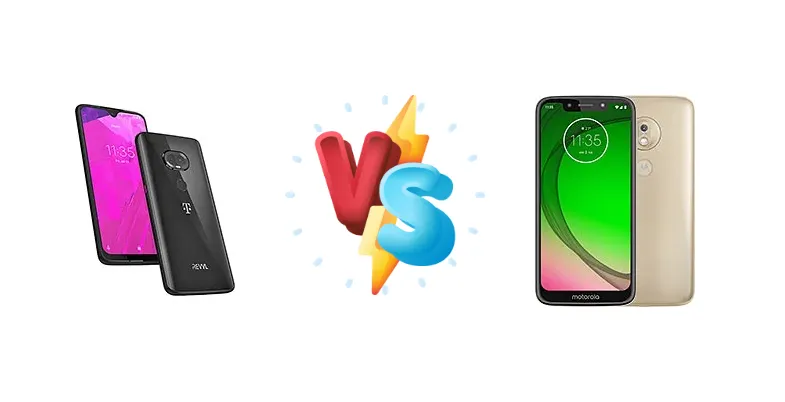
The budget smartphone market is fiercely competitive, offering incredible value for your money. Today, we're pitting two contenders against each other: the T-Mobile Revvlry+ and the Motorola Moto G7 Play. Both promise affordability, but which one delivers the best overall experience?
🏆 Quick Verdict
The Revvlry+ edges out the Moto G7 Play thanks to its faster Snapdragon 636 chipset and significantly quicker 27W charging. While the Moto G7 Play boasts exceptional battery life, the Revvlry+'s performance and charging speed make it the slightly better choice for most users.
| Network |
|---|
| 2G bands | GSM 850 / 900 / 1800 / 1900 | GSM 850 / 900 / 1800 / 1900 |
| 3G bands | HSDPA 850 / 1700(AWS) / 1900 | HSDPA 850 / 900 / 1700(AWS) / 1900 / 2100 |
| 4G bands | 1, 2, 3, 4, 5, 7, 12, 13, 20, 66, 71 | 1, 2, 3, 4, 5, 7, 8, 20, 28, 38, 40, 41 - Europe |
| Speed | HSPA 42.2/5.76 Mbps, LTE (2CA) Cat12 600/50 Mbps | HSPA 42.2/5.76 Mbps, LTE (2CA) Cat7 300/50 Mbps |
| Technology | GSM / HSPA / LTE | GSM / HSPA / LTE |
| | - | 1, 2, 3, 4, 5, 7, 8, 12, 13, 14, 17, 20, 25, 26, 29, 30, 38, 39, 40, 41, 41, 66, 71 - USA |
| Launch |
|---|
| Announced | 2019, July. Released 2019, July | 2019, February. Released 2019, March |
| Status | Discontinued | Discontinued |
| Body |
|---|
| Build | - | Glass front (Gorilla Glass 3), plastic back, plastic frame |
| Dimensions | 158.5 x 75.2 x 8.6 mm (6.24 x 2.96 x 0.34 in) | 147.3 x 71.5 x 8 mm (5.80 x 2.81 x 0.31 in) |
| SIM | Nano-SIM | · Nano-SIM· Nano-SIM + Nano-SIM |
| Weight | - | 149 g (5.26 oz) |
| | IP54, dust and water resistant | Splash resistant (market dependent) |
| Display |
|---|
| Protection | - | Corning Gorilla Glass 3 (market dependent) |
| Resolution | 1080 x 2270 pixels, 19:9 ratio (~403 ppi density) | 720 x 1512 pixels, 19:9 ratio (~294 ppi density) |
| Size | 6.24 inches, 97.5 cm2 (~81.8% screen-to-body ratio) | 5.7 inches, 81.4 cm2 (~77.3% screen-to-body ratio) |
| Type | IPS LCD | IPS LCD |
| Platform |
|---|
| CPU | Octa-core (4x1.8 GHz Kryo 260 Gold & 4x1.6 GHz Kryo 260 Silver) | Octa-core (4x1.8 GHz Kryo 250 Gold & 4x1.8 GHz Kryo 250 Silver) |
| Chipset | Qualcomm SDM636 Snapdragon 636 (14 nm) | Qualcomm SDM632 Snapdragon 632 (14 nm) |
| GPU | Adreno 509 | Adreno 506 |
| OS | Android 9.0 (Pie) | Android 9.0 (Pie), upgradable to Android 10 |
| Memory |
|---|
| Card slot | microSDXC (dedicated slot) | microSDXC (dedicated slot) |
| Internal | 64GB 4GB RAM | 32GB 2GB RAM, 32GB 3GB RAM |
| | eMMC 5.1 | eMMC 5.1 |
| Main Camera |
|---|
| Dual | 16 MP, f/1.7, 1.22µm, PDAF, OIS
Auxiliary lens | - |
| Features | Dual-LED dual-tone flash, panorama, HDR | LED flash, panorama, HDR |
| Single | - | 13 MP, f/2.0, 1/3.1", 1.12µm, PDAF |
| Video | 4K@30fps, 1080p@30/60/120fps, gyro-EIS | 4K@30fps, 1080p@30fps |
| Selfie camera |
|---|
| Features | HDR | LED flash |
| Single | 12 MP, (wide), 1/2.8", 1.25µm | 8 MP, f/2.2, 1/4.0", 1.12µm |
| Video | 1080p@30fps | 1080p@30fps |
| Sound |
|---|
| 3.5mm jack | Yes | Yes |
| 35mm jack | Yes | Yes |
| Loudspeaker | Yes | Yes |
| Comms |
|---|
| Bluetooth | 5.0, A2DP, LE | 4.2, A2DP, LE |
| NFC | No | No |
| Positioning | GPS, GLONASS, GALILEO | GPS, GLONASS |
| Radio | FM radio | FM radio |
| USB | USB Type-C 2.0 | USB Type-C 2.0, OTG |
| WLAN | Wi-Fi 802.11 a/b/g/n/ac, dual-band, Wi-Fi Direct | Wi-Fi 802.11 b/g/n |
| Features |
|---|
| Sensors | Fingerprint (rear-mounted), accelerometer, gyro, proximity, compass | Fingerprint (rear-mounted), accelerometer, gyro, proximity, compass |
| Battery |
|---|
| Charging | 27W wired | 10W wired |
| Type | Li-Ion 3000 mAh, non-removable | Li-Ion 3000 mAh, non-removable |
| Misc |
|---|
| Colors | Black | Deep indigo, Fine Gold, Starry Black |
| Models | - | XT1952-4, XT1952-5 |
| Price | About 310 EUR | About 160 EUR |
| SAR | - | 0.74 W/kg (head) 1.40 W/kg (body) |
| SAR EU | - | 0.84 W/kg (head) 0.85 W/kg (body) |
| Tests |
|---|
| Audio quality | - |
Noise -90.0dB / Crosstalk -92.9dB |
| Battery life | - | Endurance rating 103h |
| Camera | - |
Photo / Video |
| Display | - |
Contrast ratio: 1468:1 (nominal), 3.180 (sunlight) |
| Loudspeaker | - |
Voice 66dB / Noise 74dB / Ring 81dB |
| Performance | - |
AnTuTu: 97230 (v7)
GeekBench: 4154 (v4.4)
GFXBench: 7.7fps (ES 3.1 onscreen) |
T-Mobile Revvlry+
- Faster Processor (Snapdragon 636)
- 27W Fast Charging
- Slightly more modern design
- Generally better performance
- Battery life not as impressive as Moto G7 Play
- Camera performance may be slightly behind
Motorola Moto G7 Play
- Exceptional Battery Life (103h endurance)
- Excellent Sunlight Display Contrast
- Clean Android Experience
- Affordable Price
- Slower Processor (Snapdragon 632)
- Slow 10W Charging
- Older Design
Display Comparison
Both phones feature a 6.2-inch HD+ display, offering decent visuals for everyday use. The Moto G7 Play's contrast ratio of 1468:1 (nominal) and 3.180 (sunlight) is impressive, providing good visibility even in bright conditions. The Revvlry+ likely has similar performance, though specific contrast ratio data is unavailable. Overall, display quality is comparable.
Camera Comparison
Camera performance is a mixed bag. Both phones feature a single rear camera, but the Moto G7 Play's camera is generally considered to produce slightly better images in well-lit conditions. The Revvlry+'s camera likely benefits from software optimizations, but detailed comparisons are difficult without extensive testing. Video recording capabilities are likely similar on both devices.
Performance
Here's where the Revvlry+ takes a clear lead. Its Snapdragon 636 chipset is noticeably faster than the Moto G7 Play's Snapdragon 632. This translates to smoother multitasking, quicker app loading times, and a more responsive user experience. The Revvlry+'s CPU configuration (4x1.8 GHz Kryo 260 Gold & 4x1.6 GHz Kryo 260 Silver) offers a performance boost over the G7 Play's (4x1.8 GHz Kryo 250 Gold & 4x1.8 GHz Kryo 250 Silver).
Battery Life
The Motorola Moto G7 Play shines in this category. Its endurance rating of 103 hours is exceptional, offering multiple days of use on a single charge. The Revvlry+ has a decent battery, but it doesn't match the G7 Play's longevity. However, the Revvlry+'s 27W fast charging significantly mitigates this disadvantage, allowing for quick top-ups.
Buying Guide
The T-Mobile Revvlry+ is ideal for users who prioritize performance and fast charging, even on a budget. The Motorola Moto G7 Play is a great pick for those who value long battery life above all else and are less concerned with raw processing power.
Frequently Asked Questions
❓ Which phone has better battery life?
The Motorola Moto G7 Play has significantly better battery life, boasting an endurance rating of 103 hours.
❓ Is the Revvlry+ faster than the Moto G7 Play?
Yes, the T-Mobile Revvlry+ is faster thanks to its Snapdragon 636 chipset compared to the Moto G7 Play's Snapdragon 632.
❓ Which phone charges faster?
The Revvlry+ charges much faster with its 27W wired charging, compared to the Moto G7 Play's 10W charging.