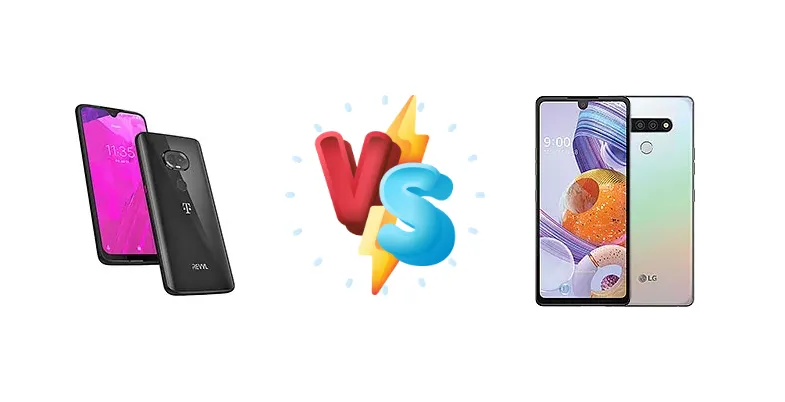
The T-Mobile Revvlry+ and LG Stylo 6 represent a shrinking segment: affordable smartphones focused on essential functionality. Both aim to provide a usable experience without breaking the bank, but they take different approaches to achieving this. This comparison dissects their core components to determine which device offers the best value for budget-conscious consumers.
🏆 Quick Verdict
For the average user prioritizing responsiveness and sustained performance, the T-Mobile Revvlry+ is the better choice. Its Snapdragon 636 chipset provides a noticeable advantage over the LG Stylo 6’s Helio P35, particularly in multitasking and moderately demanding applications. While the Stylo 6 attempts to compensate with a slightly newer manufacturing process, the architectural strengths of the Snapdragon ultimately prevail.
| Network |
|---|
| 2G bands | GSM 850 / 900 / 1800 / 1900 | GSM 850 / 900 / 1800 / 1900 |
| 3G bands | HSDPA 850 / 1700(AWS) / 1900 | HSDPA 850 / 900 / 1900 / 2100 |
| 4G bands | 1, 2, 3, 4, 5, 7, 12, 13, 20, 66, 71 | LTE |
| Speed | HSPA 42.2/5.76 Mbps, LTE (2CA) Cat12 600/50 Mbps | HSPA 42.2/5.76 Mbps, LTE (2CA) Cat6 300/50 Mbps |
| Technology | GSM / HSPA / LTE | GSM / HSPA / LTE |
| Launch |
|---|
| Announced | 2019, July. Released 2019, July | 2020, May 20. Released 2020, May 20 |
| Status | Discontinued | Discontinued |
| Body |
|---|
| Dimensions | 158.5 x 75.2 x 8.6 mm (6.24 x 2.96 x 0.34 in) | 171.2 x 77.7 x 8.6 mm (6.74 x 3.06 x 0.34 in) |
| SIM | Nano-SIM | Nano-SIM |
| Weight | - | 219 g (7.72 oz) |
| | IP54, dust and water resistant | Stylus |
| Display |
|---|
| Resolution | 1080 x 2270 pixels, 19:9 ratio (~403 ppi density) | 1080 x 2460 pixels (~395 ppi density) |
| Size | 6.24 inches, 97.5 cm2 (~81.8% screen-to-body ratio) | 6.8 inches, 109.8 cm2 (~82.5% screen-to-body ratio) |
| Type | IPS LCD | IPS LCD |
| Platform |
|---|
| CPU | Octa-core (4x1.8 GHz Kryo 260 Gold & 4x1.6 GHz Kryo 260 Silver) | Octa-core (4x2.3 GHz Cortex-A53 & 4x1.8 GHz Cortex-A53) |
| Chipset | Qualcomm SDM636 Snapdragon 636 (14 nm) | Mediatek MT6765 Helio P35 (12 nm) |
| GPU | Adreno 509 | PowerVR GE8320 |
| OS | Android 9.0 (Pie) | Android 10 |
| Memory |
|---|
| Card slot | microSDXC (dedicated slot) | microSDXC (dedicated slot) |
| Internal | 64GB 4GB RAM | 64GB 3GB RAM |
| | eMMC 5.1 | eMMC 5.1 |
| Main Camera |
|---|
| Dual | 16 MP, f/1.7, 1.22µm, PDAF, OIS
Auxiliary lens | - |
| Features | Dual-LED dual-tone flash, panorama, HDR | LED flash, panorama, HDR |
| Triple | - | 13 MP, (wide), PDAF
5 MP, 120˚, (ultrawide)
Auxiliary lens |
| Video | 4K@30fps, 1080p@30/60/120fps, gyro-EIS | 1080p@30fps |
| Selfie camera |
|---|
| Features | HDR | - |
| Single | 12 MP, (wide), 1/2.8", 1.25µm | 13 MP, 1/3.1", 1.12µm |
| Video | 1080p@30fps | 1080p@30fps |
| Sound |
|---|
| 3.5mm jack | Yes | Yes |
| 35mm jack | Yes | Yes |
| Loudspeaker | Yes | Yes |
| Comms |
|---|
| Bluetooth | 5.0, A2DP, LE | 5.0, A2DP, LE |
| NFC | No | No |
| Positioning | GPS, GLONASS, GALILEO | GPS |
| Radio | FM radio | No |
| USB | USB Type-C 2.0 | USB Type-C 2.0 |
| WLAN | Wi-Fi 802.11 a/b/g/n/ac, dual-band, Wi-Fi Direct | Wi-Fi 802.11 b/g/n, Wi-Fi Direct |
| Features |
|---|
| Sensors | Fingerprint (rear-mounted), accelerometer, gyro, proximity, compass | Fingerprint (rear-mounted), accelerometer, proximity |
| Battery |
|---|
| Charging | 27W wired | - |
| Type | Li-Ion 3000 mAh, non-removable | Li-Po 4000 mAh |
| Misc |
|---|
| Colors | Black | White |
| Models | - | LMQ730TM, LM-Q730TM |
| Price | About 310 EUR | About 200 EUR |
T-Mobile Revvlry+
- Faster and more responsive performance thanks to the Snapdragon 636.
- 27W fast charging significantly reduces charging times.
- More efficient chipset for better sustained performance.
- May have slightly lower battery life during heavy usage compared to the Stylo 6.
- Details on display quality are unknown.
LG Stylo 6
- Potentially longer battery life during very light usage.
- 12nm process may offer slightly better idle power consumption.
- Likely a lower price point than the Revvlry+.
- Noticeably slower performance compared to the Revvlry+.
- Helio P35 prone to throttling under load.
- Slower charging speeds.
Display Comparison
Neither device boasts a standout display. Details on panel technology (IPS, TFT) and resolution are missing, but both likely target a 720p+ resolution given their price point. The key difference lies under the hood: the Revvlry+’s chipset will have to drive the display, and a more efficient chipset means less strain and potentially better responsiveness. Without specific brightness data, it’s difficult to declare a clear winner, but the Revvlry+’s more powerful GPU suggests it could handle more complex visual processing.
Camera Comparison
Camera details are sparse, but the focus should be on the primary sensor. Assuming both devices feature similar megapixel counts for their main cameras (a reasonable assumption in this segment), the Snapdragon 636’s image signal processor (ISP) will likely deliver superior image quality. Qualcomm’s ISPs are generally known for better dynamic range and noise reduction. The Helio P35’s ISP is adequate, but it won’t match the processing capabilities of the Snapdragon. Any secondary cameras (macro, depth) on either device are likely to be of limited utility.
Performance
The performance gap is the most significant differentiator. The T-Mobile Revvlry+ utilizes the Qualcomm Snapdragon 636, built on a 14nm process, featuring an octa-core CPU with Kryo 260 cores. This architecture prioritizes sustained performance and efficiency. Conversely, the LG Stylo 6 employs the MediaTek Helio P35, fabricated on a smaller 12nm node. While the smaller node *can* indicate improved efficiency, the Helio P35’s Cortex-A53 cores are less performant than the Kryo 260 cores in the Snapdragon 636. The Revvlry+ will exhibit smoother multitasking and faster app loading times. The Helio P35 is prone to throttling under sustained load, impacting gaming and demanding applications.
Battery Life
Battery capacity is not specified, but both phones likely fall in the 3000-4000 mAh range. The Revvlry+’s advantage lies in its 27W wired charging. This significantly reduces charging times compared to the Stylo 6, which likely supports a slower charging standard. While the Helio P35’s 12nm process *could* offer slightly better idle power consumption, the Snapdragon 636’s overall efficiency and the Revvlry+’s faster charging make it the more practical choice for users who need to quickly top up their battery.
Buying Guide
Buy the T-Mobile Revvlry+ if you need a phone that can handle everyday tasks smoothly, including social media, streaming, and light gaming, without significant lag. It’s ideal for users who value a responsive experience and faster charging. Buy the LG Stylo 6 if you prioritize a potentially longer battery life during very light usage and are willing to accept compromises in processing speed. It’s best suited for users who primarily make calls, send texts, and occasionally browse the web.
Frequently Asked Questions
❓ Will the Helio P35 in the LG Stylo 6 struggle with modern mobile games?
Yes, the Helio P35 is a relatively weak chipset and will likely struggle with graphically demanding games. You'll likely need to lower graphics settings significantly, and even then, expect frame rate drops and potential stuttering. The Snapdragon 636 in the Revvlry+ offers a much smoother gaming experience.
❓ How much faster is the 27W charging on the T-Mobile Revvlry+ compared to the LG Stylo 6?
While the exact charging speed of the Stylo 6 is unknown, it likely supports a standard 10W or 15W charging rate. 27W charging on the Revvlry+ will significantly reduce charging times, potentially taking the phone from 0% to 50% in around 30 minutes, while the Stylo 6 could take over an hour for the same charge level.
❓ Is the difference in performance between the Snapdragon 636 and Helio P35 noticeable in everyday tasks?
Absolutely. The Snapdragon 636 offers a more responsive experience when opening apps, multitasking, and browsing the web. The Helio P35 may exhibit noticeable lag and slowdowns, especially when running multiple apps simultaneously.