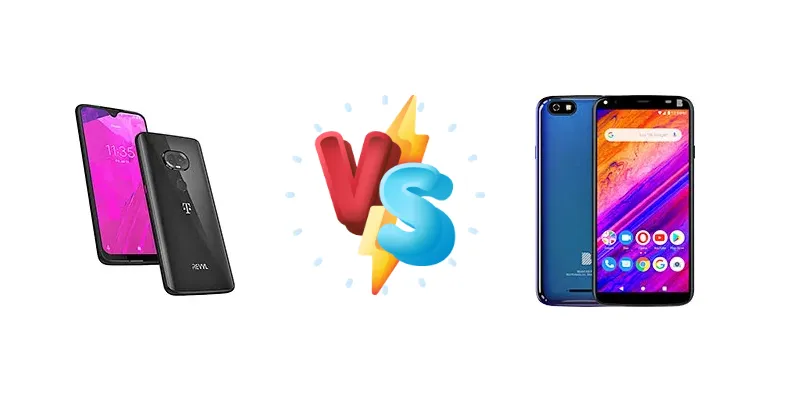
The T-Mobile Revvlry+ and BLU G5 Plus represent two approaches to the budget smartphone market. The Revvlry+ leverages Qualcomm's Snapdragon 636, a chip known for its balanced performance, while the BLU G5 Plus opts for an octa-core Cortex-A55 processor. This comparison dissects the implications of these choices, helping you determine which device delivers the best experience for your needs.
🏆 Quick Verdict
For the average user prioritizing responsiveness and smoother multitasking, the T-Mobile Revvlry+ is the clear winner. Its Snapdragon 636 chipset offers significantly better CPU and GPU performance than the BLU G5 Plus’s Cortex-A55, making it a more capable device for gaming and demanding applications.
| Network |
|---|
| 2G bands | GSM 850 / 900 / 1800 / 1900 | GSM 850 / 900 / 1800 / 1900 |
| 3G bands | HSDPA 850 / 1700(AWS) / 1900 | HSDPA 850 / 1700(AWS) / 1900 - G0190UU |
| 4G bands | 1, 2, 3, 4, 5, 7, 12, 13, 20, 66, 71 | 1, 3, 4, 5, 7, 28 - G0190LL, G0190VV |
| Speed | HSPA 42.2/5.76 Mbps, LTE (2CA) Cat12 600/50 Mbps | HSPA 42.2/11.5 Mbps, LTE Cat4 150/50 Mbps |
| Technology | GSM / HSPA / LTE | GSM / HSPA / LTE |
| | - | 2, 4, 5, 12, 17 - G0190UU |
| Launch |
|---|
| Announced | 2019, July. Released 2019, July | 2019, July. Released 2019, July |
| Status | Discontinued | Discontinued |
| Body |
|---|
| Dimensions | 158.5 x 75.2 x 8.6 mm (6.24 x 2.96 x 0.34 in) | 161.4 x 78 x 9.6 mm (6.35 x 3.07 x 0.38 in) |
| SIM | Nano-SIM | Nano-SIM + Nano-SIM |
| Weight | - | 181 g (6.38 oz) |
| | IP54, dust and water resistant | - |
| Display |
|---|
| Resolution | 1080 x 2270 pixels, 19:9 ratio (~403 ppi density) | 720 x 1440 pixels, 18:9 ratio (~268 ppi density) |
| Size | 6.24 inches, 97.5 cm2 (~81.8% screen-to-body ratio) | 6.0 inches, 92.9 cm2 (~73.8% screen-to-body ratio) |
| Type | IPS LCD | IPS LCD |
| Platform |
|---|
| CPU | Octa-core (4x1.8 GHz Kryo 260 Gold & 4x1.6 GHz Kryo 260 Silver) | Octa-core 1.6 GHz Cortex-A55 |
| Chipset | Qualcomm SDM636 Snapdragon 636 (14 nm) | - |
| GPU | Adreno 509 | IMG8322 |
| OS | Android 9.0 (Pie) | Android 9.0 (Pie) |
| Memory |
|---|
| Card slot | microSDXC (dedicated slot) | microSDXC |
| Internal | 64GB 4GB RAM | 32GB 2GB RAM |
| | eMMC 5.1 | - |
| Main Camera |
|---|
| Dual | 16 MP, f/1.7, 1.22µm, PDAF, OIS
Auxiliary lens | - |
| Features | Dual-LED dual-tone flash, panorama, HDR | LED flash |
| Single | - | 13 MP, AF |
| Video | 4K@30fps, 1080p@30/60/120fps, gyro-EIS | 1080p@30fps |
| Selfie camera |
|---|
| Features | HDR | LED flash |
| Single | 12 MP, (wide), 1/2.8", 1.25µm | 8 MP |
| Video | 1080p@30fps | 1080p@30fps |
| Sound |
|---|
| 3.5mm jack | Yes | Yes |
| 35mm jack | Yes | Yes |
| Loudspeaker | Yes | Yes |
| Comms |
|---|
| Bluetooth | 5.0, A2DP, LE | 4.1, A2DP |
| NFC | No | No |
| Positioning | GPS, GLONASS, GALILEO | GPS |
| Radio | FM radio | FM radio |
| USB | USB Type-C 2.0 | microUSB 2.0 |
| WLAN | Wi-Fi 802.11 a/b/g/n/ac, dual-band, Wi-Fi Direct | Wi-Fi 802.11 b/g/n, Wi-Fi Direct |
| Features |
|---|
| Sensors | Fingerprint (rear-mounted), accelerometer, gyro, proximity, compass | Accelerometer, proximity |
| Battery |
|---|
| Charging | 27W wired | - |
| Stand-by | - | Up to 575 h (2G) / Up to 525 h (3G) |
| Talk time | - | Up to 20 h (2G) / Up to 15 h (3G) |
| Type | Li-Ion 3000 mAh, non-removable | Li-Po 3000 mAh, removable |
| Misc |
|---|
| Colors | Black | Black, Red, Twilight, Chameleon Blue |
| Price | About 310 EUR | - |
T-Mobile Revvlry+
- Significantly faster processor (Snapdragon 636)
- Superior GPU performance for gaming
- Faster 27W charging
- More capable ISP for better image processing
- Price likely higher than BLU G5 Plus
- Specific display details are unknown
BLU G5 Plus
- Likely lower price point
- Power-efficient Cortex-A55 processor
- Functional for basic tasks
- Simple and straightforward user experience
- Significantly slower processor
- Poor graphics performance
- Likely slower charging speeds
- Limited multitasking capabilities
Display Comparison
Unfortunately, display specifications for the BLU G5 Plus are unavailable. However, given its market positioning, it likely features a 720p LCD panel. The Revvlry+’s display details are also missing, but the Snapdragon 636 supports displays up to 1080p with a 60Hz refresh rate. The architectural advantage here lies with the Revvlry+, as the 636’s ISP can handle higher resolution and potentially better color processing, even if both phones end up with similar panel quality. The lack of information on PWM dimming rates for either device makes it difficult to assess suitability for users sensitive to flicker.
Camera Comparison
Camera specifications for both devices are limited. Without sensor size or aperture information, a direct comparison is difficult. However, the Snapdragon 636’s image signal processor (ISP) is far more capable than what’s typically found in phones using Cortex-A55 processors. This translates to better image processing, dynamic range, and low-light performance on the Revvlry+. The absence of details on optical image stabilization (OIS) suggests neither phone features it, relying instead on software stabilization.
Performance
The core difference between these phones is the chipset. The T-Mobile Revvlry+’s Snapdragon 636 utilizes a 14nm process and a Kryo 260 architecture with a split core configuration (4x1.8 GHz Gold & 4x1.6 GHz Silver). This design prioritizes performance when needed, while conserving power during less demanding tasks. In contrast, the BLU G5 Plus employs an octa-core Cortex-A55 processor clocked at 1.6 GHz. While the Cortex-A55 is power-efficient, it’s a significantly less powerful architecture than the Kryo 260. The Snapdragon 636’s Adreno 509 GPU also provides a substantial advantage in graphics performance, making the Revvlry+ the better choice for mobile gaming. The Revvlry+ will exhibit noticeably faster app loading times and smoother multitasking.
Battery Life
Battery capacity for both phones is unknown. However, the T-Mobile Revvlry+ boasts 27W wired charging, a significant advantage over the likely slower charging speeds of the BLU G5 Plus. The Snapdragon 636’s power efficiency also contributes to potentially longer battery life, even with a similar capacity battery. The 27W charging allows for a much quicker top-up, reducing downtime and improving usability.
Buying Guide
Buy the T-Mobile Revvlry+ if you need a phone that can handle moderate gaming, streaming, and multitasking without significant slowdowns. Its superior chipset provides a more future-proof experience. Buy the BLU G5 Plus if your primary needs are basic communication – calls, texts, and light web browsing – and you prioritize minimizing cost above all else. It's a functional device for essential tasks, but will struggle with more intensive workloads.
Frequently Asked Questions
❓ Will the T-Mobile Revvlry+ handle demanding games like PUBG Mobile or Call of Duty Mobile?
The Snapdragon 636 in the Revvlry+ is capable of running PUBG Mobile and Call of Duty Mobile, but likely at medium settings to maintain a stable frame rate. Expect some frame drops during intense action. The BLU G5 Plus would struggle significantly with these titles.
❓ Is the 27W charging on the Revvlry+ a significant advantage in real-world use?
Yes, 27W charging is a substantial benefit. It will allow you to charge the Revvlry+ from 0% to 50% in approximately 30-40 minutes, significantly reducing downtime compared to the slower charging speeds likely found in the BLU G5 Plus.
❓ How does the Snapdragon 636's power efficiency compare to the Cortex-A55 in the BLU G5 Plus?
While the Cortex-A55 is designed for power efficiency, the Snapdragon 636's architecture and 14nm process are also quite efficient. However, the 636 offers a much higher performance ceiling, meaning it can complete tasks faster and then return to an idle state, potentially resulting in similar or even better overall battery life despite its greater processing power.