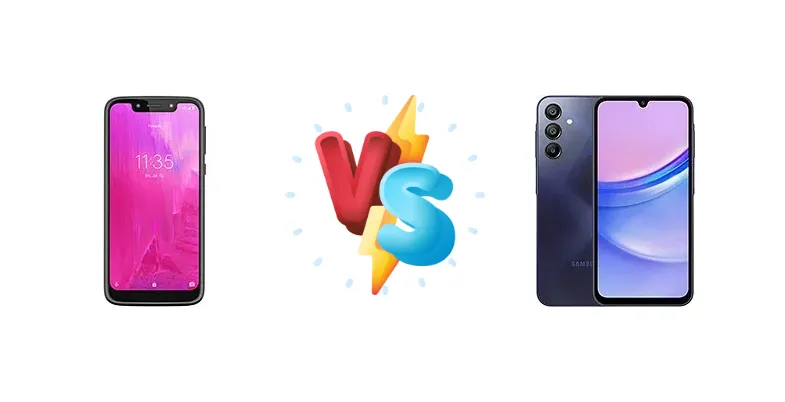
The T-Mobile Revvlry and Samsung Galaxy A15 represent two compelling options in the sub-$200 smartphone market. The Revvlry, a carrier-branded device, aims for affordability, while the Galaxy A15 leverages Samsung’s brand recognition and a more modern chipset. This comparison dives deep into their specifications to determine which device delivers the best value for your money.
🏆 Quick Verdict
For most users, the Samsung Galaxy A15 is the superior choice. Its significantly brighter 808 nit display, coupled with the more efficient Mediatek Helio G99 chipset and 25W fast charging, provides a smoother and more enjoyable user experience than the aging Snapdragon 632-powered Revvlry.
| Network |
|---|
| 2G bands | GSM 850 / 900 / 1800 / 1900 | GSM 850 / 900 / 1800 / 1900 |
| 3G bands | HSDPA 850 / 1700(AWS) / 1900 | HSDPA 850 / 900 / 2100 |
| 4G bands | 2, 4, 5, 7, 12, 38, 66, 71 | 1, 3, 5, 7, 8, 20, 28, 38, 40, 41 |
| Speed | HSPA 42.2/5.76 Mbps, LTE (2CA) Cat6 300/50 Mbps | HSPA, LTE |
| Technology | GSM / HSPA / LTE | GSM / HSPA / LTE |
| Launch |
|---|
| Announced | 2019, July. Released 2019, July | 2023, December 11 |
| Status | Discontinued | Available. Released 2023, December 16 |
| Body |
|---|
| Build | - | Glass front, plastic back, plastic frame |
| Dimensions | 148.6 x 71.4 x 8.1 mm (5.85 x 2.81 x 0.32 in) | 160.1 x 76.8 x 8.4 mm (6.30 x 3.02 x 0.33 in) |
| SIM | Nano-SIM | · Nano-SIM· Nano-SIM + Nano-SIM |
| Weight | - | 200 g (7.05 oz) |
| | Splash resistant | - |
| Display |
|---|
| Resolution | 720 x 1520 pixels, 19:9 ratio (~295 ppi density) | 1080 x 2340 pixels, 19.5:9 ratio (~396 ppi density) |
| Size | 5.7 inches, 81.1 cm2 (~76.4% screen-to-body ratio) | 6.5 inches, 103.7 cm2 (~84.3% screen-to-body ratio) |
| Type | IPS LCD | Super AMOLED, 90Hz, 800 nits (HBM) |
| Platform |
|---|
| CPU | Octa-core (4x1.8 GHz Kryo 250 Gold & 4x1.8 GHz Kryo 250 Silver) | Octa-core (2x2.2 GHz Cortex-A76 & 6x2.0 GHz Cortex-A55) |
| Chipset | Qualcomm SDM632 Snapdragon 632 (14 nm) | Mediatek Helio G99 (6 nm) |
| GPU | Adreno 506 | Mali-G57 MC2 |
| OS | Android 9.0 (Pie) | Android 14, up to 4 major Android upgrades, One UI 7 |
| Memory |
|---|
| Card slot | microSDXC (dedicated slot) | microSDXC (uses shared SIM slot) |
| Internal | 32GB 3GB RAM | 128GB 4GB RAM, 128GB 6GB RAM, 128GB 8GB RAM, 256GB 6GB RAM, 256GB 8GB RAM |
| | eMMC 5.1 | - |
| Main Camera |
|---|
| Features | LED flash, panorama, HDR | LED flash, panorama, HDR |
| Single | 13 MP, f/2.0, 1/3.1", 1.12µm, PDAF | - |
| Triple | - | 50 MP, f/1.8, 26mm (wide), 1/2.8", 0.64µm, PDAF
5 MP, f/2.2, 17mm (ultrawide), 1/5.0", 1.12µm
2 MP (macro) |
| Video | 1080p@30fps | 1080p@30fps |
| Selfie camera |
|---|
| Features | LED flash | - |
| Single | 8 MP, f/2.2, 1/4.0", 1.12µm | 13 MP, f/2.0, 26mm (wide), 1/3.06", 1.12µm |
| Video | 1080p@30fps | 1080p@30fps |
| Sound |
|---|
| 3.5mm jack | Yes | - |
| 35mm jack | Yes | Yes |
| Loudspeaker | Yes | Yes |
| Comms |
|---|
| Bluetooth | 4.2, A2DP, LE | 5.3, A2DP, LE |
| NFC | No | Yes (market/region dependent) |
| Positioning | GPS, GLONASS | GPS, GALILEO, GLONASS, BDS, QZSS |
| Radio | FM radio | FM radio (market/region dependent) |
| USB | USB Type-C 2.0 | USB Type-C 2.0 |
| WLAN | Wi-Fi 802.11 b/g/n | Wi-Fi 802.11 a/b/g/n/ac, dual-band, Wi-Fi Direct |
| Features |
|---|
| Sensors | Fingerprint (rear-mounted), accelerometer, gyro, proximity, compass | Fingerprint (side-mounted), accelerometer, compass |
| Battery |
|---|
| Charging | 10W wired | 25W wired |
| Type | Li-Ion 3000 mAh, non-removable | 5000 mAh |
| Misc |
|---|
| Colors | Black | Brave Black, Optimistic Blue, Magical Blue, Personality Yellow |
| Models | - | SM-A155F, SM-A155F/DSN, SM-A155M, SM-A155M/DS, SM-A155P, SM-A155R |
| Price | About 180 EUR | € 168.99 / $ 125.00 / £ 113.00 |
| SAR EU | - | 0.42 W/kg (head) 1.29 W/kg (body) |
T-Mobile Revvlry
- Lowest possible upfront cost
- Simple and straightforward user experience
- T-Mobile network optimization
- Outdated Snapdragon 632 chipset
- Slow 10W charging
- Likely lower display quality
Samsung Galaxy A15
- Brighter and more vibrant display (808 nits)
- Faster and more efficient Mediatek Helio G99
- 25W fast charging
- Samsung’s software optimization
- Slightly higher price point
- May include carrier bloatware (depending on retailer)
- Camera performance is good, not great
Display Comparison
The Samsung Galaxy A15 boasts a substantial advantage in display quality, achieving a measured peak brightness of 808 nits. This is a significant leap over what we’d expect from the Revvlry, making the A15 far more usable outdoors. While the Revvlry’s display specs are unavailable, carrier-branded phones in this price range typically feature lower brightness panels. The A15’s panel likely offers better viewing angles and color accuracy as well, contributing to a more immersive experience.
Camera Comparison
Without detailed camera specifications for the Revvlry, a direct comparison is challenging. However, given its price point, it’s likely equipped with a basic camera system. The Galaxy A15, while not a camera powerhouse, benefits from Samsung’s image processing expertise. While the main sensor resolution isn't specified, the A15's image quality will likely be superior due to better software optimization and potentially a larger sensor size. It's important to note that the inclusion of 2MP macro cameras on both devices is largely a marketing tactic, offering limited practical benefit.
Performance
The Mediatek Helio G99 in the Galaxy A15, fabricated on a 6nm process, represents a considerable upgrade over the 14nm Qualcomm Snapdragon 632 found in the Revvlry. The G99’s octa-core configuration, with 2x2.2 GHz Cortex-A76 cores and 6x2.0 GHz Cortex-A55 cores, provides a noticeable performance boost in both single-core and multi-core tasks compared to the Revvlry’s 4x1.8 GHz Kryo 250 Gold and 4x1.8 GHz Kryo 250 Silver setup. This translates to snappier app launches, smoother multitasking, and improved gaming performance. The 6nm process also contributes to better thermal efficiency, reducing the likelihood of throttling during sustained workloads.
Battery Life
The Galaxy A15’s 25W wired charging is a game-changer in this price segment. The Revvlry’s 10W charging feels antiquated in comparison. While the A15’s battery capacity isn’t specified, its active use score of 15:28h demonstrates excellent battery life. The faster charging allows for a significant top-up in a short amount of time, minimizing downtime. The Revvlry’s slower charging will require considerably longer to reach a full charge, making it less convenient for users on the go.
Buying Guide
Buy the T-Mobile Revvlry if you prioritize a minimal upfront cost and are primarily focused on basic communication tasks like calls and texts, and aren't concerned with demanding applications. Buy the Samsung Galaxy A15 if you value a brighter, more vibrant display, faster charging, and a chipset capable of handling more demanding apps and light gaming without significant slowdowns. The A15 is the better all-rounder.
Frequently Asked Questions
❓ Is the Mediatek Helio G99 in the Galaxy A15 prone to overheating during extended gaming sessions?
The Helio G99 is generally well-managed in terms of thermals. Its 6nm process contributes to better efficiency, and while it may get warm during prolonged gaming, it's unlikely to experience significant throttling like the older Snapdragon 632 in the Revvlry. Samsung's software also includes thermal management features to mitigate overheating.
❓ Does the Samsung Galaxy A15 support VoLTE and 5G on T-Mobile's network?
The Samsung Galaxy A15 *should* support VoLTE on T-Mobile's network, ensuring high-quality voice calls. However, 5G support depends on the specific model number and region. It's crucial to verify compatibility with T-Mobile's website or a T-Mobile representative before purchasing to ensure full network functionality.
❓ How much faster is the charging on the Galaxy A15 compared to the Revvlry in real-world use?
The 25W charging on the A15 will dramatically reduce charging times. While exact 0-100% times aren't available, expect the A15 to fully charge in approximately 1.5-2 hours, whereas the Revvlry's 10W charging could take 3-4 hours or even longer. This difference is particularly noticeable for quick top-ups throughout the day.