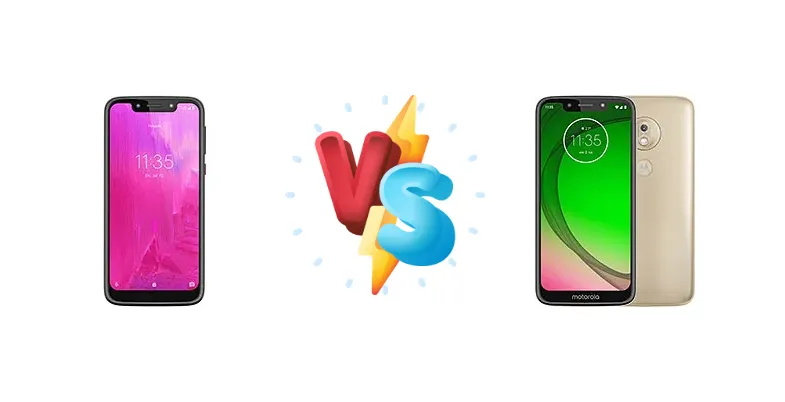
Looking for an affordable smartphone that doesn't completely break the bank? The T-Mobile Revvlry and the Motorola Moto G7 Play are both contenders in the budget phone arena. But which one reigns supreme? We'll break down their specs, performance, and features to help you decide.
🏆 Quick Verdict
The Motorola Moto G7 Play edges out the Revvlry thanks to its significantly longer battery life and superior display contrast. While both share the same chipset, the G7 Play's endurance and screen quality make it the better overall value for most users.
| Network |
|---|
| 2G bands | GSM 850 / 900 / 1800 / 1900 | GSM 850 / 900 / 1800 / 1900 |
| 3G bands | HSDPA 850 / 1700(AWS) / 1900 | HSDPA 850 / 900 / 1700(AWS) / 1900 / 2100 |
| 4G bands | 2, 4, 5, 7, 12, 38, 66, 71 | 1, 2, 3, 4, 5, 7, 8, 20, 28, 38, 40, 41 - Europe |
| Speed | HSPA 42.2/5.76 Mbps, LTE (2CA) Cat6 300/50 Mbps | HSPA 42.2/5.76 Mbps, LTE (2CA) Cat7 300/50 Mbps |
| Technology | GSM / HSPA / LTE | GSM / HSPA / LTE |
| | - | 1, 2, 3, 4, 5, 7, 8, 12, 13, 14, 17, 20, 25, 26, 29, 30, 38, 39, 40, 41, 41, 66, 71 - USA |
| Launch |
|---|
| Announced | 2019, July. Released 2019, July | 2019, February. Released 2019, March |
| Status | Discontinued | Discontinued |
| Body |
|---|
| Build | - | Glass front (Gorilla Glass 3), plastic back, plastic frame |
| Dimensions | 148.6 x 71.4 x 8.1 mm (5.85 x 2.81 x 0.32 in) | 147.3 x 71.5 x 8 mm (5.80 x 2.81 x 0.31 in) |
| SIM | Nano-SIM | · Nano-SIM· Nano-SIM + Nano-SIM |
| Weight | - | 149 g (5.26 oz) |
| | Splash resistant | Splash resistant (market dependent) |
| Display |
|---|
| Protection | - | Corning Gorilla Glass 3 (market dependent) |
| Resolution | 720 x 1520 pixels, 19:9 ratio (~295 ppi density) | 720 x 1512 pixels, 19:9 ratio (~294 ppi density) |
| Size | 5.7 inches, 81.1 cm2 (~76.4% screen-to-body ratio) | 5.7 inches, 81.4 cm2 (~77.3% screen-to-body ratio) |
| Type | IPS LCD | IPS LCD |
| Platform |
|---|
| CPU | Octa-core (4x1.8 GHz Kryo 250 Gold & 4x1.8 GHz Kryo 250 Silver) | Octa-core (4x1.8 GHz Kryo 250 Gold & 4x1.8 GHz Kryo 250 Silver) |
| Chipset | Qualcomm SDM632 Snapdragon 632 (14 nm) | Qualcomm SDM632 Snapdragon 632 (14 nm) |
| GPU | Adreno 506 | Adreno 506 |
| OS | Android 9.0 (Pie) | Android 9.0 (Pie), upgradable to Android 10 |
| Memory |
|---|
| Card slot | microSDXC (dedicated slot) | microSDXC (dedicated slot) |
| Internal | 32GB 3GB RAM | 32GB 2GB RAM, 32GB 3GB RAM |
| | eMMC 5.1 | eMMC 5.1 |
| Main Camera |
|---|
| Features | LED flash, panorama, HDR | LED flash, panorama, HDR |
| Single | 13 MP, f/2.0, 1/3.1", 1.12µm, PDAF | 13 MP, f/2.0, 1/3.1", 1.12µm, PDAF |
| Video | 1080p@30fps | 4K@30fps, 1080p@30fps |
| Selfie camera |
|---|
| Features | LED flash | LED flash |
| Single | 8 MP, f/2.2, 1/4.0", 1.12µm | 8 MP, f/2.2, 1/4.0", 1.12µm |
| Video | 1080p@30fps | 1080p@30fps |
| Sound |
|---|
| 3.5mm jack | Yes | Yes |
| 35mm jack | Yes | Yes |
| Loudspeaker | Yes | Yes |
| Comms |
|---|
| Bluetooth | 4.2, A2DP, LE | 4.2, A2DP, LE |
| NFC | No | No |
| Positioning | GPS, GLONASS | GPS, GLONASS |
| Radio | FM radio | FM radio |
| USB | USB Type-C 2.0 | USB Type-C 2.0, OTG |
| WLAN | Wi-Fi 802.11 b/g/n | Wi-Fi 802.11 b/g/n |
| Features |
|---|
| Sensors | Fingerprint (rear-mounted), accelerometer, gyro, proximity, compass | Fingerprint (rear-mounted), accelerometer, gyro, proximity, compass |
| Battery |
|---|
| Charging | 10W wired | 10W wired |
| Type | Li-Ion 3000 mAh, non-removable | Li-Ion 3000 mAh, non-removable |
| Misc |
|---|
| Colors | Black | Deep indigo, Fine Gold, Starry Black |
| Models | - | XT1952-4, XT1952-5 |
| Price | About 180 EUR | About 160 EUR |
| SAR | - | 0.74 W/kg (head) 1.40 W/kg (body) |
| SAR EU | - | 0.84 W/kg (head) 0.85 W/kg (body) |
| Tests |
|---|
| Audio quality | - |
Noise -90.0dB / Crosstalk -92.9dB |
| Battery life | - | Endurance rating 103h |
| Camera | - |
Photo / Video |
| Display | - |
Contrast ratio: 1468:1 (nominal), 3.180 (sunlight) |
| Loudspeaker | - |
Voice 66dB / Noise 74dB / Ring 81dB |
| Performance | - |
AnTuTu: 97230 (v7)
GeekBench: 4154 (v4.4)
GFXBench: 7.7fps (ES 3.1 onscreen) |
T-Mobile Revvlry
- Potentially more modern design (speculative)
- T-Mobile ecosystem integration
- Limited display information suggests lower quality
- Unknown battery life
- Camera performance unknown
- Charging speed is slow (10W)
Motorola Moto G7 Play
- Exceptional battery life (103h endurance rating)
- Excellent display contrast
- Reliable Motorola software
- Generally good value
- Chipset is aging
- Charging speed is slow (10W)
- Design is somewhat dated
Display Comparison
The Moto G7 Play boasts a significantly better display, with a contrast ratio of 1468:1 (nominal) and an impressive 3180:1 in sunlight. This translates to deeper blacks, brighter whites, and better visibility outdoors. The Revvlry's display details are scarce, suggesting it likely lags behind in this area. Expect a more vibrant and enjoyable viewing experience with the Moto G7 Play.
Camera Comparison
Camera performance is difficult to definitively compare without detailed testing. Both phones are advertised as having 'Photo / Video' capabilities. However, the Moto G7 Play likely has a slight edge due to Motorola's generally reliable camera software and image processing. The Revvlry's camera is largely unknown.
Performance
Both phones share the same Qualcomm SDM632 Snapdragon 632 chipset and Octa-core CPU. Performance will be generally similar for everyday tasks like browsing, social media, and light gaming. Don't expect blazing-fast speeds or high-end gaming capabilities from either device.
Battery Life
This is where the Moto G7 Play truly shines. Its endurance rating of 103 hours is exceptional for a budget phone. The Revvlry's battery details are limited, but it's safe to assume it won't match the G7 Play's longevity. If battery life is a priority, the Moto G7 Play is the clear winner.
Buying Guide
The T-Mobile Revvlry is a good option for those deeply embedded in the T-Mobile ecosystem and prioritizing a potentially slightly more modern design (though this is speculative without more details). The Motorola Moto G7 Play is ideal for users who prioritize long battery life, a vibrant display, and a reliable, no-frills experience.
Frequently Asked Questions
❓ Which phone has better battery life?
The Motorola Moto G7 Play has significantly better battery life, boasting an endurance rating of 103 hours. The Revvlry's battery performance is unknown.
❓ Are these phones good for gaming?
Neither phone is ideal for demanding games. Both utilize the Snapdragon 632 chipset, which is sufficient for light gaming but will struggle with more graphically intensive titles.