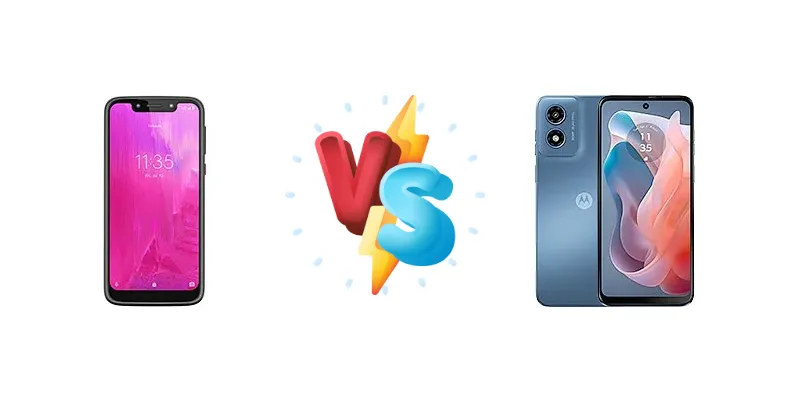
The T-Mobile Revvlry and the Motorola Moto G Play (2024) represent two distinct approaches to the ultra-budget smartphone market. The Revvlry, utilizing the older Snapdragon 632, aims for affordability, while the Moto G Play (2024) leverages the newer, more efficient Snapdragon 680. This comparison dissects the core differences to determine which device delivers the best experience for your money.
🏆 Quick Verdict
For most users, the Motorola Moto G Play (2024) is the superior choice. Its Snapdragon 680, built on a 6nm process, offers a noticeable performance uplift and improved power efficiency compared to the Revvlry’s Snapdragon 632. While the Revvlry may be cheaper, the G Play’s advantages justify the potential price difference.
| Network |
|---|
| 2G bands | GSM 850 / 900 / 1800 / 1900 | GSM 850 / 900 / 1800 / 1900 |
| 3G bands | HSDPA 850 / 1700(AWS) / 1900 | HSDPA 850 / 900 / 1700(AWS) / 1900 / 2100 |
| 4G bands | 2, 4, 5, 7, 12, 38, 66, 71 | 1, 2, 3, 4, 5, 7, 8, 12, 13, 17, 25, 26, 28, 38, 41, 66, 71 - USA |
| Speed | HSPA 42.2/5.76 Mbps, LTE (2CA) Cat6 300/50 Mbps | HSPA, LTE |
| Technology | GSM / HSPA / LTE | GSM / HSPA / LTE |
| Launch |
|---|
| Announced | 2019, July. Released 2019, July | 2024, January 16 |
| Status | Discontinued | Available. Released 2024, January 26 |
| Body |
|---|
| Build | - | Glass front, plastic frame, plastic back |
| Dimensions | 148.6 x 71.4 x 8.1 mm (5.85 x 2.81 x 0.32 in) | 163.8 x 75 x 8.3 mm (6.45 x 2.95 x 0.33 in) |
| SIM | Nano-SIM | Nano-SIM |
| Weight | - | 185 g (6.53 oz) |
| | Splash resistant | - |
| Display |
|---|
| Protection | - | Corning Gorilla Glass 3 |
| Resolution | 720 x 1520 pixels, 19:9 ratio (~295 ppi density) | 720 x 1600 pixels, 20:9 ratio (~270 ppi density) |
| Size | 5.7 inches, 81.1 cm2 (~76.4% screen-to-body ratio) | 6.5 inches, 102.0 cm2 (~83.0% screen-to-body ratio) |
| Type | IPS LCD | IPS LCD, 90Hz, 500 nits (typ) |
| Platform |
|---|
| CPU | Octa-core (4x1.8 GHz Kryo 250 Gold & 4x1.8 GHz Kryo 250 Silver) | Octa-core (4x2.4 GHz Kryo 265 Gold & 4x1.9 GHz Kryo 265 Silver) |
| Chipset | Qualcomm SDM632 Snapdragon 632 (14 nm) | Qualcomm SM6225 Snapdragon 680 4G (6 nm) |
| GPU | Adreno 506 | Adreno 610 |
| OS | Android 9.0 (Pie) | Android 13, upgradable to Android 14 |
| Memory |
|---|
| Card slot | microSDXC (dedicated slot) | microSDXC (dedicated slot) |
| Internal | 32GB 3GB RAM | 64GB 4GB RAM, 128GB 4GB RAM |
| | eMMC 5.1 | - |
| Main Camera |
|---|
| Features | LED flash, panorama, HDR | LED flash, HDR, panorama |
| Single | 13 MP, f/2.0, 1/3.1", 1.12µm, PDAF | 50 MP, f/1.8, (wide), 0.64µm, PDAF |
| Video | 1080p@30fps | 1080p@30fps |
| Selfie camera |
|---|
| Features | LED flash | HDR |
| Single | 8 MP, f/2.2, 1/4.0", 1.12µm | 8 MP, f/2.0, (wide), 1.12µm |
| Video | 1080p@30fps | 1080p@30fps |
| Sound |
|---|
| 3.5mm jack | Yes | - |
| 35mm jack | Yes | Yes |
| Loudspeaker | Yes | Yes, with stereo speakers |
| Comms |
|---|
| Bluetooth | 4.2, A2DP, LE | 5.1, A2DP, LE |
| NFC | No | No |
| Positioning | GPS, GLONASS | GPS, GALILEO, GLONASS |
| Radio | FM radio | No |
| USB | USB Type-C 2.0 | USB Type-C 2.0 |
| WLAN | Wi-Fi 802.11 b/g/n | Wi-Fi 802.11 a/b/g/n/ac, dual-band |
| Features |
|---|
| Sensors | Fingerprint (rear-mounted), accelerometer, gyro, proximity, compass | Fingerprint (side-mounted), accelerometer, proximity, compass, barometer |
| Battery |
|---|
| Charging | 10W wired | 15W wired |
| Type | Li-Ion 3000 mAh, non-removable | 5000 mAh |
| Misc |
|---|
| Colors | Black | Sapphire Blue |
| Models | - | XT2413-1, XT2413 |
| Price | About 180 EUR | $ 55.00 |
T-Mobile Revvlry
- Potentially lower upfront cost.
- Simple and straightforward user experience.
- Reliable for basic communication tasks.
- Older, less efficient Snapdragon 632.
- Slower performance and multitasking.
- Likely slower charging speeds.
Motorola Moto G Play (2024)
- More powerful and efficient Snapdragon 680.
- Faster 15W wired charging.
- Improved performance for gaming and multitasking.
- May be slightly more expensive.
- Still a budget device with potential compromises in build quality.
- Software update support may be limited.
Display Comparison
Neither device boasts a standout display. Given the context data focuses on processing power, we can infer both likely utilize LCD panels, common in this price bracket. The key difference lies in the chipset’s ability to efficiently drive the display. The Snapdragon 680’s improved GPU could translate to slightly smoother scrolling and animations on the Moto G Play (2024), but without specific display specs, it’s difficult to quantify. Bezels are likely comparable, reflecting the budget nature of both phones.
Camera Comparison
Without detailed camera specifications, a direct comparison is challenging. However, the Snapdragon 680’s image signal processor (ISP) is more advanced than the 632’s, suggesting the Moto G Play (2024) will likely produce better image quality, particularly in low-light conditions. Expect improved noise reduction and dynamic range. Both phones likely feature a primary camera and depth/macro sensors; the G Play’s ISP will likely extract more detail from the main sensor. The Revvlry’s older ISP may struggle to keep up, resulting in softer images and less accurate colors.
Performance
The Motorola Moto G Play (2024) holds a significant advantage in performance. The Snapdragon 680, fabricated on a 6nm process, is demonstrably more efficient and powerful than the Revvlry’s 14nm Snapdragon 632. While both are octa-core CPUs, the G Play’s Kryo 265 Gold cores clock higher at 2.4 GHz versus the Revvlry’s 1.8 GHz Kryo 250 Gold cores. This translates to faster app loading times, smoother multitasking, and a more responsive user experience. The 6nm process also means less heat generation under load, potentially reducing thermal throttling during prolonged use. The Revvlry will handle basic tasks, but the G Play offers a more fluid experience.
Battery Life
The Moto G Play (2024) benefits from both a more efficient chipset and faster charging. The Snapdragon 680’s 6nm process consumes less power than the Snapdragon 632, leading to longer battery life on a single charge. While the exact battery capacities are unknown, the 15W wired charging on the G Play will significantly reduce charging times compared to the Revvlry’s 10W charging. This means less time tethered to an outlet and more time using the device.
Buying Guide
Buy the T-Mobile Revvlry if you absolutely need the lowest possible upfront cost and your smartphone usage is limited to basic tasks like calls, texts, and light social media. Buy the Motorola Moto G Play (2024) if you prioritize smoother performance for multitasking, occasional gaming, and a more future-proofed experience, even if it means spending a bit more.
Frequently Asked Questions
❓ Will the Motorola Moto G Play (2024) handle popular games like PUBG Mobile or Call of Duty Mobile?
The Snapdragon 680 is capable of running PUBG Mobile and Call of Duty Mobile, but you'll likely need to lower the graphics settings to medium or low to achieve a smooth frame rate. The Revvlry’s Snapdragon 632 will struggle with these titles, even on the lowest settings.
❓ How much faster will app loading times be on the Moto G Play (2024) compared to the Revvlry?
Expect app loading times to be noticeably faster on the Moto G Play (2024), potentially 20-30% quicker for common apps like social media and web browsers. This is due to the Snapdragon 680’s faster CPU cores and more efficient architecture.
❓ Does the Moto G Play (2024) support VoLTE and Wi-Fi calling on T-Mobile?
Generally, Motorola phones are compatible with T-Mobile's VoLTE and Wi-Fi calling services. However, it's always best to confirm compatibility with T-Mobile directly, as carrier support can change. The Revvlry, being a T-Mobile branded phone, will inherently support these features.
❓ What type of storage does the Moto G Play (2024) use, and is it expandable?
While the exact storage type isn't specified, budget phones like the Moto G Play (2024) typically use eMMC storage. It's highly likely to include a microSD card slot for expandable storage, allowing you to add more space for photos, videos, and apps.