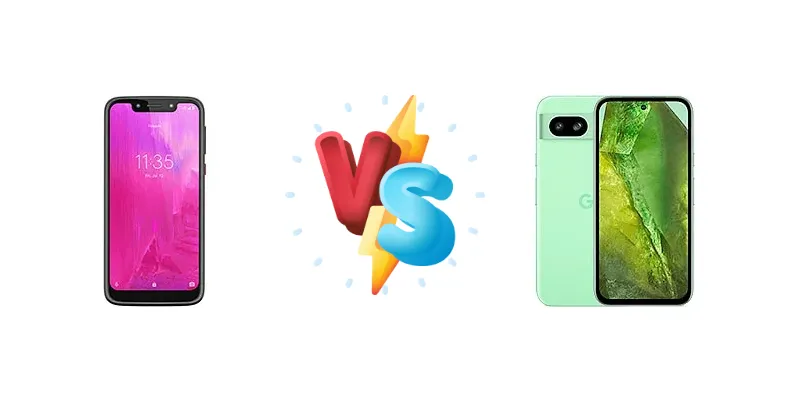
The Google Pixel 8a represents Google's latest attempt to deliver a flagship experience at a more accessible price point, while the T-Mobile Revvlry occupies the ultra-budget segment. This comparison isn't about direct competition; it's about understanding where the Pixel 8a's advancements justify the cost for users seeking a significant upgrade over a basic device like the Revvlry.
🏆 Quick Verdict
For most users, the Google Pixel 8a is the clear winner. Its Tensor G3 chipset delivers substantially faster performance and AI capabilities, complemented by a brighter display and significantly better camera experience. While the Revvlry offers basic functionality at a low price, the Pixel 8a provides a far more refined and future-proof experience.
| Network |
|---|
| 2G bands | GSM 850 / 900 / 1800 / 1900 | GSM 850 / 900 / 1800 / 1900 |
| 3G bands | HSDPA 850 / 1700(AWS) / 1900 | HSDPA 800 / 850 / 900 / 1700(AWS) / 1900 / 2100 |
| 4G bands | 2, 4, 5, 7, 12, 38, 66, 71 | 1, 2, 3, 4, 5, 7, 8, 12, 17, 18, 19, 20, 26, 28, 32, 38, 40, 41, 42, 66 - G6GPR (International) |
| 5G bands | - | 1, 2, 3, 5, 7, 8, 12, 20, 26, 28, 38, 40, 41, 66, 75, 76, 77, 78 SA/NSA/Sub6 - G6GPR (International) |
| Speed | HSPA 42.2/5.76 Mbps, LTE (2CA) Cat6 300/50 Mbps | HSPA, LTE, 5G |
| Technology | GSM / HSPA / LTE | GSM / HSPA / LTE / 5G |
| Launch |
|---|
| Announced | 2019, July. Released 2019, July | 2024, May 07 |
| Status | Discontinued | Available. Released 2024, May 14 |
| Body |
|---|
| Build | - | Glass front (Gorilla Glass 3), aluminum frame, plastic back |
| Dimensions | 148.6 x 71.4 x 8.1 mm (5.85 x 2.81 x 0.32 in) | 152.1 x 72.7 x 8.9 mm (5.99 x 2.86 x 0.35 in) |
| SIM | Nano-SIM | Nano-SIM + eSIM |
| Weight | - | 188 g (6.63 oz) |
| | Splash resistant | - |
| Display |
|---|
| Protection | - | Corning Gorilla Glass 3, Mohs level 5 |
| Resolution | 720 x 1520 pixels, 19:9 ratio (~295 ppi density) | 1080 x 2400 pixels, 20:9 ratio (~430 ppi density) |
| Size | 5.7 inches, 81.1 cm2 (~76.4% screen-to-body ratio) | 6.1 inches, 90.3 cm2 (~81.6% screen-to-body ratio) |
| Type | IPS LCD | OLED, HDR, 120Hz, 2000 nits (peak) |
| Platform |
|---|
| CPU | Octa-core (4x1.8 GHz Kryo 250 Gold & 4x1.8 GHz Kryo 250 Silver) | Nona-core (1x3.0 GHz Cortex-X3 & 4x2.45 GHz Cortex-A715 & 4x2.15 GHz Cortex-A510) |
| Chipset | Qualcomm SDM632 Snapdragon 632 (14 nm) | Google Tensor G3 (4 nm) |
| GPU | Adreno 506 | Immortalis-G715s MC10 |
| OS | Android 9.0 (Pie) | Android 14, upgradable to Android 16, up to 7 major Android upgrades |
| Memory |
|---|
| Card slot | microSDXC (dedicated slot) | No |
| Internal | 32GB 3GB RAM | 128GB 8GB RAM, 256GB 8GB RAM |
| | eMMC 5.1 | - |
| Main Camera |
|---|
| Dual | - | 64 MP (16 MP eff.), f/1.9, 26mm (wide), 1/1.73", 0.8µm, dual pixel PDAF, OIS
13 MP, f/2.2, 120˚ (ultrawide), 1.12µm |
| Features | LED flash, panorama, HDR | Dual-LED flash, Pixel Shift, Ultra HDR, panorama, Best Take |
| Single | 13 MP, f/2.0, 1/3.1", 1.12µm, PDAF | - |
| Video | 1080p@30fps | 4K@30/60fps, 1080p@30/60/120/240fps, OIS |
| Selfie camera |
|---|
| Features | LED flash | HDR, panorama |
| Single | 8 MP, f/2.2, 1/4.0", 1.12µm | 13 MP, f/2.2, 20mm (ultrawide), 1.12µm |
| Video | 1080p@30fps | 4K@30fps, 1080p@30/60fps |
| Sound |
|---|
| 3.5mm jack | Yes | - |
| 35mm jack | Yes | No |
| Loudspeaker | Yes | Yes, with stereo speakers |
| Comms |
|---|
| Bluetooth | 4.2, A2DP, LE | 5.3, A2DP, LE |
| NFC | No | Yes |
| Positioning | GPS, GLONASS | GPS, GLONASS, GALILEO, BDS, QZSS, NavIC |
| Radio | FM radio | No |
| USB | USB Type-C 2.0 | USB Type-C 3.2 |
| WLAN | Wi-Fi 802.11 b/g/n | Wi-Fi 802.11 a/b/g/n/ac/6e, dual/tri-band (market/region dependent) |
| Features |
|---|
| Sensors | Fingerprint (rear-mounted), accelerometer, gyro, proximity, compass | Fingerprint (under display, optical), accelerometer, gyro, proximity, compass, barometer |
| Battery |
|---|
| Charging | 10W wired | 18W wired, PD3.0
7.5W wireless
Bypass charging |
| Type | Li-Ion 3000 mAh, non-removable | Li-Po 4492 mAh |
| Misc |
|---|
| Colors | Black | Obsidian, Porcelain, Bay, Aloe |
| Models | - | GKV4X, G6GPR, G8HHN, G576D |
| Price | About 180 EUR | $ 229.98 / C$ 417.99 / £ 279.00 / € 299.99 / ₹ 33,300 |
| EU LABEL |
|---|
| Battery | - | 40:06h endurance, 1000 cycles |
| Energy | - | Class B |
| Free fall | - | Class A (270 falls) |
| Repairability | - | Class B |
T-Mobile Revvlry
- Significantly faster performance with the Tensor G3 chip
- Superior camera quality and AI-powered features
- Brighter and more vibrant display
- Faster charging speeds and wireless charging support
- Higher price point
- May be slightly larger and heavier than the Revvlry
Google Pixel 8a
- Extremely affordable price
- Compact and lightweight design (assumed)
- Functional for basic smartphone tasks
- Acceptable battery life for light usage
- Slow performance with the Snapdragon 632
- Limited camera capabilities
- Slow charging speeds
- Likely limited software update support
Display Comparison
The Pixel 8a boasts a significantly brighter display, reaching a measured peak of 1508 nits, compared to an assumed lower brightness on the Revvlry (typical of budget phones). This translates to far better visibility outdoors. While the Revvlry's panel specifications are unknown, it likely lacks features like high refresh rates or HDR support found on the Pixel 8a. The Pixel 8a's display is crucial for enjoying content and utilizing its camera capabilities to the fullest.
Camera Comparison
The Pixel 8a's camera system is a major differentiator. While specific sensor details aren't provided, Pixel phones are renowned for their computational photography prowess. The Tensor G3's image signal processor (ISP) enables features like Magic Eraser and Photo Unblur, which are unavailable on the Revvlry. The Revvlry likely features a basic camera setup focused on capturing acceptable images in good lighting conditions, but will struggle in low light and lack the advanced processing capabilities of the Pixel 8a. We can assume the Revvlry lacks Optical Image Stabilization (OIS), further hindering low-light performance.
Performance
The core difference lies in the chipsets. The T-Mobile Revvlry utilizes the Qualcomm Snapdragon 632, a 14nm processor designed for efficiency, but lacking in raw power. The Google Pixel 8a, however, is powered by the Google Tensor G3, a 4nm chip with a nona-core configuration (1x3.0 GHz Cortex-X3, 4x2.45 GHz Cortex-A715, 4x2.15 GHz Cortex-A510). The 4nm process node of the Tensor G3 offers significantly improved power efficiency and performance per watt, resulting in faster app loading, smoother multitasking, and better gaming performance. The Tensor G3's architecture, including the Cortex-X3 prime core, is designed for demanding AI tasks, a feature absent in the Revvlry.
Battery Life
The Pixel 8a's battery endurance is rated at 40:06 hours, with an active use score of 11:25 hours, and a lifespan of 1000 cycles. This suggests a well-optimized battery system. The Revvlry, with its 10W wired charging, will take considerably longer to charge than the Pixel 8a's 18W wired charging with PD3.0, 7.5W wireless charging, and bypass charging. While the Revvlry may offer acceptable battery life for light users, the Pixel 8a provides significantly longer runtime and faster, more versatile charging options.
Buying Guide
Buy the T-Mobile Revvlry if you need a functional smartphone for basic tasks like calls, texts, and light social media, and your budget is extremely limited. You prioritize affordability above all else and don't require advanced features or long-term performance. Buy the Google Pixel 8a if you value a smooth user experience, excellent camera quality, timely software updates, and the benefits of Google's AI features, even if it means spending more upfront.
Frequently Asked Questions
❓ Does the Google Tensor G3 in the Pixel 8a get hot during extended gaming sessions?
While the Tensor G3 is a powerful chip, Google has implemented thermal management solutions to mitigate overheating. Users may experience some warmth during prolonged gaming, but it's unlikely to cause significant throttling or performance degradation. The 4nm process helps with thermal efficiency compared to older, larger node chipsets.
❓ How long will the Pixel 8a's battery realistically last with moderate use (social media, browsing, some video streaming)?
With moderate use, the Pixel 8a should easily last a full day on a single charge. The 40:06h endurance rating suggests it can comfortably handle 8-10 hours of screen-on time. The adaptive battery features and efficient Tensor G3 chip contribute to excellent battery life.
❓ Is the 10W charging on the T-Mobile Revvlry painfully slow in 2024?
Yes, 10W charging is significantly slower than the 18W (and wireless) charging offered by the Pixel 8a. Expect a full charge to take several hours, making overnight charging essential. This is a major drawback for users accustomed to faster charging speeds.
❓ Will the T-Mobile Revvlry receive regular software updates and security patches?
The Revvlry, being a budget device, is unlikely to receive the same level of software support as the Pixel 8a. Expect limited updates, potentially only security patches for a short period. The Pixel 8a, on the other hand, is guaranteed several years of Android OS and security updates directly from Google.