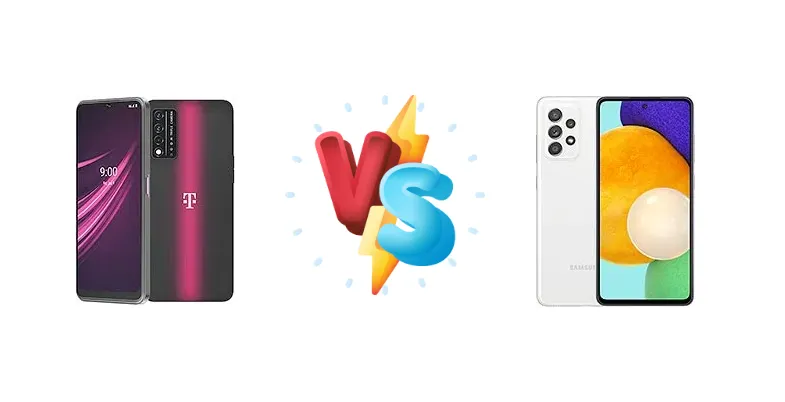
The T-Mobile REVVL V+ 5G and Samsung Galaxy A52 5G represent compelling options in the increasingly competitive mid-range 5G smartphone market. While both aim to deliver 5G connectivity at an accessible price point, they diverge in their core hardware and feature sets. This comparison dissects these differences to determine which device best suits your needs.
🏆 Quick Verdict
For the average user prioritizing display quality and a more refined software experience, the Samsung Galaxy A52 5G emerges as the better choice. While the REVVL V+ 5G offers a competitive chipset, the A52 5G’s brighter display and established brand reputation provide a more polished overall experience.
| Network |
|---|
| 2G bands | GSM 850 / 900 / 1800 / 1900 | GSM 850 / 900 / 1800 / 1900 |
| 3G bands | HSDPA 850 / 900 / 1700(AWS) / 1900 / 2100 | HSDPA 850 / 900 / 1700(AWS) / 1900 / 2100 |
| 4G bands | 2, 4, 5, 12, 25, 26, 41, 66, 71 | 1, 2, 3, 4, 5, 7, 8, 12, 17, 20, 26, 28, 32, 38, 40, 41, 66 |
| 5G bands | 25, 41, 66, 71 SA/NSA | 1, 3, 5, 7, 8, 20, 28, 38, 40, 41, 66, 78 SA/NSA/Sub6 |
| Speed | HSPA, LTE, 5G | HSPA, LTE, 5G |
| Technology | GSM / HSPA / LTE / 5G | GSM / HSPA / LTE / 5G |
| Launch |
|---|
| Announced | 2021, July 01 | 2021, March 17 |
| Status | Available. Released 2021, July 12 | Available. Released 2021, March 19 |
| Body |
|---|
| Build | - | Glass front (Gorilla Glass 5), plastic back |
| Dimensions | 173.7 x 77.5 x 7.1 mm (6.84 x 3.05 x 0.28 in) | 159.9 x 75.1 x 8.4 mm (6.30 x 2.96 x 0.33 in) |
| SIM | Nano-SIM | · Nano-SIM· Nano-SIM + Nano-SIM |
| Weight | - | 189 g (6.67 oz) |
| | - | IP67 dust/water resistant (up to 1m for 30 min) |
| Display |
|---|
| Protection | - | Corning Gorilla Glass 5 |
| Resolution | 720 x 1640 pixels, 20:9 ratio (~257 ppi density) | 1080 x 2400 pixels, 20:9 ratio (~407 ppi density) |
| Size | 6.82 inches, 112.3 cm2 (~83.4% screen-to-body ratio) | 6.5 inches, 101.0 cm2 (~84.1% screen-to-body ratio) |
| Type | IPS LCD | Super AMOLED, 120Hz, HDR10+, 800 nits (HBM) |
| | - | Always-on display |
| Platform |
|---|
| CPU | Octa-core (2x2.2 GHz Cortex-A76 & 6x2.0 GHz Cortex-A55) | Octa-core (2x2.2 GHz Kryo 570 & 6x1.8 GHz Kryo 570) |
| Chipset | Mediatek MT6833 Dimensity 700 (7 nm) | Qualcomm SM7225 Snapdragon 750G 5G (8 nm) |
| GPU | Mali-G57 MC2 | Adreno 619 |
| OS | Android 11 | Android 11, upgradable to Android 14, One UI 6.1 |
| Memory |
|---|
| Card slot | Unspecified | microSDXC (uses shared SIM slot) |
| Internal | 64GB 4GB RAM | 128GB 4GB RAM, 128GB 6GB RAM, 128GB 8GB RAM, 256GB 4GB RAM, 256GB 8GB RAM |
| Main Camera |
|---|
| Features | LED flash, HDR, panorama | LED flash, panorama, HDR |
| Quad | - | 64 MP, f/1.8, 26mm (wide), 1/1.7X", 0.8µm, PDAF, OIS
12 MP, f/2.2, 123˚ (ultrawide), 1.12µm
5 MP (macro)
Auxiliary lens |
| Single | 16 MP | - |
| Triple | 16 MP, (wide), AF
5 MP, (ultrawide)
2 MP | - |
| Video | 1080p@30fps | 4K@30fps, 1080p@30/60fps; gyro-EIS |
| Selfie camera |
|---|
| Features | - | HDR |
| Single | 16 MP | 32 MP, f/2.2, 26mm (wide), 1/2.8", 0.8µm |
| Video | 1080p@30fps | 4K@30fps, 1080p@30fps |
| Sound |
|---|
| 3.5mm jack | Yes | Yes |
| 35mm jack | - | Yes |
| Loudspeaker | Yes | Yes, with stereo speakers |
| Comms |
|---|
| Bluetooth | Yes | 5.0, A2DP, LE |
| NFC | Yes | Yes (market/region dependent) |
| Positioning | GPS | GPS, GLONASS, GALILEO, BDS |
| Radio | No | FM radio (market/region dependent) |
| USB | Yes | USB Type-C 2.0, OTG |
| WLAN | Yes | Wi-Fi 802.11 a/b/g/n/ac, dual-band, Wi-Fi Direct |
| Features |
|---|
| Sensors | Fingerprint (side-mounted), accelerometer, proximity | Fingerprint (under display, optical), accelerometer, gyro, compass |
| | - | Virtual proximity sensing |
| Battery |
|---|
| Charging | 18W wired | 25W wired, 50% in 30 min |
| Type | Li-Po 5000 mAh, non-removable | Li-Po 4500 mAh |
| Misc |
|---|
| Colors | Nebula Black | Awesome Black, Awesome White, Awesome Violet, Awesome Blue |
| Models | - | SM-A526B, SM-A526B/DS, SM-A5260, SM-A526W, SM-A526U, SM-A526U1 |
| Price | About 170 EUR | $ 137.39 / £ 280.00 / € 115.49 |
| SAR | - | 0.74 W/kg (head) 0.53 W/kg (body) |
| SAR EU | - | 1.05 W/kg (head) 1.42 W/kg (body) |
| Tests |
|---|
| Battery life | - |
Endurance rating 111h
|
| Camera | - |
Photo / Video |
| Display | - |
Contrast ratio: Infinite (nominal) |
| Loudspeaker | - |
-27.5 LUFS (Good)
|
| Performance | - |
AnTuTu: 334981 (v8), 386474 (v9)
GeekBench: 1820 (v5.1)
GFXBench: 16fps (ES 3.1 onscreen) |
T-Mobile REVVL V+ 5G
- Competitive chipset for the price
- 5G connectivity
- Potentially lower cost
- Less detailed display specifications
- Slower charging speed (18W)
- Less established brand reputation
Samsung Galaxy A52 5G
- Brighter display (787 nits)
- Faster charging (25W, 50% in 30 min)
- More refined software experience
- Potentially higher price
- Similar chipset performance to REVVL V+ 5G
- 2MP macro camera is largely unnecessary
Display Comparison
The Samsung Galaxy A52 5G boasts a significantly brighter display, reaching a measured 787 nits, compared to an unspecified brightness for the REVVL V+ 5G. This higher peak brightness translates to better outdoor visibility. While both displays have an 'infinite' contrast ratio (typical for OLED/AMOLED panels), the A52 5G’s superior brightness is a tangible advantage for users who frequently consume content in bright environments. The REVVL V+ 5G’s display specifications are less detailed, suggesting a potentially lower-quality panel.
Camera Comparison
Both phones feature photo and video capabilities, but detailed sensor information is lacking for the REVVL V+ 5G. The Galaxy A52 5G likely benefits from Samsung’s established image processing algorithms and potentially a larger main sensor (though not specified). The presence of a 2MP macro camera on the A52 5G is largely inconsequential, as these sensors typically deliver limited detail. The A52 5G’s image processing pipeline is likely more refined, offering better dynamic range and noise reduction compared to the REVVL V+ 5G.
Performance
Both devices utilize octa-core CPUs clocked at 2.2 GHz, but the underlying architectures differ. The REVVL V+ 5G employs Mediatek’s Dimensity 700 built on a 7nm process, while the Galaxy A52 5G features Qualcomm’s Snapdragon 750G fabricated on a more efficient 8nm node. The 8nm process generally leads to better thermal efficiency, potentially reducing throttling during sustained workloads. While both chipsets are capable of handling everyday tasks and moderate gaming, the Snapdragon 750G’s slightly more advanced architecture may offer a marginal performance edge in demanding applications.
Battery Life
Both devices share an endurance rating of 111 hours, indicating similar overall battery life. However, the Galaxy A52 5G supports 25W wired charging, capable of reaching 50% charge in 30 minutes, while the REVVL V+ 5G is limited to 18W charging. This faster charging speed on the A52 5G provides a significant convenience advantage, allowing for quicker top-ups when time is limited.
Buying Guide
Buy the T-Mobile REVVL V+ 5G if you need a straightforward 5G experience and prioritize value above all else, accepting potential compromises in display brightness and camera refinement. Buy the Samsung Galaxy A52 5G if you prefer a brighter, more vibrant display, a more established brand ecosystem, and a potentially more versatile camera system, even if it means paying a slight premium.
Frequently Asked Questions
❓ Does the Snapdragon 750G in the Galaxy A52 5G get noticeably warmer than the Dimensity 700 during extended gaming sessions?
While both chipsets are capable, the Snapdragon 750G’s 8nm process generally offers better thermal efficiency. This means the Galaxy A52 5G is likely to maintain higher sustained performance for longer periods under heavy load, experiencing less throttling than the REVVL V+ 5G’s Dimensity 700.
❓ Is the 18W charging on the REVVL V+ 5G significantly slower in real-world use compared to the 25W charging on the Galaxy A52 5G?
Yes, the 25W charging on the Galaxy A52 5G provides a noticeable advantage. Reaching 50% charge in 30 minutes is considerably faster than the REVVL V+ 5G’s 18W charging, making it more convenient for users who need a quick power boost.
❓ How does the software experience differ between T-Mobile's REVVL V+ 5G and Samsung's Galaxy A52 5G?
Samsung’s One UI offers a more polished and feature-rich software experience compared to the typically more stock-Android approach of T-Mobile. Samsung provides longer software support and more frequent updates, which is a significant advantage for long-term usability.