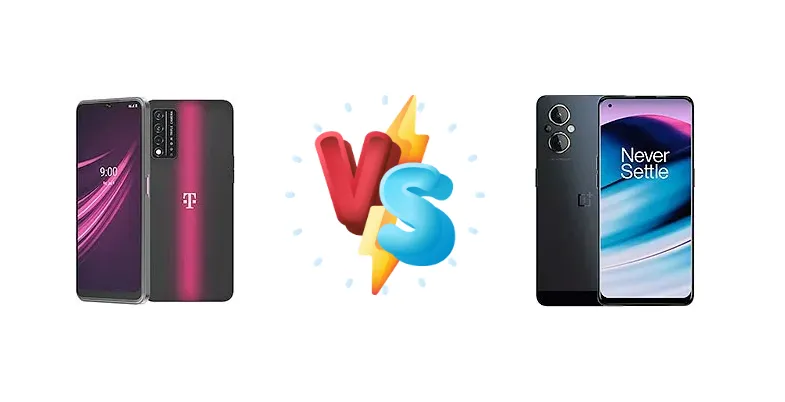
The T-Mobile REVVL V+ 5G and OnePlus Nord N20 5G occupy a similar price bracket, targeting budget-conscious consumers seeking 5G connectivity. However, they diverge in their core hardware choices, specifically the chipset and charging capabilities. This comparison dissects these differences to determine which device delivers the best overall experience.
🏆 Quick Verdict
For the average user, the OnePlus Nord N20 5G is the better choice. While both phones offer comparable endurance ratings at 129 hours, the Nord N20 5G’s Snapdragon 695 (6nm) provides a slight efficiency advantage and crucially, its 33W charging significantly outperforms the REVVL V+ 5G’s 18W charging.
| Network |
|---|
| 2G bands | GSM 850 / 900 / 1800 / 1900 | GSM 850 / 900 / 1800 / 1900 |
| 3G bands | HSDPA 850 / 900 / 1700(AWS) / 1900 / 2100 | HSDPA 850 / 900 / 1700(AWS) / 1900 / 2100 |
| 4G bands | 2, 4, 5, 12, 25, 26, 41, 66, 71 | 1, 2, 3, 4, 5, 7, 8, 12, 13, 17, 20, 25, 26, 28, 38, 39, 40, 41, 66, 71 |
| 5G bands | 25, 41, 66, 71 SA/NSA | 2, 25, 41, 66, 71 SA/NSA |
| Speed | HSPA, LTE, 5G | HSPA 42.2/5.76 Mbps, LTE Cat15 800/200 Mbps, 5G |
| Technology | GSM / HSPA / LTE / 5G | GSM / HSPA / LTE / 5G |
| Launch |
|---|
| Announced | 2021, July 01 | 2022, April 28 |
| Status | Available. Released 2021, July 12 | Available. Released 2022, April 28 |
| Body |
|---|
| Build | - | Glass front (Schott Xensation Up), plastic frame, plastic back |
| Dimensions | 173.7 x 77.5 x 7.1 mm (6.84 x 3.05 x 0.28 in) | 159.9 x 73.2 x 7.5 mm (6.30 x 2.88 x 0.30 in) |
| SIM | Nano-SIM | Nano-SIM |
| Weight | - | 173 g (6.10 oz) |
| Display |
|---|
| Protection | - | Schott Xensation Up |
| Resolution | 720 x 1640 pixels, 20:9 ratio (~257 ppi density) | 1080 x 2400 pixels, 20:9 ratio (~409 ppi density) |
| Size | 6.82 inches, 112.3 cm2 (~83.4% screen-to-body ratio) | 6.43 inches, 99.8 cm2 (~85.3% screen-to-body ratio) |
| Type | IPS LCD | AMOLED |
| | - | Always-on display |
| Platform |
|---|
| CPU | Octa-core (2x2.2 GHz Cortex-A76 & 6x2.0 GHz Cortex-A55) | Octa-core (2x2.2 GHz Kryo 660 Gold & 6x1.7 GHz Kryo 660 Silver) |
| Chipset | Mediatek MT6833 Dimensity 700 (7 nm) | Qualcomm SM6375 Snapdragon 695 5G (6 nm) |
| GPU | Mali-G57 MC2 | Adreno 619 |
| OS | Android 11 | Android 11, OxygenOS 11 |
| Memory |
|---|
| Card slot | Unspecified | microSDXC (dedicated slot) |
| Internal | 64GB 4GB RAM | 128GB 6GB RAM |
| | - | UFS 2.2 |
| Main Camera |
|---|
| Features | LED flash, HDR, panorama | LED flash, HDR, panorama |
| Single | 16 MP | 16 MP, f/2.4, (wide) |
| Triple | 16 MP, (wide), AF
5 MP, (ultrawide)
2 MP | 64 MP, f/1.8, (wide), PDAF
2 MP (macro)
Auxiliary lens |
| Video | 1080p@30fps | 1080p@30fps |
| Selfie camera |
|---|
| Features | - | HDR |
| Single | 16 MP | 16 MP, f/2.4, (wide) |
| Video | 1080p@30fps | 1080p@30fps |
| Sound |
|---|
| 3.5mm jack | Yes | Yes |
| 35mm jack | - | Yes |
| Loudspeaker | Yes | Yes |
| Comms |
|---|
| Bluetooth | Yes | 5.1, A2DP, LE |
| NFC | Yes | Yes |
| Positioning | GPS | GPS (L1+L5), GLONASS, GALILEO, BDS |
| Radio | No | No |
| USB | Yes | USB Type-C 2.0, OTG |
| WLAN | Yes | Wi-Fi 802.11 a/b/g/n/ac, dual-band, Wi-Fi Direct |
| Features |
|---|
| Sensors | Fingerprint (side-mounted), accelerometer, proximity | Fingerprint (under display, optical), accelerometer, gyro, proximity, compass, barometer |
| Battery |
|---|
| Charging | 18W wired | 33W wired |
| Type | Li-Po 5000 mAh, non-removable | Li-Po 4500 mAh |
| Misc |
|---|
| Colors | Nebula Black | Blue |
| Models | - | GN2200, CPH2459 |
| Price | About 170 EUR | About 120 EUR |
| Tests |
|---|
| Battery life | - |
Endurance rating 129h
|
| Display | - |
Contrast ratio: Infinite (nominal) |
| Performance | - |
AnTuTu: 316974 (v8), 380672 (v9)
GeekBench: 1945 (v5.1)
GFXBench: 16fps (ES 3.1 onscreen) |
T-Mobile REVVL V+ 5G
- Potentially lower upfront cost
- 5G connectivity
- Decent performance for everyday tasks
- Slower 18W charging
- Less efficient 7nm chipset
- Display brightness likely lower than Nord N20 5G
OnePlus Nord N20 5G
- Faster 33W charging
- More efficient 6nm Snapdragon 695
- Brighter 647 nit display
- Potentially higher price
- Similar battery endurance to REVVL V+ 5G
- Camera performance relies heavily on software processing
Display Comparison
The OnePlus Nord N20 5G boasts a notably brighter display, reaching a measured 647 nits, compared to an unspecified brightness for the REVVL V+ 5G. This higher peak brightness translates to better visibility outdoors. Both displays are advertised with an 'infinite' contrast ratio, a common marketing term for OLED-like performance, but the REVVL V+ 5G’s panel technology remains unconfirmed. The Nord N20 5G’s brightness advantage is a significant benefit for users who frequently consume media in bright environments.
Camera Comparison
Detailed camera specifications are limited, but focusing on the main sensors is crucial. Without specific sensor sizes, it’s difficult to definitively declare a winner. However, the emphasis should be on image processing capabilities, which are proprietary to each manufacturer. The inclusion of Optical Image Stabilization (OIS) on either device is unknown, but would be a significant advantage for low-light photography. The prevalence of low-resolution auxiliary cameras (often 2MP) on budget phones suggests minimal benefit from these lenses.
Performance
The core difference lies in the chipsets: the T-Mobile REVVL V+ 5G utilizes the Mediatek Dimensity 700 (7nm), while the OnePlus Nord N20 5G features the Qualcomm Snapdragon 695 5G (6nm). The Snapdragon 695, built on a smaller 6nm process, generally offers better power efficiency than the 7nm Dimensity 700. Both CPUs feature an octa-core configuration with similar high-performance core counts (2x2.2 GHz), but the Nord N20 5G’s Kryo 660 Gold cores operate alongside less power-hungry Kryo 660 Silver cores at 1.7 GHz, potentially contributing to improved sustained performance. While both are capable of handling everyday tasks, the Snapdragon 695 is likely to exhibit less thermal throttling during extended gaming sessions.
Battery Life
Both devices share an endurance rating of 129 hours, indicating similar overall battery life under typical usage. However, the charging speeds are drastically different. The OnePlus Nord N20 5G supports 33W wired charging, allowing for a significantly faster 0-100% charge time compared to the T-Mobile REVVL V+ 5G’s 18W charging. This difference is critical for users who prioritize quick top-ups throughout the day. While battery capacity isn’t specified, the faster charging of the Nord N20 5G mitigates any potential disadvantage from a slightly smaller battery.
Buying Guide
Buy the T-Mobile REVVL V+ 5G if you prioritize a potentially lower upfront cost and are comfortable with slower charging speeds. Buy the OnePlus Nord N20 5G if you value faster charging, a brighter display, and the slightly more efficient 6nm Snapdragon 695 chipset, even if it means a potentially higher price tag.
Frequently Asked Questions
❓ Does the Snapdragon 695 in the Nord N20 5G get hot during prolonged gaming sessions?
The Snapdragon 695, built on a 6nm process, is generally more thermally efficient than the Dimensity 700. While it will still generate heat during demanding tasks like gaming, it's less prone to significant throttling, allowing for more sustained performance. However, sustained performance will still depend on the phone's thermal design.
❓ Is the 129-hour endurance rating accurate for real-world usage on either phone?
Endurance ratings are based on a standardized test profile and represent a typical usage scenario. Your actual battery life will vary depending on your usage patterns, such as screen brightness, app usage, and network conditions. However, the identical rating suggests both phones offer comparable overall battery performance.
❓ How much faster is the 33W charging on the Nord N20 5G compared to the 18W charging on the REVVL V+ 5G?
While exact charge times depend on battery temperature and other factors, 33W charging will significantly reduce the time to reach 100%. Expect the Nord N20 5G to charge from 0-100% in approximately 60-75 minutes, while the REVVL V+ 5G will likely take over 90-120 minutes.