
T-Mobile REVVL Tab 2 vs. Lenovo Tab M10 Plus (3rd Gen): Which Budget Tablet Reigns Supreme?
| Phones Images | |||||
|---|---|---|---|---|---|
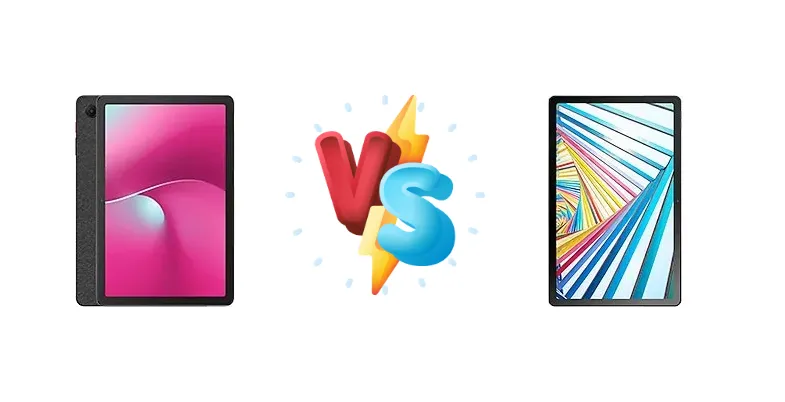
|
🏆 Quick Verdict
For most users, the T-Mobile REVVL Tab 2 emerges as the stronger choice. Its Mediatek Dimensity 6300, built on a 6nm process, offers a more modern CPU architecture and potentially better sustained performance than the Snapdragon 680 or Helio G80 found in the Lenovo Tab M10 Plus, especially considering the latter's 12nm node in the Wi-Fi variant.
| PHONES | ||
|---|---|---|
| Phone Names | T-Mobile REVVL Tab 2 | Lenovo Tab M10 Plus (3rd Gen) |
| Network | ||
|---|---|---|
| 2G bands | GSM 850 / 900 / 1800 / 1900 | GSM 850 / 900 / 1800 / 1900 |
| 3G bands | HSDPA 850 / 900 / 1700(AWS) / 1900 / 2100 | HSDPA 800 / 850 / 900 / 1900 / 2100 |
| 4G bands | 1, 2, 3, 4, 5, 7, 8, 12, 20, 25, 26, 28, 38, 41, 66, 71 | 1, 2, 3, 4, 5, 7, 8, 19, 20, 26, 28, 28, 38, 40, 41 |
| 5G bands | SA/NSA | - |
| Speed | HSPA, LTE, 5G | HSPA 42.2/5.76 Mbps, LTE Cat13 390/75 Mbps - cellular model only |
| Technology | GSM / HSPA / LTE / 5G | GSM / HSPA / LTE |
| Launch | ||
|---|---|---|
| Announced | 2025, June 18 | 2022, May |
| Status | Available. Released 2025, June 26 | Available. Released 2022, May |
| Body | ||
|---|---|---|
| Dimensions | 240 x 156.5 x 8.4 mm (9.45 x 6.16 x 0.33 in) | 251.2 x 158.8 x 7.5 mm (9.89 x 6.25 x 0.30 in) |
| SIM | Nano-SIM + eSIM | Nano-SIM (cellular model only) |
| Weight | 412.8 g (14.57 oz) | 465 g (1.03 lb) |
| - | Stylus support | |
| Display | ||
|---|---|---|
| Resolution | 800 x 1280 pixels, 16:10 ratio (~149 ppi density) | 1200 x 2000 pixels, 5:3 ratio (~220 ppi density) |
| Size | 10.1 inches, 295.8 cm2 (~78.8% screen-to-body ratio) | 10.61 inches, 320.4 cm2 (~80.3% screen-to-body ratio) |
| Type | IPS LCD | IPS LCD, 400 nits (typ) |
| Platform | ||
|---|---|---|
| CPU | Octa-core (2x2.4 GHz Cortex-A76 & 6x2.0 GHz Cortex-A55) | Octa-core (4x2.4 GHz Kryo 265 Gold & 4x1.9 GHz Kryo 265 Silver) - LTE model Octa-core (2x2.0 GHz Cortex-A75 & 6x1.8 GHz Cortex-A55) - Wi-Fi only model |
| Chipset | Mediatek Dimensity 6300 (6 nm) | Qualcomm SM6225 Snapdragon 680 4G (6 nm) - LTE model Mediatek MT6769V/CU Helio G80 (12 nm) - Wi-Fi only model |
| GPU | Mali-G57 MC2 | Adreno 610 - LTE model Mali-G52 MC2 - Wi-Fi only model |
| OS | Android 15 | Android 12 |
| Memory | ||
|---|---|---|
| Card slot | microSDXC | microSDXC (dedicated slot) |
| Internal | 64GB 4GB RAM | 32GB 3GB RAM, 64GB 4GB RAM, 128GB 4GB RAM, 128GB 6GB RAM |
| - | eMCP/uMCP | |
| Main Camera | ||
|---|---|---|
| Single | 8 MP | 8 MP, AF |
| Video | 1080p@30fps | 1080p |
| Selfie camera | ||
|---|---|---|
| Single | 5 MP | 8 MP |
| Video | 1080p@30fps | - |
| Sound | ||
|---|---|---|
| 3.5mm jack | - | Yes |
| 35mm jack | Yes | Yes |
| Loudspeaker | Yes | Yes, with stereo speakers (4 speakers) |
| Comms | ||
|---|---|---|
| Bluetooth | 5.3, A2DP, LE | 5.0, A2DP, LE |
| NFC | No | No |
| Positioning | No | GPS, GLONASS, BDS - cellular model only |
| Radio | No | FM Radio |
| USB | USB Type-C 2.0 | USB Type-C 2.0 |
| WLAN | Wi-Fi 802.11 a/b/g/n/ac, dual-band, Wi-Fi Direct | Wi-Fi 802.11 a/b/g/n/ac, dual-band, Wi-Fi Direct |
| Features | ||
|---|---|---|
| Sensors | Accelerometer | Accelerometer, proximity, gyro |
| Battery | ||
|---|---|---|
| Charging | 18W wired | 20W wired |
| Type | 6000 mAh | Li-Po 7700 mAh |
| Misc | ||
|---|---|---|
| Colors | Black | Storm Grey, Frost Blue |
| Price | About 150 EUR | About 260 EUR |
T-Mobile REVVL Tab 2
- More modern CPU architecture (Dimensity 6300)
- Potentially better thermal management due to 6nm process
- More efficient chipset for longer battery life
- Charging speed is slightly slower (18W)
- Display specifications are currently unknown
Lenovo Tab M10 Plus (3rd Gen)
- Faster charging (20W)
- LTE connectivity available (on select models)
- Potentially better display calibration (Lenovo's history)
- Wi-Fi model uses an older, less efficient chipset (Helio G80)
- Snapdragon 680 CPU architecture is less modern than Dimensity 6300
Display Comparison
Neither tablet boasts a standout display. Both are likely to feature IPS LCD panels, common in this price bracket. However, without specific brightness or color gamut data, we can infer that the Lenovo Tab M10 Plus might offer a slightly more refined experience due to Lenovo's generally better display calibration. The REVVL Tab 2's display specs are currently unknown, making a definitive comparison impossible, but the absence of features like LTPO suggests neither will offer adaptive refresh rates.
Camera Comparison
Camera performance is unlikely to be a deciding factor for either tablet. Both will likely feature basic camera setups geared towards casual snapshots. Without detailed sensor information, it’s difficult to make a direct comparison. However, the focus should be on the main sensor; any 2MP macro or depth sensors are unlikely to deliver meaningful results. The image processing capabilities of Mediatek and Qualcomm are comparable at this level, so the difference will likely come down to sensor quality, which is currently unknown.
Performance
The core of the difference lies in the chipsets. The T-Mobile REVVL Tab 2’s Mediatek Dimensity 6300 (6nm) utilizes a more modern CPU configuration – 2x2.4 GHz Cortex-A76 cores paired with 6x2.0 GHz Cortex-A55 cores. This contrasts with the Lenovo Tab M10 Plus’s Snapdragon 680 (6nm) which features 4x2.4 GHz Kryo 265 Gold and 4x1.9 GHz Kryo 265 Silver cores. The A76 cores in the Dimensity 6300 generally outperform the Kryo 265 Gold cores in single-core tasks. Crucially, the Wi-Fi only version of the Lenovo Tab M10 Plus uses the Helio G80 (12nm), a significantly older and less efficient chip, making the REVVL Tab 2 a clear winner in that configuration. The 6nm process of the Dimensity 6300 also suggests better thermal management, potentially reducing throttling during extended use.
Battery Life
The Lenovo Tab M10 Plus has a slight edge in charging speed with 20W wired charging compared to the REVVL Tab 2’s 18W. However, the Dimensity 6300’s 6nm efficiency could offset this difference in real-world usage. A more efficient chip consumes less power, potentially leading to longer battery life despite a similar capacity (which is currently unknown for both devices). The faster charging on the Lenovo will translate to quicker top-ups, but the REVVL Tab 2 might require charging less frequently.
Buying Guide
Buy the T-Mobile REVVL Tab 2 if you prioritize consistent performance for multitasking, streaming, and light gaming, and value a more efficient chipset. Buy the Lenovo Tab M10 Plus (3rd Gen) if cellular connectivity (LTE model) is essential, or if you find a significantly lower price point and your usage is limited to basic tasks like web browsing and video playback.