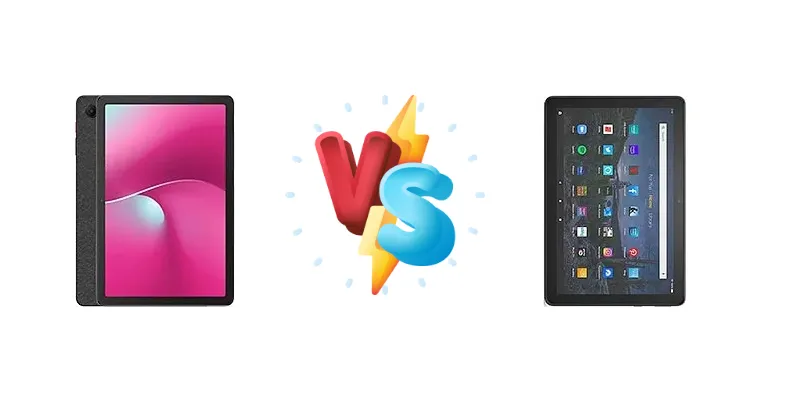
The tablet market offers a wide range of options, but finding the right balance between price and performance can be challenging. The T-Mobile REVVL Tab 2 and the Amazon Fire HD 10 Plus (2021) both aim for the budget-friendly segment, but they take distinctly different approaches to achieving that goal. The REVVL Tab 2 boasts a newer, more efficient chipset, while the Fire HD 10 Plus emphasizes convenience with wireless charging and Amazon’s ecosystem integration. This comparison will dissect their key differences to help you determine which tablet best suits your needs.
🏆 Quick Verdict
For users prioritizing raw performance and future-proofing, the T-Mobile REVVL Tab 2 emerges as the winner. Its Mediatek Dimensity 6300 chipset offers a significant leap in processing power over the Fire HD 10 Plus’s Helio P60T. However, the Fire HD 10 Plus remains a compelling option for those deeply invested in the Amazon ecosystem and value wireless charging.
| Network |
|---|
| 2G bands | GSM 850 / 900 / 1800 / 1900 | N/A |
| 3G bands | HSDPA 850 / 900 / 1700(AWS) / 1900 / 2100 | - |
| 4G bands | 1, 2, 3, 4, 5, 7, 8, 12, 20, 25, 26, 28, 38, 41, 66, 71 | - |
| 5G bands | SA/NSA | - |
| EDGE | - | No |
| GPRS | - | No |
| Speed | HSPA, LTE, 5G | - |
| Technology | GSM / HSPA / LTE / 5G | No cellular connectivity |
| Launch |
|---|
| Announced | 2025, June 18 | 2021, April 27. Released 2021, May 26 |
| Status | Available. Released 2025, June 26 | Discontinued |
| Body |
|---|
| Dimensions | 240 x 156.5 x 8.4 mm (9.45 x 6.16 x 0.33 in) | 247 x 166 x 9.2 mm (9.72 x 6.54 x 0.36 in) |
| SIM | Nano-SIM + eSIM | No |
| Weight | 412.8 g (14.57 oz) | 468 g (1.03 lb) |
| Display |
|---|
| Protection | - | Aluminosilicate glass |
| Resolution | 800 x 1280 pixels, 16:10 ratio (~149 ppi density) | 1920 x 1200 pixels, 16:10 ratio (~224 ppi density) |
| Size | 10.1 inches, 295.8 cm2 (~78.8% screen-to-body ratio) | 10.1 inches, 295.8 cm2 (~72.1% screen-to-body ratio) |
| Type | IPS LCD | IPS LCD |
| Platform |
|---|
| CPU | Octa-core (2x2.4 GHz Cortex-A76 & 6x2.0 GHz Cortex-A55) | Octa-core (4x2.0 GHz Cortex-A73 & 4x2.0 GHz Cortex-A53) |
| Chipset | Mediatek Dimensity 6300 (6 nm) | Mediatek MT8183 Helio P60T (12 nm) |
| GPU | Mali-G57 MC2 | Mali-G72 MP3 |
| OS | Android 15 | Android 9.0 (Pie), Fire OS 7 |
| Memory |
|---|
| Card slot | microSDXC | microSDXC (dedicated slot) |
| Internal | 64GB 4GB RAM | 32GB 4GB RAM, 64GB 4GB RAM |
| | - | eMMC 5.1 |
| Main Camera |
|---|
| Single | 8 MP | 5 MP |
| Video | 1080p@30fps | 720p |
| Selfie camera |
|---|
| Single | 5 MP | 2 MP |
| Video | 1080p@30fps | 720p |
| Sound |
|---|
| 3.5mm jack | - | Yes |
| 35mm jack | Yes | Yes |
| Loudspeaker | Yes | Yes, with stereo speakers |
| Comms |
|---|
| Bluetooth | 5.3, A2DP, LE | 5.0, A2DP, LE |
| NFC | No | No |
| Positioning | No | No |
| Radio | No | No |
| USB | USB Type-C 2.0 | USB Type-C 2.0, OTG |
| WLAN | Wi-Fi 802.11 a/b/g/n/ac, dual-band, Wi-Fi Direct | Wi-Fi 802.11 a/b/g/n/ac, dual-band |
| Features |
|---|
| Sensors | Accelerometer | Accelerometer |
| | - | Text-to-Speech English-language content reader |
| Battery |
|---|
| Charging | 18W wired | Wireless |
| Type | 6000 mAh | Li-Ion |
| Misc |
|---|
| Colors | Black | Slate |
| Models | - | T76N2P |
| Price | About 150 EUR | About 150 EUR |
T-Mobile REVVL Tab 2
- Significantly more powerful processor (Dimensity 6300)
- More efficient 6nm process for better battery life
- Modern CPU architecture (Cortex-A76 cores)
- Likely better long-term software support
- Lacks wireless charging
- Wired charging speed (18W) is standard, not exceptional
Amazon Fire HD 10 Plus (2021)
- Wireless charging for added convenience
- Deep integration with Amazon’s ecosystem (Prime Video, Kindle)
- Generally lower price point
- Familiar Fire OS interface
- Older, less powerful processor (Helio P60T)
- Less efficient 12nm process
- Potentially limited software updates
- Fire OS can feel restrictive for some users
Display Comparison
Neither device boasts a particularly high-end display. While specific display specs (resolution, brightness) are not provided, the Fire HD 10 Plus’s age suggests it likely uses an IPS LCD panel. The REVVL Tab 2, being newer, *may* benefit from slight improvements in color accuracy. However, the core difference lies in the underlying processing power impacting UI smoothness. The REVVL Tab 2’s more powerful chipset will contribute to a more responsive and fluid visual experience, even if the panels themselves are comparable.
Camera Comparison
Given the budget nature of both tablets, camera performance isn’t a primary focus. It’s highly probable both devices feature modest camera setups. Without specific sensor details, it’s difficult to make a definitive judgment. However, the REVVL Tab 2’s newer chipset *may* include a more advanced image signal processor (ISP), potentially leading to slightly better image processing and noise reduction. Expect both tablets to perform adequately in well-lit conditions but struggle in low light.
Performance
The performance gap is the most significant differentiator. The T-Mobile REVVL Tab 2’s Mediatek Dimensity 6300 (6nm) is a substantial upgrade over the Amazon Fire HD 10 Plus’s Mediatek MT8183 Helio P60T (12nm). The 6nm process node of the Dimensity 6300 translates to greater power efficiency and reduced thermal throttling, allowing for sustained performance. The REVVL Tab 2’s CPU configuration – 2x2.4 GHz Cortex-A76 & 6x2.0 GHz Cortex-A55 – offers a more modern architecture than the Fire HD 10 Plus’s 4x2.0 GHz Cortex-A73 & 4x2.0 GHz Cortex-A53. The Cortex-A76 cores in the REVVL Tab 2 provide a noticeable boost in single-core performance, crucial for app responsiveness, while the combination of A76 and A55 cores offers better multi-core performance for multitasking. This means the REVVL Tab 2 will handle demanding apps and games with greater ease.
Battery Life
Battery capacity isn’t specified for either device. However, the Fire HD 10 Plus’s inclusion of wireless charging is a key advantage for convenience. While 18W wired charging on the REVVL Tab 2 is respectable, the Fire HD 10 Plus offers the flexibility of topping up without a cable. The Dimensity 6300’s 6nm process should contribute to better battery life on the REVVL Tab 2, offsetting the lack of wireless charging, but real-world usage will determine the actual difference.
Buying Guide
Buy the T-Mobile REVVL Tab 2 if you need a tablet capable of handling demanding apps, multitasking, and occasional gaming with a smoother experience. It’s ideal for users who want a more standard Android experience and aren’t heavily reliant on Amazon services. Buy the Amazon Fire HD 10 Plus (2021) if you prefer a tablet tightly integrated with Amazon’s services – Prime Video, Kindle, Alexa – and prioritize wireless charging convenience over peak performance. It’s a great choice for media consumption and casual use within the Amazon ecosystem.
Frequently Asked Questions
❓ Will the Mediatek Dimensity 6300 in the REVVL Tab 2 handle demanding games like Genshin Impact?
While the Dimensity 6300 isn't a flagship gaming chip, it's significantly more capable than the Helio P60T. You'll likely be able to play Genshin Impact on medium settings with acceptable frame rates, but don't expect a consistently smooth experience on the highest settings. The 6nm process will also help mitigate thermal throttling during extended gaming sessions.
❓ How much does Amazon’s ecosystem lock-in affect the Fire HD 10 Plus experience?
The Fire HD 10 Plus is heavily geared towards Amazon services. While you can sideload apps, the interface is designed to promote Amazon’s content and services. If you’re a heavy user of Prime Video, Kindle, and Alexa, this integration is a benefit. However, if you prefer a more open Android experience with easy access to the Google Play Store, the REVVL Tab 2 is a better choice.
❓ Is the lack of Google Play Store on the Fire HD 10 Plus a dealbreaker?
The Fire HD 10 Plus uses Fire OS, a fork of Android that doesn't include the Google Play Store. You can access a limited app store, and sideload apps, but it requires more technical knowledge and may not be as seamless as using the Play Store. This is a significant drawback for users heavily reliant on Google apps.