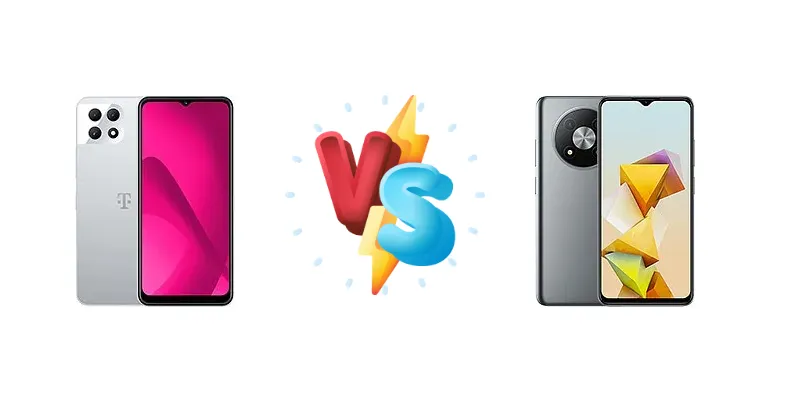
The T-Mobile REVVL 7 and ZTE Blade A73 5G represent the increasingly competitive sub-$200 5G smartphone market. Both aim to deliver connectivity without breaking the bank, but they take different approaches under the hood. The REVVL 7 leverages Qualcomm’s efficiency, while the Blade A73 5G opts for a Unisoc chipset. This comparison dissects the key differences to determine which phone offers the best value.
🏆 Quick Verdict
For the average user prioritizing sustained performance and efficiency, the T-Mobile REVVL 7 is the better choice. Its Snapdragon 6 Gen 1 (4nm) offers a more refined experience than the Unisoc T760 (6nm), translating to smoother multitasking and potentially better long-term stability. While the Blade A73 5G is a capable device, the REVVL 7’s chipset provides a noticeable advantage.
| Network |
|---|
| 2G bands | GSM 850 / 900 / 1800 / 1900 | GSM 850 / 900 / 1800 / 1900 |
| 3G bands | HSDPA 850 / 1700(AWS) / 2100 | HSDPA 850 / 900 / 1900 / 2100 |
| 4G bands | 2, 4, 5, 7, 12, 25, 26, 41, 66, 71 | 1, 2, 3, 4, 5, 7, 8, 20, 28, 38, 40, 41 |
| 5G bands | 25, 41, 66, 71, 77 SA/NSA | 1, 3, 7, 8, 20, 28, 38, 40, 41, 77, 78 SA/NSA |
| Speed | HSPA, LTE, 5G | HSPA, LTE, 5G |
| Technology | GSM / HSPA / LTE / 5G | GSM / HSPA / LTE / 5G |
| Launch |
|---|
| Announced | 2024, May 13 | 2023, August 10 |
| Status | Available. Released 2024, June | Available. Released 2023, September |
| Body |
|---|
| Dimensions | 167.4 x 77.5 x 9.1 mm (6.59 x 3.05 x 0.36 in) | 163.5 x 75.2 x 8.5 mm (6.44 x 2.96 x 0.33 in) |
| SIM | Nano-SIM + eSIM | Nano-SIM + Nano-SIM |
| Weight | 206 g (7.27 oz) | 197 g (6.95 oz) |
| Display |
|---|
| Resolution | 1080 x 2408 pixels, 20:9 ratio (~401 ppi density) | 720 x 1600 pixels, 20:9 ratio (~269 ppi density) |
| Size | 6.58 inches, 104.3 cm2 (~80.4% screen-to-body ratio) | 6.52 inches, 102.6 cm2 (~83.5% screen-to-body ratio) |
| Type | AMOLED, 120Hz | IPS LCD, 90Hz |
| Platform |
|---|
| CPU | Octa-core (4x2.2 GHz Cortex-A78 & 4x1.8 GHz Cortex-A55) | Octa-core (1x2.2 GHz Cortex-A76 & 3x Cortex-A76 & 4x Cortex-A55) |
| Chipset | Qualcomm SM6450 Snapdragon 6 Gen 1 (4 nm) | Unisoc T760 (6 nm) |
| GPU | Adreno 710 | Mali-G57 |
| OS | Android 14 | Android 13 |
| Memory |
|---|
| Card slot | microSDXC | No |
| Internal | 128GB 6GB RAM | 128GB 4GB RAM |
| Main Camera |
|---|
| Dual | - | 50 MP (13 MP in Asia), (wide), AF
Auxiliary lens |
| Features | LED flash, HDR, panorama | LED flash |
| Triple | 50 MP, (wide), PDAF
2 MP (macro)
Auxiliary lens | - |
| Video | 1440p@30fps, 1080p@30/60fps | 1080p@30fps |
| Selfie camera |
|---|
| Single | 8 MP | 5 MP |
| Video | 1080p@30fps | 1080p@30fps |
| Sound |
|---|
| 35mm jack | Yes | Yes |
| Loudspeaker | Yes, with stereo speakers | Yes |
| Comms |
|---|
| Bluetooth | 5.1, A2DP, LE | 5.2, A2DP, LE |
| NFC | Yes | Yes (market/region dependent) |
| Positioning | GPS | GPS |
| Radio | No | FM radio |
| USB | USB Type-C 2.0 | USB Type-C 2.0, OTG |
| WLAN | Wi-Fi 802.11 a/b/g/n/ac, dual-band | Wi-Fi 802.11 a/b/g/n/ac, dual-band |
| Features |
|---|
| Sensors | Fingerprint (side-mounted); unspecified sensors | Accelerometer, proximity |
| Battery |
|---|
| Charging | 15W wired, PD3.0, QC3 | - |
| Type | 5000 mAh | Li-Ion 5000 mAh |
| Misc |
|---|
| Colors | Arctic Gray | Gray, Blue |
| Price | About 190 EUR | About 120 EUR |
| SAR | 1.14 W/kg (head) 1.12 W/kg (body) | - |
| SAR EU | - | 1.42 W/kg (head) 1.69 W/kg (body) |
T-Mobile REVVL 7
- More efficient Snapdragon 6 Gen 1 chipset
- Potentially better sustained performance
- Superior ISP for improved image processing
- May be slightly more expensive
- Limited detailed specifications available
ZTE Blade A73 5G
- Potentially lower price point
- Unisoc T760 offers 5G connectivity
- Acceptable performance for basic tasks
- Less efficient Unisoc T760 chipset
- Potential for thermal throttling under load
- Inferior ISP compared to Qualcomm
Display Comparison
Neither T-Mobile nor ZTE provide detailed display specifications beyond the basic resolution. However, the chipset differences indirectly impact the display experience. The more powerful GPU within the Snapdragon 6 Gen 1 can drive the display more efficiently, potentially resulting in smoother animations. The absence of high refresh rate support on either device suggests a focus on battery conservation. Bezels are likely comparable given the price bracket, and color accuracy will likely be standard for this segment.
Camera Comparison
Without detailed camera specs, a direct comparison is difficult. However, the chipset’s image signal processor (ISP) plays a crucial role. Qualcomm’s ISPs are generally known for superior image processing capabilities, potentially leading to better dynamic range and noise reduction in the REVVL 7’s photos. The absence of optical image stabilization (OIS) on either device suggests a reliance on software stabilization, where the Snapdragon’s ISP could again provide an advantage. The inclusion of a 2MP macro lens on either device is largely a marketing tactic, offering minimal practical benefit.
Performance
The core of the difference lies in the chipsets. The T-Mobile REVVL 7’s Qualcomm Snapdragon 6 Gen 1 (4nm) utilizes a more modern architecture and a smaller fabrication process than the ZTE Blade A73 5G’s Unisoc T760 (6nm). The 4nm process inherently offers better power efficiency and thermal characteristics. While both CPUs feature an octa-core configuration with Cortex-A76/A78 cores, the Snapdragon’s Cortex-A78 cores clocked at 2.2 GHz offer a performance edge over the Blade A73’s mix of A76 and A76 cores. The REVVL 7’s more efficient chipset will translate to less throttling during prolonged use, benefiting gamers and multi-taskers.
Battery Life
Battery capacity isn’t specified, but both phones likely feature batteries in the 4000-5000 mAh range, typical for this price point. The REVVL 7’s Snapdragon 6 Gen 1 (4nm) offers a significant advantage in power efficiency. This translates to longer battery life on a single charge, even with similar battery capacities. While both support 15W wired charging with PD3.0 and QC3, the REVVL 7’s more efficient chipset will likely reach a full charge faster in real-world scenarios due to reduced heat generation.
Buying Guide
Buy the T-Mobile REVVL 7 if you need a phone that can handle everyday tasks and light gaming without significant slowdowns, and if you value a chipset known for its power efficiency. Buy the ZTE Blade A73 5G if you prioritize a potentially lower price point and are willing to accept some compromises in sustained performance and thermal management. The Blade A73 5G is a viable option for basic smartphone use.
Frequently Asked Questions
❓ Will the Unisoc T760 in the ZTE Blade A73 5G struggle with graphically demanding games like PUBG Mobile?
The Unisoc T760 can run PUBG Mobile, but you’ll likely need to lower the graphics settings to medium or low to maintain a stable frame rate. The chipset’s thermal limitations may also lead to frame drops during extended gaming sessions. The Snapdragon 6 Gen 1 in the REVVL 7 will provide a smoother and more consistent gaming experience.
❓ Does the T-Mobile REVVL 7 support VoLTE and VoWiFi on all carriers?
While the REVVL 7 is a T-Mobile branded device, compatibility with VoLTE and VoWiFi on other carriers (like AT&T or Verizon) is not guaranteed. It’s crucial to check compatibility with your specific carrier before purchasing, as functionality may be limited or unavailable.
❓ How does the 6nm process of the Unisoc T760 compare to the 4nm process of the Snapdragon 6 Gen 1 in terms of heat generation?
A smaller fabrication process (like 4nm) generally results in lower heat generation for the same level of performance. The Unisoc T760’s 6nm process will produce more heat than the Snapdragon 6 Gen 1, potentially leading to thermal throttling and reduced performance during intensive tasks.